01 / Roundup
The best nano tank filters
Nano filters ranked on controllable flow and rinsable media. Not one manufacturer in this category publishes a flow rate, and that absence is recorded on every entry.
Most nano filters are rated by tank size and never publish a flow rate at all. Here is the turnover a betta actually wants, and what to do about the ones that overshoot it.
Filtration in a nano tank is two separate problems that get sold as one. The first is biological: something has to host the bacteria that turn ammonia into nitrate, and in a small tank that is the whole ballgame. The second is hydraulic: whatever you install is going to move water, and a betta with long finnage has to swim in it for the rest of its life. Solve the first and ignore the second and you get a technically clean tank containing a permanently exhausted fish.
Here is the number we size to. 4.3 gal of actual water x 4 turnovers an hour is about 17.2 GPH. Past roughly 25.8 GPH you are baffling the outflow or buying a different filter. The general aquarium convention for a hang-on-back is four to six turnovers an hour; for a betta we take the bottom of that range and treat anything the flow control cannot bring under six as a baffling job, not a reason to buy something else.
You cannot do that sum with most of what is on sale, and that is worth saying plainly. Fluval’s Nano Aquarium Filter is rated “up to 15 US Gal / 60 L” and publishes no flow rate anywhere on the product page. The AquaClear 20 publishes a tank range of 5-20 gallons and, again, no GPH. Sponge filters have no manufacturer at all - they are sold under a dozen interchangeable brand names with no published specifications of any kind.
So a buyer is asked to match a filter to a tank using a range that spans a factor of four, with no flow figure to compute turnover from. We record that absence on every product page in this hub rather than quietly filling the gap with a number we would have had to invent.
For a betta tank under ten gallons, a sponge filter driven by an air pump is the cheapest correct answer and probably the best one. It has no impeller, so it cannot shred a fin or a shrimp. Its flow is set by the air pump, so a two-dollar valve gives you infinite adjustment. It has enormous biological surface for the money. And when the power comes back after an outage it simply starts again, with its bacteria intact, instead of sitting dry in a chamber.
What it costs you is looks and noise: a black sponge in the corner of a small display, and an air pump humming on your desk. If either of those is a dealbreaker - and for a tank on a work desk it reasonably might be - the Fluval Nano filter with its spray bar fitted is the quiet answer.
Sponge filters. Air-lift through open-cell foam. No impeller, no jet, trivially adjustable, ugly, and audible.
In-tank foam filters. A small powered box that sits inside the tank on suction cups. Quiet, adjustable, and it eats display volume in a tank that has none to spare.
Hang-on-back power filters. The default. Best media capacity per dollar by a distance, and the waterfall return is the thing you will end up baffling. In a five-gallon you are running at the very bottom of the rated range with the flow control near minimum.
Built-in rear chambers. What the all-in-one kits use. Nothing visible, no choice about the pump, and the outflow is usually the strongest of the four options.
Buying the filter with the cartridge. A cartridge is a consumable that has to be replaced monthly, and every replacement throws away most of the tank’s established bacteria along with the floss. Foam and ceramic media rinse in old tank water and go back in. Over three years the cartridge filter costs more than the tank and cycles the biology backwards every four weeks.
It ships with the spray bar, which is the part that turns a jet into a sheet and the part everybody else sells separately. Fluval also states outright that the adjustable output suits delicate fish and shrimp - a claim they are prepared to put on the page.
Skip it if: You want the equipment out of the display. This sits in the tank on three suction cups and there is no hiding it.
Media capacity, mostly, and after that the pump. An AquaClear’s open basket - foam, carbon, BIOMAX, your choice - is why it costs more than a cartridge filter of the same size and why it costs less to run. A sponge filter costs almost nothing because it is a piece of foam and a lift tube; the air pump is the real purchase, and a decent one lasts years.
Whether the flow can be brought under our ceiling. Adjustable output, a spray bar, an air valve, or somewhere to fit a baffle.
Biological surface, and whether you get to keep it. Rinsable media scores; disposable cartridges do not.
What the maker will publish. A rated tank range with no flow figure is half a specification, and we mark it as such.
What it costs to keep running. Over three years, not on the shelf.
Noise level in your room, impeller life, or how the flow control feels after two years of calcium. We have not run these filters. What we can do is compute the turnover each one implies in your tank, read what the manufacturer is prepared to state, and be explicit about the very large gaps. That is the whole method.
Nano filters ranked on controllable flow and rinsable media. Not one manufacturer in this category publishes a flow rate, and that absence is recorded on every entry.
The cheapest correct filtration for a betta, and an honest account of buying into a category where no seller publishes a specification of any kind.

The turnover a 5-gallon betta tank actually wants, why every filter rated for it overshoots, and the three that can be brought back under the ceiling.
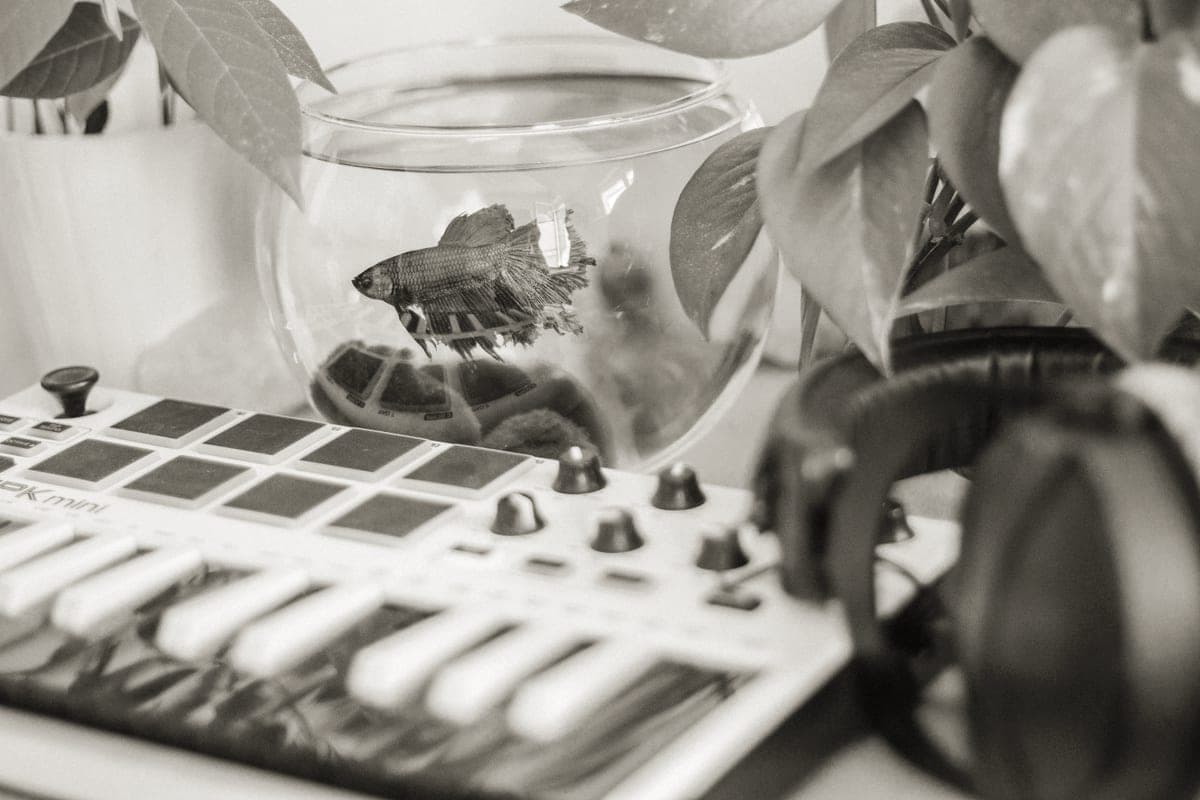
The two formats compared on flow control, biological capacity, running cost, noise and what happens in a power cut - for a betta tank specifically.
A filter is a bacteria hotel, not a water polisher. What that means for a betta, the narrow case where a planted tank can skip it, and the flow ceiling that matters more than the filter.

Four ways to bring a nano filter's flow down to something a long-finned betta can live in, what each costs, and the common fix that quietly starves the filter.
A nano tank is one system, not six purchases. Volume sets the wattage, the wattage sets the heater, the heater and the filter between them set what you can stock, and the plants decide whether any of it stays stable.