We earn a commission if you buy through the links on this page, at no extra cost to you. It never changes a ranking, and there are products recommended here with no affiliate link behind them at all. Full disclosure.
The short answer
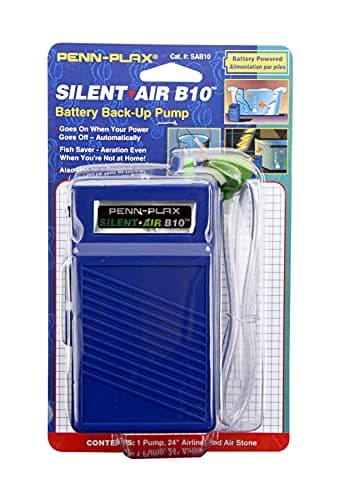
Buy the Penn-Plax Silent Air B10, because it is the one that publishes a runtime: up to 96 hours of continuous operation on two D cells, rated for aquariums to 29 gallons, with tubing and an airstone in the box. On a device whose whole job is to keep working when nothing else does, hours is the specification.
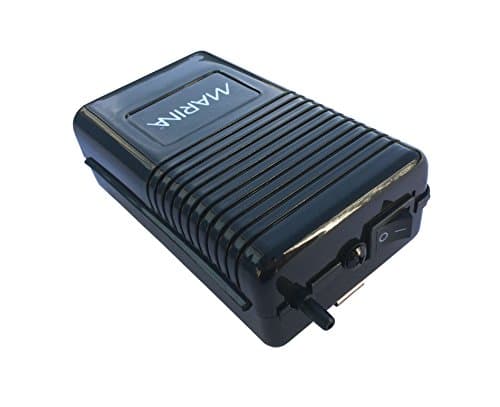
The Marina is the smaller second unit. Same idea, same two D cells, a body about the size of a deck of cards - and Marina publishes no runtime at all. It ranks second on that absence rather than on anything it does worse.
Both have the same catch, published plainly: they only run when you switch them on. Neither starts itself when the mains power fails. Plan around that or the purchase is decorative.
Who actually needs one
If your tank runs a sponge filter, you do. A sponge filter has no motor of its own - the air pump is the only thing moving water through it. Cut the power and the sponge becomes a wet block of foam with a bacterial colony on it and nothing flowing past.
If your tank runs a powered filter, it is less urgent but not irrelevant. The pump stops, the media stops receiving oxygenated water, and the same clock starts - it just starts from a better position, because a powered filter usually holds more media and the tank has more residual movement.
If you have no sponge filter and no outages, skip it. We are not going to tell someone in an apartment with reliable power that they need a fourth device. The honest trigger for this purchase is a sponge filter, a history of outages, or both.
What actually happens, in order
The flow stops first. Within hours the bacteria in the media begin to lose the oxygen supply they depend on, and colony die-off starts - this is the part people underestimate, because the fish looks fine. The fish is usually the last thing in trouble: a betta breathes atmospheric air through a labyrinth organ and can take surface air indefinitely. What you are protecting in an outage is the filter, not the fish.
How we judged these
- 01
Published runtime, in hours
The only number that answers the question you are buying the device to answer. One of these two publishes it and one does not, and that decided the ranking.
- 02
Does it start without you?
An auto-start pump senses the mains failing and switches itself on. Both units here are manual. We looked for a currently-purchasable auto-start model and could not verify one, so we are ranking what exists rather than what we wish existed.
- 03
Is the box complete?
Tubing and an airstone, or a pump and a shopping trip. Both of these ship complete, which matters for a device you buy once and hope never to use.
- 04
Battery chemistry that survives storage
Both run on D cells. Alkaline D cells sit in a drawer for years and still work, which is the correct property for an emergency device and the wrong one for a daily driver.
Side by side, published figures only
| Penn-Plax Silent Air B10 | Marina Battery-Operated |
|---|
| Batteries | 2 D cells, not included | 2 D cells, not included |
| Published runtime | Up to 96 hours continuous | Not published |
| Rated capacity | Aquariums to 29 gallons | Not published as gallons |
| In the box | Pump, 24" tubing, 1 airstone | Pump, 18" tubing, airstone |
| Switching | Manual on/off | Manual on/off |
| Dimensions | Not published for the unit itself | 2.5" x 1.5" x 5" |
| Airflow rate | Not published | Not published |
| Water protection | Not published | Not submersible, not waterproof |
Two things to notice. Neither maker publishes an airflow figure - which is the same gap every air pump in this registry has, and it means you cannot compare them on output even in principle. And Marina is the one that bothers to publish that its pump is not waterproof, which is an odd thing to have to state about an aquarium product and a genuinely useful thing to have stated.
The manual switch problem, and what to do about it
Both pumps run when a human turns them on. If the power fails at eleven in the morning and you get home at seven, the tank spent eight hours with no flow and the pump spent eight hours in a drawer being useless.
There is an auto-start category - pumps that monitor the mains and switch over themselves. We could not verify a currently-purchasable listing for one at the time of writing, so there is no pick for it here. If you find one, that feature is worth paying for and it is the only meaningful upgrade over either of these.
For a manual pump, the mitigations are unglamorous and they work:
- 01
Store it beside the tank, not in a drawer
With the batteries already in it and the airline already attached to the sponge filter. The version of this device that is assembled and reachable in the dark is the version that gets used.
- 02
Leave the airline connected to the sponge filter
Use a T-piece or simply swap the line at the pump end. In an outage you want one action, not a setup task by torchlight.
- 03
Check the cells twice a year
Pair it with something you already do - the twice-yearly smoke alarm habit works. D cells last, but 'last' is not 'forever'.
- 04
Know that the fish is not the emergency
A betta surfaces for air and is fine. Do not open the tank, do not do a panic water change in the dark. The filter is what you are protecting, and it has hours, not minutes.
What not to do during an outage
Do not feed. No flow means no filtration, and food you add now becomes ammonia the tank cannot process. A skipped day costs nothing.
Do not run the heater on a generator or inverter unsupervised. A heater cycling on unstable power with nobody watching is the scenario our heater safety page exists for. Wrap the tank in a towel or a blanket instead - in 4.3 gallons, insulation buys you longer than you would expect.
Do not rinse the filter media when the power comes back. The colony has just had a hard time; give it a week of normal running before you do anything to it.
Do not assume a long outage left the cycle intact. After a day or more without flow, test for ammonia and nitrite over the following week the way you would on a newly cycled tank, and be ready to do water changes if either shows up.