Skip to content
Glass & Gravel
Roundup

The best filter for a 20-gallon tank

The size where you finally get to pick a filter on media capacity instead of on whether it will blow the fish across the tank.

By Scooter M., Enthusiast. Published September 13, 2026.

We earn a commission if you buy through the links on this page, at no extra cost to you. It never changes a ranking, and there are products recommended here with no affiliate link behind them at all. Full disclosure.

Goldfish swimming in a densely planted freshwater aquarium
Quick picks

The shortlist, ranked

Ranked on published manufacturer specifications and, where the figures exist, on the arithmetic they imply for a tank this size. Tap any row for the full write-up, including who should skip it.

#ProductBest forScorePrice
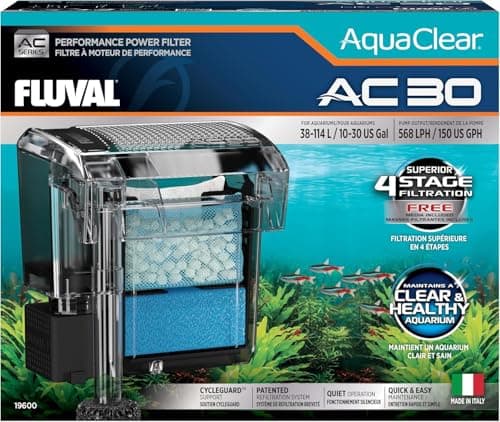
01Fluval AquaClear 30 Power FilterFluval AquaClear 30 Power FilterA 20-gallon where you want media capacity and room on the dialThe right answer8.4$49.99 - View on Amazon
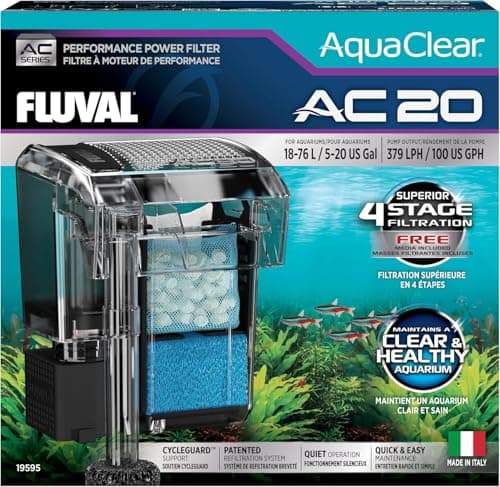
02Fluval AquaClear 20 Power FilterFluval AquaClear 20 Power FilterA 10-gallon where you want media capacity, not a cartridgeIf the stocking stays light8.3$41.99 - View on Amazon
03Aquarium filtration equipment of the type described - a stand-in for the Nano sponge filter with air pump, not a photograph of this modelNano sponge filter with air pumpA betta tank, a shrimp tank, or a quarantine tank on a budgetAs the second filter8.1Check price on Amazon

Scores are ours and editorial. They are never published as review or rating markup, because we have not tested these products.

The sum, for this exact tank

17 gal of actual water x 4 turnovers an hour is about 68 GPH. Past roughly 102 GPH you are baffling the outflow or buying a different filter.

A rated 20-gallon holds about 17 gallons of water once there is substrate in it and you have stopped filling below the rim. The general aquarium convention is four to six turnovers an hour; for a betta we size to 4 and treat anything the flow control cannot bring under 6 as a baffling job rather than a purchase.

Tank (rated)Actual waterTarget flow (4x)Ceiling (6x)
20 US gal17 gal68 GPH102 GPH

So the target is about 68 GPH with a ceiling near 102. Hold onto those numbers, because the rest of this page is about the fact that you cannot check a single filter against them.

The finding, before the picks

The AquaClear range is rated by tank size and nothing else. Fluval publishes “5-20 US Gal” for the 20 and “10-30 US Gal” for the 30, and publishes no gallons-per-hour figure for either. Sponge filters have no manufacturer at all. We checked, we recorded each absence on the product entries below, and that absence is the single most useful thing on this page: a buyer cannot size a filter from the box in this category.

What you can do instead is buy a filter whose published range puts your tank in the middle rather than at an edge, and which has real flow control on top. That is not arithmetic. It is what the category leaves you with, and inventing GPH numbers to look more precise would be worse.

What we ranked these on

We have not run these filters. No test bench, no flow meter, no drawer of samples - so every criterion below is either read off a published page or is a structural property anybody can verify by looking at the product.

Published spec depth. Flow rate, rated range and media contents all present would score 9 or 10. Nothing in this class scores above 5.5, because nothing publishes flow.

Where your tank sits in the published range. This is the criterion that decides the page. A 20-gallon is the ceiling of the AquaClear 20 and the middle of the AquaClear 30, and a flow control has room to work in both directions only in the second case.

Biological capacity. How much media the basket holds, and whether that media is rinseable foam and ceramic or a cartridge you re-buy. At twenty gallons you are likely running a community, and bioload is the thing the biological media actually processes.

Flow suitability for a betta. Whether the outflow can be brought down to something a long-finned fish holds station in, using parts in the box rather than a sponge cable-tied over the outlet.

Running cost. Cartridges cost money forever. Foam and ceramic get rinsed in old tank water and go back in.

Why the AquaClear 20 is second, not first

It is the same filter design, the same open basket, the same usable flow control - and Fluval’s published range for it ends at exactly 20 gallons. Buying a filter whose stated ceiling is your tank leaves you no headroom for the day you add three more fish, and it means running the pump near the top of its dial rather than the middle.

It is still a legitimate pick if the stocking is genuinely light - one betta and a small group, no more - and it costs less. That is the honest trade, and it is the reverse of the one we describe on the 10-gallon page, where the 20 sits comfortably mid-range and the 30 would be too much filter.

Two filters beats one big one at this size

At twenty gallons there is room to run a sponge filter alongside the hang-on-back, and we would. The sponge is a biological reserve that keeps working through a power cut, it gives you a seeded filter to start a quarantine tank with, and it is shrimp-safe in a way an impeller never is. It costs a few dollars plus an air pump. In a 5-gallon the idea does not fit; at twenty it is simply the better system.

What actually changes between ten gallons and twenty

Stocking changes, so bioload changes. Twenty gallons is where a betta community stops being a careful compromise and becomes an ordinary community tank that happens to contain a betta. More fish is more ammonia, and the answer to more ammonia is more biological media - not more flow. Turning the pump up to compensate for stocking is the wrong lever and it is hard on the fish.

Surface agitation matters more. A longer, wider tank has more surface to keep moving, and gas exchange happens at the surface. A filter return that dimples the whole surface without driving a current through the middle of the tank is what you are aiming for.

You get somewhere to hide the equipment. A 24-inch tank has corners a 10-gallon does not. That is the first time an in-tank filter stops costing you the display, though a hang-on-back still costs you nothing at all.

Setting the flow, since you cannot compute it

Fill the tank, run the filter with no fish in it, and watch the surface. You want a moving surface without a standing ripple pattern, and plants that sway rather than stream. Then add the fish and watch where it chooses to be: a betta that spends its day wedged behind hardscape at the far end is telling you the flow is too high; one that hangs in the outflow is telling you it is fine.

That is behavioral evidence rather than measurement, and we would rather label it as such than dress it up. If the flow control alone will not get you there, baffling the outflow takes about ten minutes and costs nothing.

What goes in the basket

Coarse foam at the intake side, ceramic or sintered media in the middle, fine foam or floss last, and carbon only when you have a specific reason. At twenty gallons the basket is big enough that skipping the carbon buys you a meaningful amount of extra biological surface - what each layer is actually for works through the whole decision, including why replacing a cartridge monthly is the worst standing deal in this hobby.

The filter is not what cycles your tank

A new filter is a box of clean plastic. The bacteria that process ammonia live on the media and take weeks to establish, which is why a brand-new filter on a brand-new tank does nothing useful for the first month. Cycle the tank first, and if you are moving up from a smaller tank, carry the old media across rather than starting again. It is the single biggest favor you can do a new twenty.

What we did not rank, and why

Canister filters. A canister is a genuinely good answer at this size and it is the wrong tool for this site’s reader: it costs several times what the tank cost, it is a weekend to plumb, and the flow it delivers is far past what a betta wants without restriction.

Internal power filters from rotating brand names. Same standard we apply to heaters: a filter we cannot trace to a manufacturer specification is one we cannot recommend on the basis this site uses.

What we cannot tell you

How loud any of these are in a bedroom, how the impellers age, or the real GPH at the setting you will actually run. That last one is a genuine gap in this page and we would rather name it than paper over it - our method is to publish the arithmetic and the absences, and here the absence is the story.

The write-ups

Every pick, in full

01 / The right answerFluval AquaClear 30 Power Filter

Fluval

8.4 / 10

Fluval AquaClear 30 Power Filter

The next size up in the same range, sold for 10 to 30 gallon tanks, and the one that puts a 20-gallon in the middle of its published range instead of at the top. Same open media basket as the 20, same genuinely usable flow control, same missing GPH figure. If you are choosing between the 20 and the 30 for a 20-gallon, the honest answer is the 30 - the 20 tops out exactly where your tank starts.

$49.99 - View on Amazon

#ad Price as of September 18, 2026, from Amazon. Prices change. How this site is funded.

Published specifications for the Fluval AquaClear 30 Power Filter, with the page each figure was read from
SpecificationValueSource
Rated aquarium range10-30 US Gal / 38-114 LFluval published model range
Flow rateNot published on the product page - the AquaClear range is rated by tank size only, exactly as the 20 isAbsence recorded by Glass & Gravel
Media includedAquaClear Foam, Activated Carbon, BIOMAXFluval published specifications
Flow controlPatented adjustable flow control, as on the rest of the rangeFluval published specifications

What it does well

  • A 20-gallon sits mid-range rather than at the ceiling, so the dial works both ways
  • Larger media basket than the 20 - more biological capacity for a bigger bioload
  • Same rinseable foam and BIOMAX, no cartridge subscription
  • Media and impellers are stocked everywhere

What it does not

  • Still no published GPH figure, so you cannot compute turnover before buying
  • Too much filter for a 5 or 10 gallon even at minimum flow
  • The waterfall return needs baffling for a long-finned betta, same as the 20
  • Physically larger on the back glass, which matters on a tight shelf

Skip this one if

The tank is 5 or 10 gallons. The bottom of this model's published range is 10 gallons and its minimum flow is more than a nano needs.

How it scores, by criterion

Published spec depth5.0
Flow suitability for a betta6.0
Biological capacity9.5
Running cost8.5
Concealability7.0
02 / If the stocking stays lightFluval AquaClear 20 Power Filter

Fluval

8.3 / 10

Fluval AquaClear 20 Power Filter

The hang-on-back that everyone eventually buys, rated 5-20 gallons. Its advantage is the media basket: you choose what goes in it, and you can pack it with foam and BIOMAX and skip the carbon entirely. Its problem in a nano is that a 5-gallon sits at the very bottom of its range, so you will be running the flow control near minimum and probably baffling the waterfall as well.

$41.99 - View on Amazon

#ad Price as of September 18, 2026, from Amazon. Prices change. How this site is funded.

Published specifications for the Fluval AquaClear 20 Power Filter, with the page each figure was read from
SpecificationValueSource
Rated aquarium range5-20 US Gal / 18-76 LFluval published model range
Flow rateNot published on the product page on the AquaClear 20 product pageAbsence recorded by Glass & Gravel
Media includedAquaClear Foam, Activated Carbon, BIOMAXFluval published specifications
Flow controlPatented adjustable flow controlFluval published specifications
Item numberA595FFluval published specifications

What it does well

  • Open media basket - you decide what filtration you run
  • Foam and BIOMAX included, so the biology is there on day one
  • Flow control is genuinely usable, not a token slider
  • Media is cheap and universally stocked

What it does not

  • No published GPH figure
  • A 5-gallon is the very bottom of its rated range
  • The waterfall return needs baffling for a long-finned betta

Skip this one if

The tank is 3 gallons. The bottom of AquaClear's published range is 5 gallons and there is no honest way to read that as covering a 3.

How it scores, by criterion

Published spec depth5.0
Flow suitability for a betta6.5
Biological capacity9.5
Running cost8.5
Concealability7.5
03 / As the second filterAquarium filtration equipment of the type described - a stand-in for the Nano sponge filter with air pump, not a photograph of this model

Generic (multiple sellers)

8.1 / 10

Nano sponge filter with air pump

The cheapest correct answer for a betta, and the one we would fit if we could only fit one thing. A sponge filter has no impeller, no outflow jet and no way to shred a fin. It is also the only filtration in this list that keeps working when the power comes back on after an outage without needing to re-prime. What it does not have is a manufacturer: these are sold under a dozen interchangeable brands with no published specifications at all, and we are not going to pretend otherwise.

Check price on Amazon

#ad We hold no verified live price for this product, so we show none. How this site is funded.

Published specifications for the Nano sponge filter with air pump, with the page each figure was read from
SpecificationValueSource
Flow rateNot published on the product page by any seller in this categoryAbsence recorded by Glass & Gravel
Rated aquarium capacityVaries by seller and is not traceable to a manufacturer document in this categoryAbsence recorded by Glass & Gravel
MechanismAir-lift through open-cell foam; no impellerCategory description
RequiresAn air pump and airline, usually sold separatelyCategory description

What it does well

  • No impeller, so it physically cannot injure a fin or a shrimp
  • Flow is set by the air pump, so it is trivially adjustable with a valve
  • Enormous biological surface for the money
  • Survives a power cut without losing its bacteria to a dry chamber

What it does not

  • No manufacturer, no published specifications, no accountability
  • Air pump noise is a real consideration on a desk
  • Visible black sponge in a small display
  • Zero mechanical polish - the water stays slightly less crystalline

Skip this one if

You cannot live with an air pump humming on your desk, or with a black sponge in the corner of the display.

How it scores, by criterion

Published spec depth1.0
Flow suitability for a betta10.0
Biological capacity9.0
Running cost9.5
Concealability3.5

How these picks were chosen

Everyone in this category says they tested twenty tanks. We have not tested any, and we say so. What we did instead: read the manuals, compile the published specifications, compute the wattage and the turnover against the tank’s real water volume rather than its shelf label, and show the arithmetic so you can check it.

The full method, including what we refuse to claim.

Questions

Frequently asked

What GPH filter do I need for a 20-gallon tank?

About 68 GPH with a ceiling near 102 - that is 17 gallons of actual water at 4 turnovers an hour. The catch is that no filter in this class publishes a GPH figure, so treat those as the target you steer toward with a flow control rather than a spec you can shop by.

AquaClear 20 or AquaClear 30 for a 20-gallon?

The 30. Fluval’s published range for the 20 ends at exactly 20 gallons, so your tank is its ceiling; the 30 is rated 10-30 gallons, which puts you mid-range with the dial usable in both directions and a larger media basket for the extra bioload.

Is a hang-on-back too strong for a betta in a 20-gallon?

Less often than in a nano, because turnover is output divided by volume and you now have 17 gallons to dilute it into. Turn the flow control down, watch where the fish chooses to sit, and baffle the outflow if it still pushes the fish around.

Can I run two filters on a 20-gallon?

Yes, and we would. A sponge filter alongside a hang-on-back gives you biological reserve, something that keeps working in a power cut, and a seeded filter ready for a quarantine tank. The cost is an air pump and a few dollars.

Do I need a bigger filter if I add more fish?

You need more biological media, which is not the same thing as more flow. Pack the basket with foam and ceramic instead of carbon, or add a sponge filter. Turning the flow up to handle bioload does not process ammonia any faster and it is hard on a long-finned fish.

Sources

Where the figures on this page came from

  1. Fluval Nano Aquarium Filter - published specifications
  2. Fluval AquaClear 20 Power Filter - published model range
  3. Seachem Stability - published dosing directions
Read next