We earn a commission if you buy through the links on this page, at no extra cost to you. It never changes a ranking, and there are products recommended here with no affiliate link behind them at all. Full disclosure.
The sum, for this exact tank
8.5 gal of actual water x 4 turnovers an hour is about 34 GPH. Past roughly 51 GPH you are baffling the outflow or buying a different filter.
A rated 10-gallon holds about 8.5 gallons of water once there is substrate in it and you have stopped filling below the rim. The general aquarium convention is four to six turnovers an hour; a betta is the case where the top of that range is wrong, because a long-finned fish spends its whole life in whatever current you install. We size to 4 turnovers and treat anything the flow control cannot bring under 6 as a baffling job rather than a purchase.
| Tank (rated) | Actual water | Target flow (4x) | Ceiling (6x) |
|---|
| 10 US gal | 8.5 gal | 34 GPH | 51 GPH |
So the target is about 34 GPH with a ceiling around 51. Hold onto those two numbers, because the rest of this page is about the fact that you cannot check any filter against them.
The finding, before the picks
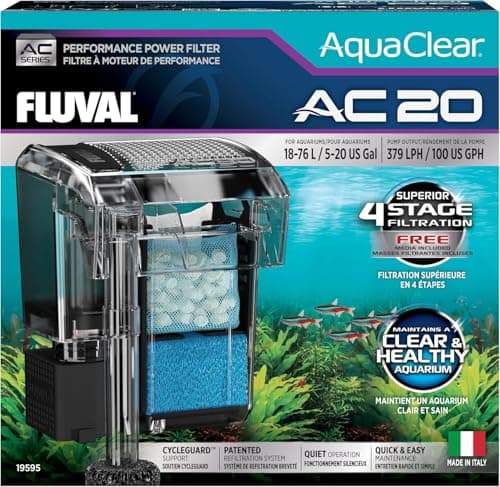
Almost nothing in this class publishes a flow rate. Fluval rates its Nano filter by tank size only. AquaClear publishes a gallon range for the 20 and no GPH on the product page. Sponge filters have no manufacturer at all, let alone a specification. The one exception in our registry is Tetra, which publishes 27 GPH for its small internal filter - a filter rated for tanks far below this one. We checked, we recorded each absence in the product entries below, and that absence is the single most useful thing on this page: a buyer literally cannot size a nano filter from the box.
What you can do instead is buy a filter with real, usable flow control and set it by watching the fish. That is not as good as arithmetic. It is what the category leaves you with, and pretending otherwise would mean inventing GPH figures, which we will not do.
What we ranked these on
We have not run these filters. There is no test bench here, no flow meter and no drawer of samples, so every criterion below is either read off a published page or is a structural property of the design that anybody can verify by looking at it.
Published spec depth. Flow rate, rated capacity and media contents all present would score 9 or 10. Nothing here scores above 5.5, because nothing here publishes flow.
Flow suitability for a betta. Whether the outflow can be brought down to something a long-finned fish can hold station in, using the parts in the box rather than a sponge cable-tied over the outlet.
Biological capacity. How much surface area the media offers, and whether that media is a rinseable foam or a disposable cartridge you re-buy - which matters more at ten gallons than at five, because there is more waste to process.
Running cost. Cartridge filters cost money forever. Foam and ceramic media get rinsed in old tank water and go back in.
Concealability. A 10-gallon is roughly 20 inches long, so you have more places to hide equipment than a 5-gallon owner does - but an in-tank filter still occupies display volume, and a sponge is still a black cylinder in the corner.
What actually changes at ten gallons
Two things, and both favor a hang-on-back over what we would recommend in a 5-gallon.
The bottom of the range stops being a problem. The AquaClear 20 is rated 5 to 20 gallons. In a 5-gallon that puts you at the very bottom of the published range, running the flow control near minimum and probably baffling the waterfall as well. At ten gallons you are in the middle of the range, which is where a flow control has room to work in both directions.
Media capacity starts to matter. A 10-gallon can hold a betta plus a small group of tank mates, and the bioload that comes with them is what a filter’s biological media actually processes. An open media basket you pack yourself - foam plus ceramic, no carbon - is a meaningfully better answer here than a sealed cartridge, and what to put in it is a decision worth making deliberately.
The three shapes of filtration, at this size
Hang-on-back. Sits outside the tank, so it costs no display volume, and gives you the largest media basket of anything here. Its cost is a waterfall return that hits the surface hard. At ten gallons that is manageable with the flow control alone in most cases, and with a baffle in the rest.
In-tank foam filter. The Fluval Nano ships with a spray bar, which is the part that turns a jet into a sheet, and Fluval describes the adjustable output as suitable for delicate fish or shrimp. It is the least fiddly way to get gentle flow out of the box. It sits in the tank on suction cups, and there is no hiding that.
Sponge filter. No impeller, so it physically cannot injure a fin. Flow is set by an air valve, which is the most granular flow control in the hobby. It has enormous biological surface for the money and it survives a power cut without losing its bacteria to a dry chamber. It also has no manufacturer, no published specification, and an air pump humming next to it - the fuller argument is in sponge filter versus hang-on-back.
Two filters is a legitimate answer here
At ten gallons there is room to run a sponge filter alongside a hang-on-back, and it is what we would do in a tank with tank mates. The sponge is a biological reserve that keeps working when the power fails and gives you a seeded filter to start a quarantine tank with. It costs a few dollars and an air pump. In a 5-gallon there is no room for the idea; at ten there is.
Setting the flow, since you cannot compute it
Fill the tank, run the filter with no fish in it, and watch the surface. You are looking for a moving surface without a standing ripple pattern, and for plants that sway rather than stream. Then add the fish and watch where it chooses to be: a betta that spends its day behind hardscape on the far side of the tank is telling you the flow is too high, and a betta that hangs in the outflow is telling you it is fine.
That is behavioral evidence rather than a measurement, and we would rather label it as such than dress it up. It is also the only method available in a category that publishes no numbers.
The filter is not what cycles your tank
A new filter is a box of clean plastic. The bacteria that process ammonia live on the media surface and take weeks to establish, which is why a brand-new filter on a brand-new tank does nothing useful for the first month. Cycle the tank first, and if you are moving up from a 5-gallon, move the old filter media across rather than starting again - it is the single biggest favor you can do a new tank.
What we did not rank, and why
Canister filters. They are excellent and they are the wrong tool here: a canister rated for a 10-gallon is either an odd small model with the same published-spec problem as everything else, or a larger unit whose flow you spend the entire setup fighting. There is also the practical point that a canister costs several times what this tank cost.
Internal power filters sold under rotating brand names with no manufacturer documentation. Same reasoning as the heaters we exclude: a filter we cannot trace to a published specification is one we cannot recommend on the basis this site uses.
What we cannot tell you
How loud any of these are in a bedroom, how the impellers age, or what the real GPH is at the setting you will actually run. The last one is a genuine gap in this page and we would rather name it than paper over it - our method is to publish the arithmetic and the absences, and here the absence is the story.