Nano tank filter media, and what each layer is for
Three jobs, three materials, and one of them is a monthly subscription you almost certainly do not need.
We earn a commission if you buy through the links on this page, at no extra cost to you. It never changes a ranking, and there are products recommended here with no affiliate link behind them at all. Full disclosure.
Three jobs, and only one of them is urgent
Filter media does three separate things, and most of the confusion in this subject comes from products that blur them together on the packaging.
- Mechanical. Strains solids out of the water. This is foam, floss or a pad. It is what makes water look clear, and it is the layer you physically clean.
- Biological. Gives nitrifying bacteria somewhere to live so they can convert ammonia to nitrite and nitrite to nitrate. This is ceramic rings, sintered glass, or - just as effectively - the same foam doing double duty. This is the layer that actually keeps a fish alive.
- Chemical. Adsorbs dissolved compounds. Almost always activated carbon, occasionally a resin. This is the layer you usually do not need.
In a nano tank, biological capacity is the whole game. Every other decision on this page follows from that: 4.3 gallons of water in a rated 5-gallon is a very small buffer, and the thing standing between your fish and an ammonia spike is bacterial colony size, not water clarity.
Foam does two of the three jobs
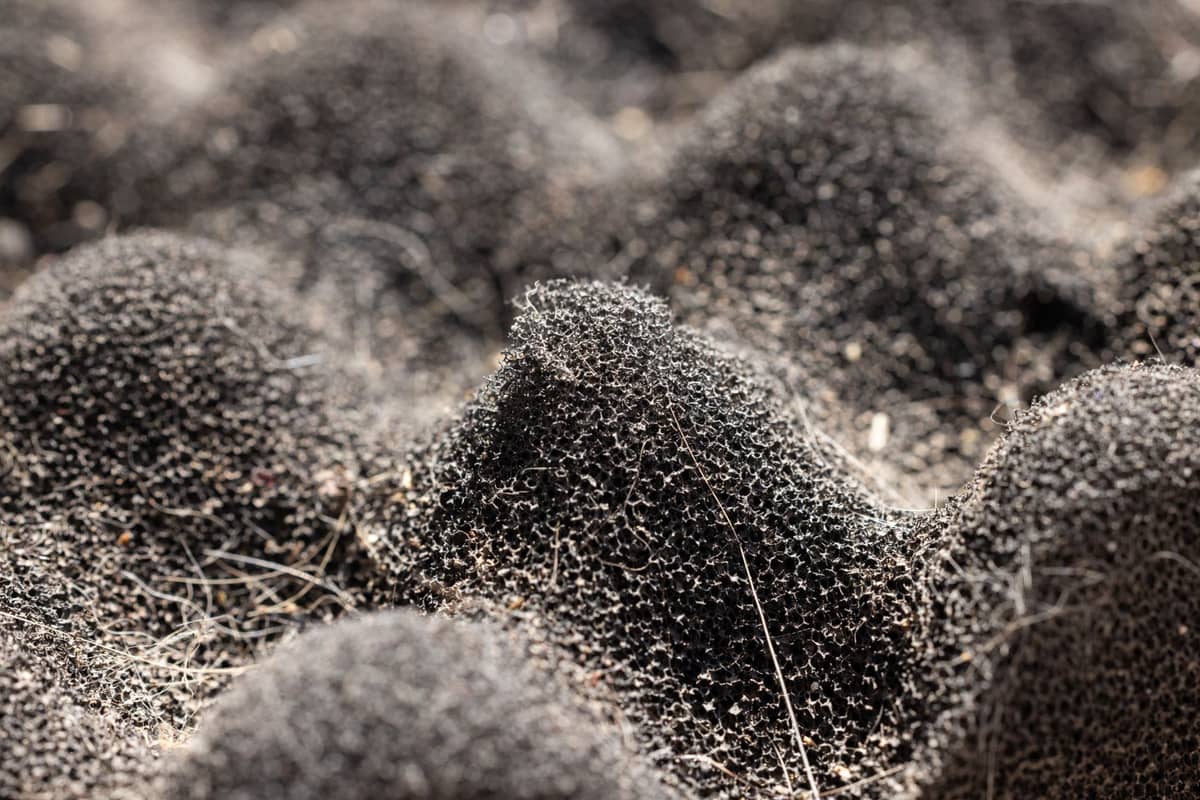
Open-cell foam strains solids and hosts bacteria at the same time, and its surface area per dollar is unbeatable. It is why a sponge filter works at all with nothing else in it, and why the Fluval Nano ships a Bio-Foam pad and a fine foam pad rather than a cartridge.
Coarse foam first, fine foam after. Water hits the coarse layer, drops the big particles there, and the fine layer polishes what is left. Reversed, the fine layer clogs in a fortnight and the coarse layer never does any work.
Ceramic and sintered glass: the biological reserve
Ceramic rings and sintered media exist to add biological surface area without adding restriction. In a hang-on-back with an open basket - the AquaClear 20 ships with foam, carbon and BIOMAX - the ceramic is the layer we would keep and never touch beyond a swirl in old tank water.
The manufacturers do not publish surface area figures for any of this, in this class, and we are not going to quote a square-meters-per-liter number we cannot source. What is verifiable is the structure: porous material, water passing through it, bacteria on every surface it touches.
Carbon is optional, and usually the wrong default
Activated carbon adsorbs tannins, some medications and some odors. It does that well, for a few weeks, and then it is an expensive lump of biological media sitting in your basket doing nothing chemical at all.
The reasons not to run it permanently in a nano tank are practical. It occupies basket space that could hold foam or ceramic, which is the capacity you actually need. It strips tannins, which is the opposite of what most betta keepers want from botanicals or driftwood. And in a small tank, the space is genuinely scarce - an AquaClear 20 basket is not large, and every cubic inch of carbon is a cubic inch not doing biology.
Run carbon when you have a reason: clearing a medication after treatment, or pulling out the smell of something that died in the tank. Then take it out.
The cartridge trap
A disposable cartridge is a slab of floss wrapped around carbon on a plastic frame. Replacing it monthly - as the box tells you - throws away your entire mechanical layer and most of your biological colony at the same time. That is why people whose tanks “cycle forever” are often the ones following the packaging most carefully. If your filter takes cartridges, cut the floss off the frame and pack the space with foam, or buy a filter with an open basket. Either is a one-time fix to a permanent expense.
How to pack an open basket, bottom to top
- 01
Coarse foam at the intake side
This takes the mechanical load. It is the layer you will rinse most often, and it protects everything behind it from clogging.
- 02
Ceramic or sintered media in the middle
Biological reserve. Once colonized, this is the part of your filter you disturb least - it is your insurance against a bad clean.
- 03
Fine foam or floss last
Polish. Optional, cheap, and the layer to leave out entirely if the basket is tight and you would rather have more ceramic.
- 04
Carbon only when you have a reason
After medication, or to clear tannins you did not want. Remove it once the job is done rather than leaving it in as a permanent tenant.
The rinsing rule that protects your cycle
Rinse mechanical media in old tank water, in a bucket, never under the faucet. Chlorine in tap water kills the nitrifying bacteria you spent a month growing, and it does it in seconds. Squeeze the foam a few times until the water runs merely murky rather than black, then put it straight back.
Never replace all your media at once. If a foam pad is genuinely falling apart, add the new one alongside the old for a few weeks, then remove the old. The bacteria migrate; you just have to give them somewhere to migrate to. This is the same principle behind cycling a tank, and it is why moving media from an established filter is the fastest legitimate way to start a new one.
Timing matters too: do the filter rinse and the water change on different days if you can. Both disturb the system, and doing them together is how an established nano tank produces a surprise ammonia reading - our cleaning schedule splits them for that reason.
Media in the three filter types
Hang-on-back with an open basket. The most control you get in this class. Pack it yourself, skip the carbon, and you have a filter whose biological capacity is limited only by basket volume.
In-tank foam filter. The Fluval Nano’s media is a Bio-Foam pad and a fine foam pad, which is a sensible pair. There is not much to decide here beyond rinsing them properly and not replacing both at once.
Sponge filter. The sponge is all three layers at once, and it is the only one on this list where the media is the filter. Rinse it in old tank water when flow drops and otherwise leave it alone. There is no cartridge to buy, ever, which is a large part of why it stays on our list despite having no published specification of any kind.
What we cannot tell you
How much biological capacity any of this media actually has. Nobody in this class publishes a surface area figure, a rated bioload or a colonization time, so there is no honest way to compare two products on the number that matters. What we can tell you is what each layer does, which layers are permanent and which are a subscription, and how not to kill the colony you already have.
What we would buy for this
Chosen from the same registry as our roundups, on published specifications and the arithmetic they imply - not on testing we have not done.
Fluval AquaClear 20 Power Filter
The hang-on-back that everyone eventually buys, rated 5-20 gallons. Its advantage is the media basket: you choose what goes in it, and you can pack it with foam and BIOMAX and skip the carbon entirely. Its problem in a nano is that a 5-gallon sits at the very bottom of its range, so you will be running the flow control near minimum and probably baffling the waterfall as well.
Skip it if: The tank is 3 gallons. The bottom of AquaClear's published range is 5 gallons and there is no honest way to read that as covering a 3.
Fluval Nano Aquarium Filter
An in-tank foam filter rated to 15 gallons, with an adjustable output and a spray bar in the box. The spray bar is why it is here: it is the only nano filter in this list that ships with the part that turns a jet into a sheet, which is exactly what a long-finned betta needs. Fluval does not publish a flow rate for it, and we are not going to invent one.
Skip it if: You want the equipment out of the display. This sits in the tank on three suction cups and there is no hiding it.
Nano sponge filter with air pump
The cheapest correct answer for a betta, and the one we would fit if we could only fit one thing. A sponge filter has no impeller, no outflow jet and no way to shred a fin. It is also the only filtration in this list that keeps working when the power comes back on after an outage without needing to re-prime. What it does not have is a manufacturer: these are sold under a dozen interchangeable brands with no published specifications at all, and we are not going to pretend otherwise.
Skip it if: You cannot live with an air pump humming on your desk, or with a black sponge in the corner of the display.
Frequently asked
Do I need carbon in my betta tank filter?
No, not as a default. Carbon is a tool for a specific job - clearing medication or an odor - and it is exhausted within weeks. In a nano filter it occupies basket space that would do more good as foam or ceramic. Use it when you have a reason, then take it out.
How often should I change filter media?
Rinse, do not change. Foam and ceramic get rinsed in old tank water when flow drops off, and go back in. Replace a foam pad only when it is physically falling apart, and then add the new one alongside the old for a few weeks before removing the old.
Can I rinse filter media in tap water?
No. Chlorine and chloramine in municipal water kill nitrifying bacteria on contact, which is the entire point of the media. Rinse in a bucket of water you just siphoned out of the tank.
What is BIOMAX and do I need it?
It is the porous ceramic media Fluval includes with the AquaClear range, and its job is biological surface area. You do not strictly need branded ceramic - foam hosts bacteria perfectly well - but if it came in the box it is the last thing in the basket we would remove.
My filter came with a cartridge. What do I do with it?
Use it until it is grubby, then cut the floss away from the plastic frame and replace the space with foam cut to fit. You keep the mechanical filtration, you keep the bacteria, and you stop paying monthly for both.