Skip to content
Glass & Gravel
Roundup

The best filter for a 3-gallon tank

The tank size where the filter aisle stops fitting, and where the single filter that publishes a flow rate publishes itself out of first place.

By Scooter M., Enthusiast. Published September 13, 2026.

We earn a commission if you buy through the links on this page, at no extra cost to you. It never changes a ranking, and there are products recommended here with no affiliate link behind them at all. Full disclosure.

A red betta photographed against a dark background
Quick picks

The shortlist, ranked

Ranked on published manufacturer specifications and, where the figures exist, on the arithmetic they imply for a tank this size. Tap any row for the full write-up, including who should skip it.

#ProductBest forScorePrice
01Aquarium filtration equipment of the type described - a stand-in for the Nano sponge filter with air pump, not a photograph of this modelNano sponge filter with air pumpA betta tank, a shrimp tank, or a quarantine tank on a budgetThe right answer8.1Check price on Amazon
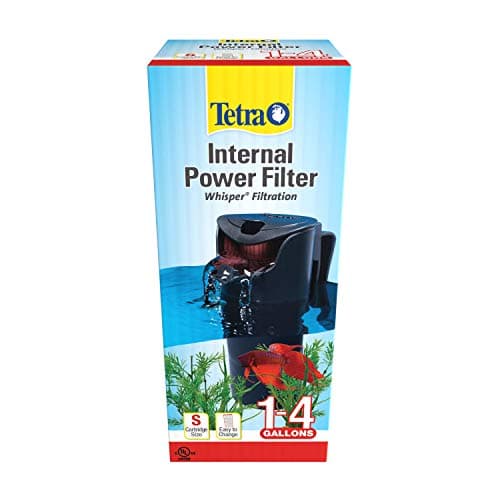
02Tetra Whisper Internal Power Filter, 27 GPHTetra Whisper Internal Power Filter, 27 GPHA 3-gallon shrimp or snail tank where you want a real published numberThe one rated for the size7.4$12.87 - View on Amazon
03Aquarium filtration equipment of the type described - a stand-in for the Fluval Nano Aquarium Filter, not a photograph of this modelFluval Nano Aquarium FilterA betta tank where the flow has to be gentle from day oneIf you want a spray bar8.6Check price on Amazon

Scores are ours and editorial. They are never published as review or rating markup, because we have not tested these products.

First: is this tank for a betta?

If it is, we would rather you spent the filter money on a bigger tank. Three rated gallons is 2.6 gallons of actual water, and that is a buffer so small that temperature and ammonia both swing faster than you can react to either. Our floor is five gallons, and it is not a close call.

A 3-gallon is a genuinely good shrimp or snail tank, though, and those need filtration too. So does a quarantine or grow-out tank. The arithmetic below stands either way, and so do the picks - we have simply told you which fish we would not put in front of them.

The sum, for this exact tank

2.6 gal of actual water x 4 turnovers an hour is about 10.4 GPH. Past roughly 15.6 GPH you are baffling the outflow or buying a different filter.

A rated 3-gallon holds about 2.6 gallons once there is substrate in it and you have stopped filling below the rim. The general aquarium convention is four to six turnovers an hour; for a betta we size to 4 and treat anything the flow control cannot bring under 6 as a baffling job rather than a purchase.

Tank (rated)Actual waterTarget flow (4x)Ceiling (6x)
3 US gal2.6 gal10.4 GPH15.6 GPH

So the target is about 10.4 GPH with a ceiling around 15.6. Ten gallons per hour is a very small number, and it is smaller than almost anything in the filter aisle is built to deliver.

The finding, before the picks

This is the one page on this site where a manufacturer’s published flow rate exists - and it makes the problem worse rather than better.

Tetra publishes 27 GPH for its small internal filter, rates it for 1 to 4 gallon aquariums, and then states outright that it “cycles a 4 gallon aquarium more than 6 times per hour.” That is a manufacturer volunteering that its own product runs at the top of the conventional range. In 2.6 gallons of actual water, 27 GPH is roughly ten turnovers an hour - about two and a half times our ceiling.

Everything else in this class publishes nothing at all. Fluval rates its Nano filter by tank size only. Sponge filters have no manufacturer, let alone a specification. We record each absence on the product entries below, and the single most useful conclusion on this page is that in a 3-gallon you are not shopping for flow - you are shopping for something whose flow you can reduce.

What we ranked these on

We have not run these filters. No test bench, no flow meter, no drawer of samples - so every criterion below is either read off a published page or is a structural property anyone can verify by looking at the product.

Can the flow be brought down? The criterion that decides this page. At 15.6 GPH of headroom, a filter you cannot slow is a filter you will be baffling on day one.

Does the published range actually include 3 gallons? Several popular nano filters are rated from 5 or 10 gallons upward. Buying below a stated range is the same error as buying above it, and it is the reason the most recommended nano hang-on-back is absent here.

Published spec depth. Flow rate, rated range and media contents all present would score 9 or 10. One product here publishes two of the three, which is unusually good for this category.

Footprint inside the tank. In 2.6 gallons, an in-tank filter is a meaningful fraction of the display. This matters far more here than at ten or twenty gallons.

Running cost. Cartridge filters bill you monthly and reset your bacteria each time. Foam rinses in old tank water and goes back in.

Why the AquaClear 20 is not on this page

Because Fluval’s published range for it starts at 5 gallons, and there is no honest way to read that as covering a 3. It is the filter we recommend most often on this site - our review says so - and it is still the wrong purchase here.

The same applies to every hang-on-back rated “5 to 20” or “10 to 30”. Being below a stated range is not a safe direction to err in: the minimum figure exists because the pump has a minimum output, and in a tank this size that output is the entire problem.

The three shapes that do fit

Sponge filter. Air rises through a lift tube and drags water through foam. There is no impeller, so it cannot shred a fin or injure a shrimplet, and the flow is set by an air valve - which makes it the only filtration in this class with genuinely continuous, fine adjustment. In a 3-gallon that adjustability is worth more than any published figure, because it is how you get to 10.4 GPH from a product that never told you what it moves.

Small in-tank power filter. The Tetra clips to the glass and is the only pick here whose published range genuinely includes a 3-gallon. What you are accepting is a fixed 27 GPH with no stated flow control, which means the baffle is not optional for a long-finned fish.

In-tank foam filter with a spray bar. The Fluval Nano is rated to 15 gallons - well above this tank - but it ships with an adjustable output and a spray bar, which is the part that turns a jet into a sheet. It is the gentlest of the three out of the box and the bulkiest in the display.

At three gallons, the baffle is part of the purchase

Budget ten minutes and a scrap of coarse filter foam. Wedged over an outflow it spreads a jet into a sheet and drops the current a fish actually feels, without restricting the intake - never restrict the intake, because that starves the media of the oxygenated flow the bacteria need. How to baffle a filter properly covers both the foam method and the bottle method. On this page it is not a fix for a bad choice; it is a normal part of running any powered filter in a tank this small.

The cartridge problem, which bites hardest here

Small in-tank filters are almost universally cartridge-driven, and a cartridge is a slab of floss wrapped around carbon on a plastic frame. Replacing it monthly - as the box instructs - throws away your entire mechanical layer and most of your bacterial colony at the same time.

In 2.6 gallons that reset is far more dangerous than it would be in a twenty. There is no spare volume to dilute the ammonia that appears while the colony rebuilds. The fix is the same as everywhere else on this site: cut the floss off the frame and pack the space with foam you rinse instead of replace. What each media layer is actually for works through it.

The sponge filter sidesteps the problem entirely, which is a large part of why it ranks first. There is no cartridge to buy, ever.

Setting the flow, since only one of these tells you anything

Fill the tank, run the filter with no livestock in it, and watch the surface. You want a moving surface without a standing ripple pattern, and plants that sway rather than stream. In a tank this small the difference between those two states is a quarter-turn of an air valve.

Then add the occupants and watch where they choose to be. A betta wedged behind hardscape at the far end all day is telling you the flow is too high; shrimp that stay under the sponge rather than grazing the glass are telling you the same thing. That is behavioral evidence rather than measurement, and we would rather label it as such than dress it up.

The filter is not what cycles the tank

A new filter is a box of clean plastic. The bacteria that process ammonia live on the media and take weeks to establish, and in 2.6 gallons there is no margin for getting that wrong. Cycle the tank first and confirm it with a test kit rather than the calendar - a 2 ppm ammonia dose processing to zero ammonia and zero nitrite in 24 hours.

If you are moving down from a larger tank, carry the old media across rather than starting again. It is the single biggest favor you can do a small tank, and it costs nothing.

What we did not rank, and why

Hang-on-backs rated from 5 gallons up. Covered above. Their own published ranges exclude this tank.

Undergravel filters. They work, and in a tank you will be vacuuming weekly with only an inch of substrate they make maintenance considerably worse for no benefit a sponge does not already provide.

Internal filters from rotating brand names. Same standard we apply to heaters: a filter we cannot trace to a manufacturer specification is one we cannot recommend on the basis this site uses. That excludes a large part of what is actually on the shelf at this size, and we would rather have a short list we can defend.

What we cannot tell you

How loud any of these are on a desk - and at three gallons the tank is almost certainly on a desk. Whether the Tetra’s published 27 GPH holds as the cartridge loads up. How the sponge brands differ, given that category has no manufacturer and no published specifications of any kind. Those absences are recorded on the product entries below rather than filled with a guess, which is the standard this whole site works to.

The write-ups

Every pick, in full

01 / The right answerAquarium filtration equipment of the type described - a stand-in for the Nano sponge filter with air pump, not a photograph of this model

Generic (multiple sellers)

8.1 / 10

Nano sponge filter with air pump

The cheapest correct answer for a betta, and the one we would fit if we could only fit one thing. A sponge filter has no impeller, no outflow jet and no way to shred a fin. It is also the only filtration in this list that keeps working when the power comes back on after an outage without needing to re-prime. What it does not have is a manufacturer: these are sold under a dozen interchangeable brands with no published specifications at all, and we are not going to pretend otherwise.

Check price on Amazon

#ad We hold no verified live price for this product, so we show none. How this site is funded.

Published specifications for the Nano sponge filter with air pump, with the page each figure was read from
SpecificationValueSource
Flow rateNot published on the product page by any seller in this categoryAbsence recorded by Glass & Gravel
Rated aquarium capacityVaries by seller and is not traceable to a manufacturer document in this categoryAbsence recorded by Glass & Gravel
MechanismAir-lift through open-cell foam; no impellerCategory description
RequiresAn air pump and airline, usually sold separatelyCategory description

What it does well

  • No impeller, so it physically cannot injure a fin or a shrimp
  • Flow is set by the air pump, so it is trivially adjustable with a valve
  • Enormous biological surface for the money
  • Survives a power cut without losing its bacteria to a dry chamber

What it does not

  • No manufacturer, no published specifications, no accountability
  • Air pump noise is a real consideration on a desk
  • Visible black sponge in a small display
  • Zero mechanical polish - the water stays slightly less crystalline

Skip this one if

You cannot live with an air pump humming on your desk, or with a black sponge in the corner of the display.

How it scores, by criterion

Published spec depth1.0
Flow suitability for a betta10.0
Biological capacity9.0
Running cost9.5
Concealability3.5
02 / The one rated for the sizeTetra Whisper Internal Power Filter, 27 GPH

Tetra

7.4 / 10

Tetra Whisper Internal Power Filter, 27 GPH

The only filter in this registry whose maker publishes a flow rate. Tetra states 27 GPH and rates it for aquariums of 1 to 4 gallons, and then goes further than any competitor by publishing what that means: it 'cycles a 4 gallon aquarium more than 6 times per hour'. That disclosure is the reason it is here - and the same figure is the reason we do not rank it first, because six turnovers is our ceiling for a betta, not our target.

$12.87 - View on Amazon

#ad Price as of September 18, 2026, from Amazon. Prices change. How this site is funded.

Published specifications for the Tetra Whisper Internal Power Filter, 27 GPH, with the page each figure was read from
SpecificationValueSource
Rated aquarium size1 to 4 US gallonsTetra published product listing
Flow rate27 GPHTetra published product listing
Published turnoverTetra states it cycles a 4 gallon aquarium more than 6 times per hourTetra published product listing
Filtration3-stage - cartridge floss traps debris, ultra-activated carbon addresses odor and discolorationTetra published product listing
MountingClips to the tank wall, in-tank; the aquarium can sit 1 inch from the wallTetra published product listing
Adjustable flow controlNot published on the product page - no flow adjustment is stated, which is what makes the published 27 GPH a fixed figure rather than a maximumAbsence recorded by Glass & Gravel

What it does well

  • Publishes an actual GPH figure - the only filter in this registry that does
  • Rated from 1 gallon, so a 3-gallon sits inside its stated range rather than below it
  • Tetra publishes the turnover implication too, which lets you check it against our sum
  • In-tank and clip-mounted, so the tank can sit an inch from the wall

What it does not

  • 27 GPH is over ten turnovers an hour in a 3-gallon - past our ceiling for a betta
  • No published flow adjustment, so the fix is a baffle rather than a dial
  • Cartridge filtration - a recurring cost and a bacterial reset every change
  • Sits in the tank, which costs display volume a 3-gallon cannot spare

Skip this one if

The occupant is a long-finned betta and you will not baffle the outflow. 27 GPH in 2.6 gallons of water is over ten turnovers an hour.

How it scores, by criterion

Published spec depth8.5
Flow suitability for a betta4.0
Biological capacity5.0
Running cost5.0
Concealability5.5
03 / If you want a spray barAquarium filtration equipment of the type described - a stand-in for the Fluval Nano Aquarium Filter, not a photograph of this model

Fluval

8.6 / 10

Fluval Nano Aquarium Filter

An in-tank foam filter rated to 15 gallons, with an adjustable output and a spray bar in the box. The spray bar is why it is here: it is the only nano filter in this list that ships with the part that turns a jet into a sheet, which is exactly what a long-finned betta needs. Fluval does not publish a flow rate for it, and we are not going to invent one.

Check price on Amazon

#ad We hold no verified live price for this product, so we show none. How this site is funded.

Published specifications for the Fluval Nano Aquarium Filter, with the page each figure was read from
SpecificationValueSource
Rated aquarium capacityup to 15 US Gal / 60 LFluval published specifications
Flow rateNot published on the product page - Fluval rates this filter by tank size only, so you cannot compute turnover from the boxAbsence recorded by Glass & Gravel
Media1 Bio-Foam pad and 1 fine foam pad included; carbon cartridge sold separatelyFluval published specifications
Flow controlAdjustable flow output with attachable spray bar, described by Fluval as safe for delicate fish or shrimpFluval published specifications
Mounting3 suction cups, in-tankFluval published specifications

What it does well

  • Spray bar included, not sold separately
  • Foam media means real biological surface, not a disposable cartridge
  • Adjustable output, and Fluval says outright it suits delicate fish
  • Cheap to keep running - foam rinses, it does not get replaced monthly

What it does not

  • No published flow rate anywhere on the product page
  • In-tank, so it occupies display volume in a tank that has none to spare
  • Suction cups on glass are a maintenance annoyance forever

Skip this one if

You want the equipment out of the display. This sits in the tank on three suction cups and there is no hiding it.

How it scores, by criterion

Published spec depth5.5
Flow suitability for a betta9.5
Biological capacity8.5
Running cost9.0
Concealability4.5

How these picks were chosen

Everyone in this category says they tested twenty tanks. We have not tested any, and we say so. What we did instead: read the manuals, compile the published specifications, compute the wattage and the turnover against the tank’s real water volume rather than its shelf label, and show the arithmetic so you can check it.

The full method, including what we refuse to claim.

Questions

Frequently asked

What GPH filter do I need for a 3 gallon tank?

About 10.4 GPH, with a ceiling near 15.6 - that is 2.6 gallons of actual water at 4 turnovers an hour. For context, the one small filter that publishes a figure moves 27 GPH, which is over ten turnovers in this tank.

Can I use an AquaClear 20 on a 3-gallon?

We would not. Fluval publishes its range as 5 to 20 gallons, and buying below a stated minimum is the same error as buying above a stated maximum - the pump has a minimum output and in this tank that output is the problem.

Is a sponge filter enough for a 3 gallon tank?

Yes, and it is what we would fit. It provides mechanical and biological filtration, cannot injure a shrimp or a fin, and its flow is set by an air valve - which is the finest flow control available in this class. The four conditions attached to that yes are worth reading.

Is a 3-gallon big enough for a betta?

It is bigger than a bowl and smaller than we would recommend. Five rated gallons is our floor, and the reason is buffer rather than swimming room - 2.6 gallons of water changes chemistry and temperature far faster than 4.3 does. A 3-gallon makes an excellent shrimp or snail tank.

Do I need to baffle a filter in a 3-gallon?

With any powered filter, almost certainly. The published flow figure available in this class is roughly ten turnovers an hour in this volume, and none of the powered options publishes an adjustable output. A scrap of coarse foam over the outflow takes ten minutes and costs nothing.

Can I run a 3-gallon with no filter at all?

Only with very large, very frequent manual water changes, and we would not recommend planning around it. A sponge filter and an air pump is one of the cheapest items in this hobby - the full answer is here.

Sources

Where the figures on this page came from

  1. Fluval Nano Aquarium Filter - published specifications
  2. Fluval AquaClear 20 Power Filter - published model range
  3. Seachem Stability - published dosing directions
  4. Tetra Whisper i Internal Power Filter - published product listing (rated gallons and GPH)
Read next