We earn a commission if you buy through the links on this page, at no extra cost to you. It never changes a ranking, and there are products recommended here with no affiliate link behind them at all. Full disclosure.
The thing to know before you buy one
A tank sold as three gallons holds about 2.6 gallons of water once there is substrate in it and you have stopped filling below the rim. Our floor for a betta is five rated gallons, and the reason is buffer rather than swimming room: at 2.6 gallons, temperature and ammonia both move faster than a beginner can react to either. The volume argument in full is not a close call.
So this page does two things. It tells you which 3-gallon tanks are actually documented products rather than anonymous boxes - because most of this category is the latter - and it tells you what a 3-gallon is genuinely excellent at, which is not a betta.
If you are set on a betta and set on a small tank, the honest advice is to spend the same money on a five or a plain ten-gallon and put the difference into a heater. We would rather say that once, clearly, than bury it.
The finding: most of this category has no manufacturer
Search for a 3-gallon aquarium kit and the results are dominated by brand names that change every eighteen months - four-letter words assembled from a syllable generator, sold with a photograph and a gallon number and nothing else. No published dimensions, no filtration specification, no stated lighting output, no company that will still exist when the pump fails.
We checked this category the same way we check every other one on this site, and found exactly two 3-gallon-class kits whose makers publish a specification we can cite. That is the ranking. It is a short list because the documented options are few, not because we ran out of patience.
This is the same standard that keeps unbranded heaters and filters off our heater list. A product we cannot size or trace is a product we cannot recommend, and at three gallons the consequences of an undocumented heater or an oversized pump are worse than they are anywhere else, because the water volume absorbs nothing.
What we ranked these on
We have not run these tanks. There is no test bench here, so every criterion below is either read off a published page or is arithmetic anyone can redo.
Published spec depth. Dimensions, capacity, filtration and lighting all published scores high. A gallon number and a photograph scores zero, and that is most of the shelf.
Water stability. The criterion that dominates at this size. Both of these hold between two and three gallons of actual water, and neither gets a good score - this is a property of the class, not of the products.
Stocking headroom. What can honestly live in it. At three gallons the answer is invertebrates, and our stocking threshold table says so before any species list.
Desk suitability. The one axis where this class wins outright. A 10-inch cube fits where nothing else does.
Completeness of the kit. What the box gets you, and what it quietly leaves out. Neither includes a heater.
Why the Fluval is first despite being 2.6 gallons
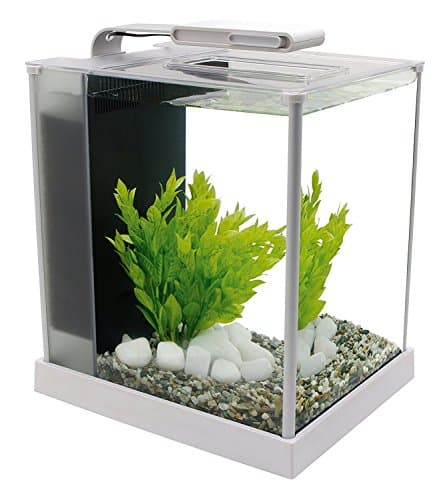
The nearest thing to a 3-gallon from a manufacturer with real documentation is 2.6 gallons. Fluval publishes the capacity, the dimensions (10 by 8 by 11.5 inches), the pump output as an actual range - 46 to 66 GPH - and the lighting as 32 LEDs at 738 lumens and 7000 K. That is four published figures in a category where the norm is none.
The published pump output is the most useful of them, and it is also a warning. Our turnover target for a betta is 4 tank volumes an hour with a ceiling of 6; 46 to 66 GPH in roughly 2.2 gallons of water is twenty turnovers an hour or more. For shrimp behind a sponge-covered intake that is survivable and adjustable. For a long-finned betta it is a washing machine, and it is another reason this tank is not the betta answer its size suggests.
The honest cons: it costs several times what the anonymous kits cost, it is still too small for a betta, and the rear chamber that makes the larger Specs tidy is cramped at this scale.
Why the Tetra is second, and where we disagree with Tetra
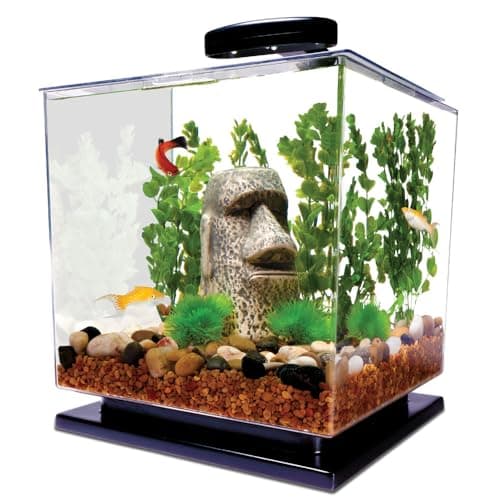
The Tetra cube is the cheapest 3-gallon kit whose maker publishes anything. It is a true 3 gallons, a 10-inch cube, with air-powered Whisper three-stage filtration and a low-voltage LED, in clear plastic that Tetra describes as virtually unbreakable.
Tetra also publishes that it is “appropriate for keeping one Betta or up to two community tropical fish.” We disagree with that, and it is the only published manufacturer claim on this site we say so about. Our floor is five rated gallons. We are not accusing Tetra of anything dishonest - a betta will survive in three gallons, and plenty do - we are saying that survival and a good tank are different standards, and the buffer argument does not go away because the box says otherwise.
Two structural points in its favor that have nothing to do with stocking. The air-powered filtration has no impeller, which makes it inherently gentle and shrimp-safe - the opposite of the Fluval’s problem. And plastic means a knock ends in a scratch rather than broken glass and a flood, which on a desk with a keyboard next to it is worth something.
Against that: plastic scratches permanently and you look into this tank every day; the Bio-Bag cartridges are a recurring cost and a bacterial reset at every change; and while the filter is air-powered, whether the pump is in the box is not something we could confirm - what an air pump is actually for covers what you would be buying.
What a 3-gallon is genuinely excellent at
A shrimp colony. Aqueon publishes that cherry, crystal and bee shrimp are “better suited to aquariums of 10 gallons or less” - one of the few places in this hobby where a manufacturer says the smaller tank is the correct one. A 3-gallon with a sponge filter and a mat of moss is a properly good shrimp tank rather than a compromise, and the nano shrimp tank page builds one. Snails work for the same reasons. A quarantine or grow-out tank is the other honest use.
What a 3-gallon costs you beyond the box
Neither kit includes a heater, and at this size the heater decision is unusually sharp. 3 US gal rated, less 15% for substrate and fill line, is 2.6 gal of water. A 78F target minus a coldest-room 68F is a 10F lift. 2.6 x 0.35 x 10 = 9.1W required. Nothing is sold at 9.1W, so the answer is the 10W. The wrinkle is that oversizing stops being harmless here: fifty watts dumped into 2.6 gallons moves the temperature fast enough to matter overnight. The 3-gallon heater page is the one place on this site where we tell you not to round up aggressively.
Filtration is the other gap. 2.6 gal of actual water x 4 turnovers an hour is about 10.4 GPH. Past roughly 15.6 GPH you are baffling the outflow or buying a different filter. That is a very small number, and it is smaller than most of the filter aisle is built to deliver - the 3-gallon filter page works through why a sponge filter wins at this size and why the popular hang-on-backs are excluded by their own published ranges.
Then a thermometer, a dechlorinator and a test kit. None of those are in any box, and the test kit matters more in a small tank than a large one because there is less water to hide a mistake in.
Three gallons versus five versus ten
| Rated | Actual water | Heater at a 68°F room | What belongs in it |
|---|
| 3 gal | 2.6 gal | 9.1W required, buy 10W | Shrimp, snails, a quarantine tank |
| 5 gal | 4.3 gal | 15.1W required, buy 25W | One betta, plus invertebrates. Our floor. |
| 10 gal | 8.5 gal | 29.7W required, buy 50W | A betta with a properly sized group of tank mates |
The equipment costs roughly the same across all three rows - a heater, a filter, a light and a dechlorinator do not get cheaper because the glass is smaller. Only the tank differs, and a plain 10-gallon is frequently cheaper than a designer 3-gallon kit while holding three times the water. That comparison is the single most useful thing on this page, and it is why the 10-gallon page exists.
If you are buying a 3-gallon anyway
Plenty of people will, and there are good reasons - a desk with ten inches of space, a shrimp project, a child’s first tank with something hardy in it. In that case:
- Buy a documented one. If the maker will not publish dimensions and a filtration type, they will not be there when the pump fails either.
- Fit a lid. Evaporation is proportionally brutal at this volume, and a lid is the cheapest degree of heat you will ever buy.
- Do not oversize the heater. 10W, not 25W, unless the room is genuinely cold.
- Change water weekly, not fortnightly. Less water means faster nitrate accumulation, and a small change is quick - the maintenance kit page covers the five things that actually matter.
- Stock it with invertebrates. The tank stops being a compromise the moment you stop trying to put a fish in it.
What we did not rank, and why
The unbranded kits. Covered above, and it is most of the category. Some of them are probably fine. Not one publishes a specification we can cite, and this site does not recommend products it cannot describe.
Bowls and vases sold at this volume. What actually happens in a bowl works through the arithmetic. No filtration and no room for a heater is a different problem from a small tank, and a worse one.
Acrylic “betta condos” and divided tanks. Dividing three gallons into two compartments produces two volumes below anything we would defend.
What we cannot tell you
How either of these sounds on a desk, how the Tetra’s plastic ages, or whether the Fluval’s pump is still smooth at year three. Those are ownership questions and we have not owned these tanks. We also cannot tell you how the anonymous kits perform, because there is nothing published to evaluate and buying a dozen to find out is not something our method supports.