We earn a commission if you buy through the links on this page, at no extra cost to you. It never changes a ranking, and there are products recommended here with no affiliate link behind them at all. Full disclosure.
Why ten gallons is the size to buy
Every problem a nano keeper has is a buffer problem. Temperature swings faster in less water. Ammonia climbs faster in less water. One missed water change matters more in less water. Ten gallons does not eliminate any of that - it just gives you roughly twice the margin a 5-gallon does, for a tank that still fits on a sideboard.
It is also the point where stocking stops being a gamble. Our floor for one betta is five rated gallons, and five is a floor rather than a target: at that size the honest answer on tank mates is invertebrates only. At ten, a properly sized group of one small species becomes a reasonable plan.
What a rated 10-gallon actually holds
Ten gallons is ten gallons of glass. Put an inch of substrate in it, add hardscape, and stop filling an inch below the rim, and on this site’s stated 15% assumption you are holding 8.5 gallons of water. Every number below comes off that figure rather than off the box, and that is the whole reason we publish the assumption instead of hiding it.
| What it implies | Figure | Where it comes from |
|---|
| Actual water | 8.5 US gal | Rated volume less our stated 15% assumption |
| Heater, 68°F room | 29.7W required, buy 50W | Our wattage sum |
| Heater, 64°F room | 41.6W required, still 50W | Same sum, colder room |
| Filter turnover for a betta | about 34 GPH, ceiling 51 | 4 turnovers an hour, ceiling 6 |
| Substrate, 20 x 10 in base at 1 in | 3.3 kg / about 7.3 lb | Fluval’s published substrate formula |
| Filled weight, water only | about 71 lb | 8.34 lb per US gallon, before glass and substrate |
Those five numbers are the entire buying decision. If a tank, kit or stand cannot satisfy them, no amount of styling fixes it.
What we ranked these on
We have not run these tanks. There is no test bench here and no drawer of samples, so every criterion below is something you can check from a published page rather than something we are asking you to take on trust.
Published spec depth. Dimensions, contents, lighting and filtration all published scores 9 or 10. A tank sold with a gallon number and nothing else scores near zero - and as the next section explains, that is most of this category.
Stocking headroom. How much of the ten gallons is actually available as water, and whether the shape supports a group of fish rather than one.
Water stability. Thermal mass and how the tank behaves through a power cut or a hot afternoon. This is the criterion that makes ten gallons worth buying over five in the first place.
Desk suitability. Honest footprint. A 10-gallon is about 20 inches long and near 100 lb filled; that is a piece of furniture’s worth of load even though it does not look like one.
Completeness of the kit. Whether the box gets you to a running tank, and what the omissions cost. A kit that includes a heater you cannot size is not as complete as it looks.
The finding: the best-value tank in this class publishes nothing
The cheapest correct answer for a 10-gallon is a plain rimmed glass aquarium from whichever shop has one on the shelf. It has no lid, no light, no filter and no heater, and it costs a fraction of any kit.
It is not one of our picks, and the reason is not that we dislike it. It is that we could not reach a manufacturer page publishing its dimensions. Aqueon’s Standard Glass Rectangle Aquariums page lists a size range from 2.5 to 210 gallons and publishes construction notes - high quality glass, clean silicone edges, black trim with clear silicone seals, a 90 day warranty - but on the page we could read, the dimensions shown belong to a single SKU. The company’s full dimensions chart exists as a document on its own site and we could not extract it.
So we will tell you plainly that the plain glass tank is very often the right purchase, and we will not list it as a pick, because this site does not link to products it cannot describe. That costs us the commission on the option we think many readers should buy, which is the arrangement described in how this site is funded.
If you buy the plain tank, budget for four things
A 50W heater, a filter you can turn down, a lid, and a light only if you intend to keep plants. Those four purchases separately usually land close to the price of a kit - the difference is that you choose each one, and none of them is a cartridge subscription. Our 10-gallon heater and 10-gallon filter pages are the two halves of that decision.
Kit or components?
A kit is the right answer if you want one box and a running tank this weekend. It is the wrong answer if you already know what you want in the filter.
The specific trade with the Aqueon kit is legible and worth stating: it is the only true 10-gallon in this list whose maker publishes both the dimensions and the full contents of the box, and its preset heater targets a constant 78°F - which is exactly the temperature this site sizes every heater to. Against that, the included filter runs a replaceable cartridge, and a cartridge is the worst standing deal in this hobby: replacing it monthly throws away your mechanical layer and most of your bacterial colony together. The fix is a five-minute one - cut the floss off the frame and pack the space with foam - but you should know it is coming.
The other omission is spectral. Aqueon publishes the hood as cool white LED lighting and publishes no color temperature, output or PAR for it. That is fine for looking at fish and it is not a plant light, which matters if you were planning a planted 10-gallon.
Nine, ten or sixteen
The three picks here are deliberately not the same size, because the honest answer to “which 10-gallon” sometimes is not a 10-gallon.
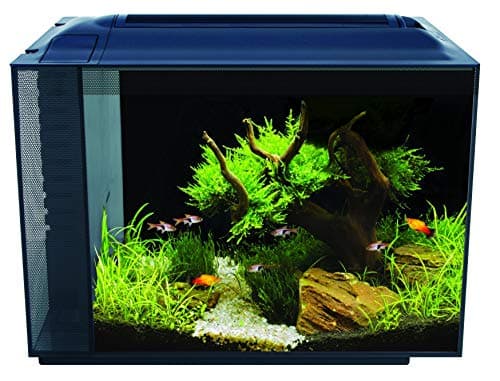
Nine. The Fluval Flex 9 is a 9 US gallon curved-front box with the equipment hidden in a rear chamber and multi-directional dual outputs that are far easier to aim away from a betta than a single nozzle. It is a gallon short of the headline and it distorts a flat-front scape through the curve. Buy it because the hidden filtration and aimable flow are worth more to you than the extra gallon.
Ten. The standard footprint - about 20 inches long - is the most replaceable, most accessorized tank shape in the hobby. Lids, hoods, mats and stands all exist for it off the shelf, which is a real advantage three years in.
Sixteen. If the furniture can take it, more water is more margin, and the Spec 16 is the same rear-chamber design scaled up. Our review of it is mostly about the thing that decides it: roughly 160 lb of filled weight is a furniture-rating question, not an aquarium question.
The two measurements to take before you order
The surface it will stand on. A filled 10-gallon is close to 100 lb over about 20 by 10 inches. That is a heavy point load on a span, and the failure is not a spill - it is a flood plus broken glass. Stand it over a leg or a load-bearing panel rather than mid-span, and check what the furniture is rated for rather than what it looks like it could take.
The clearance above it. You need room to get an arm in, lift a hood, and work a siphon. A tank on a shelf with eight inches of headroom is a tank you will resent every week, and the maintenance routine is what keeps the fish alive.
The order to set it up in
- 01
Stand and level first
Empty, on the final surface, checked with a level. A tank filled on a twist stresses the seams for its entire life, and you cannot fix it afterwards without emptying it.
- 02
Substrate, then hardscape, then equipment
About 7.3 lb for an inch across a standard footprint. Put the heater and filter in before you scape around them, not after.
- 03
Fill, then run everything for a week with no fish
This is when you find the leaks, the flow you cannot live with and the heater that reads two degrees off.
- 04
Cycle it
The fishless cycle takes weeks and it is the single biggest determinant of whether the fish you buy lives. Ten gallons is more forgiving than five; it is not immune.
What we cannot tell you
How quiet any of these are in a bedroom, whether the seams hold at year five, or what the included filter actually moves in gallons per hour - Aqueon publishes no flow rate for the QuietFlow in this kit, and Fluval publishes none for the Flex 9’s pump. Those absences are recorded on each product below rather than filled with a guess. Our method is to publish the arithmetic, cite the specifications that exist, and name the ones that do not.