We earn a commission if you buy through the links on this page, at no extra cost to you. It never changes a ranking, and there are products recommended here with no affiliate link behind them at all. Full disclosure.
The whole kit, in one list
A nano tank needs five things maintained properly, and only three of them are products worth ranking.
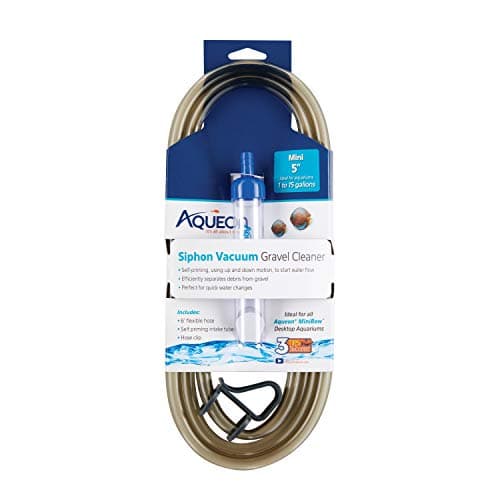
- A gravel vacuum rated for your tank size. Not one rated for 20 gallons that you are using in five.
- A dedicated bucket. Any bucket, never one that has held soap. This is the cheapest item here and the one people skip.
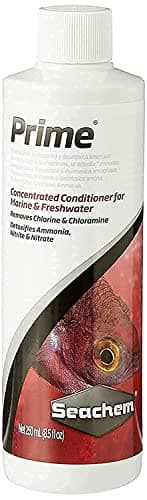
- A dechlorinator. Non-negotiable on municipal water, and the dose in a nano is smaller than the bottle’s cap.
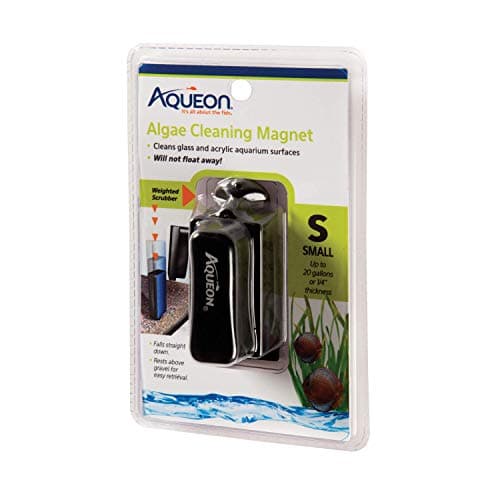
- An algae scraper or magnet. For the front pane. Optional but it keeps your arm out of the tank.
- A thermometer. The one item on this list with no manufacturer product page we could find, and the one we would give up last.
That is the kit. Everything else in the aquarium cleaning aisle - the chemical algae removers, the “tank cleaner” additives, the multi-tool sets with a rake in them - is either solving a problem a nano does not have or solving one that a water change already solved.
The sum: how much water, and how much conditioner
A rated 5-gallon holds about 4.3 gallons of water. A weekly 25% change is therefore about 1.1 gallons - a bit over a quart, which is a jug rather than a bucket.
Seachem publishes 5 mL of Prime per 200 L / 50 US gallons of new water. Applied to that change, the dose is 0.11 mL. You cannot measure a tenth of a milliliter from a bottle cap, which is the practical problem nobody mentions.
| Tank (rated) | Actual water | Prime, full volume | Prime, 50% change | Stability, day one |
|---|
| 3 US gal | 2.6 gal | 0.26 mL | 0.13 mL | 1.3 mL |
| 5 US gal | 4.3 gal | 0.43 mL | 0.22 mL | 2.15 mL |
| 10 US gal | 8.5 gal | 0.85 mL | 0.43 mL | 4.25 mL |
| 20 US gal | 17 gal | 1.7 mL | 0.85 mL | 8.5 mL |
Two workable answers: dose the new water in a jug using a 1 mL syringe, or accept a modest overdose - Seachem publishes that Prime can be used at up to five times the standard dose without harm. We do the first, because a syringe costs almost nothing and because getting into the habit of measuring is worth more than the accuracy itself.
What we ranked these on
Published spec depth. Whether the manufacturer states a rated tank size, dimensions and materials. This category is unusually good on that front compared to nano heaters and filters, and we have said so.
Nano suitability. Whether the product is actually rated for a tank this small, rather than being the smallest thing in a range designed for bigger tanks. This is the criterion that eliminates most gravel vacuums.
Ease of use. Specifically one-handed use, because in a nano water change your other hand is holding a jug.
Running cost. Whether it is a purchase or a subscription. Everything here is a purchase, which is why the kit is cheap.
Necessity. Our honest judgment of whether you would miss it. The siphon and the conditioner score high; the algae magnet is a convenience.
The siphon is the one that has to be the right size
Aqueon publishes its Mini 5" siphon as “ideal for aquariums 1 to 5 gallons,” prints the dimensions, and ships a 6-foot hose with a clip that holds the drain end inside a bucket. That last detail is the product: in a 5-gallon you have one hand on the siphon and one hand on nothing, because the hose stays put.
A larger gravel vacuum in a nano is not merely awkward, it is actively worse. A wide intake tube in 4.3 gallons empties the tank faster than you can react, and a 16-inch tube in a 12-inch tank does not fit at all. This is the one item where buying up a size costs you something real.
If your tank is 10 gallons or more, Aqueon publishes four larger sizes in the same range and the Medium is the sensible step up.
The dechlorinator, and why we do not rank three of them
Seachem Prime is already the water-care product this site recommends, on the basis that Seachem publishes dosing directions precise enough to convert to nano volumes and states an overdose tolerance. That is the whole argument: it is not that it works better than the alternatives, it is that we can compute a dose from published directions.
There are several perfectly good conditioners. We list one because listing three would mean either repeating manufacturer marketing or implying a comparison we have not made.
The bucket rule
One bucket, used only for the aquarium, marked so nobody in the house uses it for anything else. Detergent residue is not visible and does not rinse out reliably, and a fish tank is the most soap-sensitive container in your home. A five-dollar bucket from a hardware store is the correct purchase. So is a plastic jug for carrying treated water back to the tank - in a nano you are moving about a quart, and a jug pours where a bucket sloshes.
The algae magnet, and its one real risk
Aqueon publishes its Small magnet as rated for glass or acrylic up to 20 gallons or quarter-inch thickness, ships both a glass and an acrylic pad, and - the detail worth knowing - weights the inner scrubber so it falls straight down if it separates from the outer magnet rather than floating up into your scape.
The risk is grit. A grain of substrate caught under the pad will scratch glass, permanently, in one pass. Keep the magnet away from the bottom inch of the tank, and if it does touch the substrate, lift it out and check the pad before carrying on. A plain algae pad on a handle avoids the problem entirely and costs less; the magnet buys you a dry sleeve.
The thermometer: an absence worth recording
This site tells you on every heater page that a thermometer is the only object in the tank taking a measurement rather than making a claim. It is therefore genuinely awkward that we cannot point you at a manufacturer-documented standalone thermometer in this category - we looked, and the major aquarium brands publish thermometers as accessories bundled into starter kits rather than as products with their own specification pages.
Worse, the ones bundled in kits are usually stick-on liquid crystal strips, which sit on the outside of the glass and read a blend of water and room temperature.
So the recommendation is a category rather than a product: a glass alcohol thermometer or a cheap digital probe, placed mid-water at the opposite end of the tank from the heater. We are not going to invent a spec table for a product whose manufacturer publishes none, and we would rather flag the gap than fill it - why the thermometer matters more than the heater makes the case in full.
The routine these five things support
- 01
Switch the heater off at the wall
Before anything goes in the water. Leave it off until a few minutes after the refill so the glass and the new water equalize.
- 02
Siphon about a quarter of the volume
1.1 gallons from a rated 5-gallon. Work the vacuum through the open substrate rather than under plants, and stop when the jug is full rather than when the tank looks clean.
- 03
Treat the new water in the jug, not the tank
Match the temperature by feel, dose the conditioner into the jug, and swirl. Treating the jug means the tank never sees untreated water even for a second.
- 04
Refill slowly, against the glass
Pouring straight onto substrate craters a scape and clouds the tank. Down the side, or onto a saucer, or over your hand.
- 05
Glass last, heater back on
Scrape the front pane after the change rather than before, so what comes off leaves with the next one. Then switch the heater back on and check the thermometer before you walk away.
Frequency, and what to do on the weeks you skip, is on the cleaning schedule. One timing rule belongs here though: do not rinse the filter on water-change day. Both disturb the system, and doing them together is how an established nano tank produces a surprise ammonia reading - how to rinse media without crashing the cycle covers the rest.
What not to buy
All-in-one cleaning kits. They pair a decent net with a plastic rake and an algae pad on a 24-inch handle you will never use in a 12-inch tank. Buy the siphon separately.
Chemical algae removers. Algae in a nano is a light and nutrient problem, and a chemical that kills it leaves the dead algae and the original cause in place. Shorten the photoperiod and feed less first.
“Tank cleaner” bacterial additives sold as a substitute for water changes. Nothing in a bottle removes nitrate from a closed system. Water changes remove nitrate. That is the mechanism, and there is no product around it.
Automatic water changers plumbed to a faucet. Excellent products for a 75-gallon. In a nano you are moving a quart, and a jug is faster than setting one up.
What we cannot tell you
How long any of these last. Aqueon publishes a 90-day warranty on both the siphon and the magnet, which tells you what the manufacturer is prepared to stand behind and nothing about the actual service life. We have not run them for years and will not pretend otherwise - that is the standard we hold every product page here to.