We earn a commission if you buy through the links on this page, at no extra cost to you. It never changes a ranking, and there are products recommended here with no affiliate link behind them at all. Full disclosure.
Why this purchase is not optional
Everything else this site recommends is a judgment call. A test kit is not. Without one there is exactly no way to know whether the tank is cycled, and a fish put into an uncycled tank is a fish living in its own ammonia.
Our definition of a cycled tank is a measurement, not a calendar date: a 2 ppm ammonia dose processes to zero ammonia and zero nitrite within 24 hours. That sentence contains three numbers you can only obtain from a test kit. Everything on the cycling page depends on owning one.
And a nano tank needs it more than a big one does. A rated 5-gallon holds 4.3 gallons of water and a 10-gallon holds 8.5; the smaller the buffer, the faster a problem becomes a number that matters, and the less time you have to notice by eye.
What we ranked these on
We have not run laboratory comparisons of reagent accuracy - that would need reference standards and equipment we do not have. Every criterion below is either published by the manufacturer or is a structural property of how the test works.
Does it answer the cycling question? The single criterion that reorders this category. A kit that does not test ammonia cannot tell you whether a tank is cycled, whatever else it measures. This is worth more than every other criterion combined.
Published spec depth. What the maker states about parameters, test count and contents. Nobody in this category publishes an accuracy tolerance, and we record that absence on both products below.
Cost per test. A kit you feel bad about using is a kit you do not use.
Ease of use. Bluntly: the more steps, the less often it happens. This is the axis where strips win outright.
Necessity. Our honest judgment of whether a nano keeper would miss it.
The ammonia gap, which decides the whole page
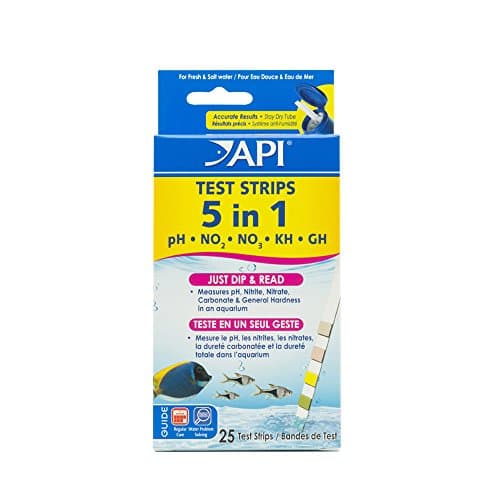
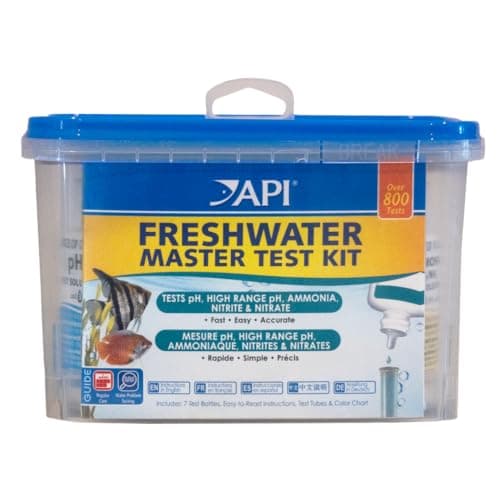
Liquid master kits test ammonia. The common 5-in-1 strips do not - they read pH, nitrate, nitrite, carbonate hardness and general hardness. Five parameters, and the missing sixth is the one that kills fish.
| Parameter | Liquid master kit | 5-in-1 strips | Why it matters |
|---|
| Ammonia | Yes | No | The toxic one. Rises first in a new or crashed tank. |
| Nitrite | Yes | Yes | The second stage. Also toxic; must read zero. |
| Nitrate | Yes | Yes | The end product. Removed by water changes, not by products. |
| pH | Yes, plus high range | Yes | Stability matters more than the number itself. |
| KH / GH | No | Yes | Useful for plants and shrimp; not a cycling question. |
So the two products here are not really competitors either. The master kit is how you cycle a tank and how you diagnose a problem. Strips are how you keep an eye on an established tank in twenty seconds. Owning both is reasonable; owning only strips is a gap.
Liquid reagents versus strips, honestly
Resolution. Liquid reagents resolve low readings that strips round toward zero. In a cycling tank the difference between 0 and 0.25 ppm is the difference between finished and not finished.
Subjectivity. Both are color matched by eye against a printed card, and both are harder in warm indoor light than in daylight. Neither gives you a digital number. Anyone claiming laboratory precision from either is overselling.
Time. A full liquid test is five tubes, a careful drop count and a five-minute wait. A strip is one dip. That gap is the real reason people stop testing, and a test you skip has an accuracy of zero.
Shelf life. Reagent bottles and strip pads both degrade, and strips degrade faster once the tube has been opened in a humid room. Keep the cap on, keep them dry, and replace anything that has been open a year.
The nitrate test everyone gets wrong
The nitrate test in a liquid master kit has two reagent bottles, and bottle two contains a suspension that settles solid in storage. API’s instructions are to bang and shake that bottle vigorously for a full 30 seconds before use, and then shake the filled tube for a further minute. Almost nobody does it for long enough, and the result is a nitrate reading that comes back far lower than reality - which is exactly the wrong direction for a reading you use to decide whether to change water.
How often to actually test
Testing is a habit with two completely different intensities, and the mistake is running the cycling intensity forever or the maintenance intensity from day one.
- 01
While cycling - every day or two
Ammonia and nitrite are the numbers that matter. You are watching for ammonia to rise and fall, nitrite to rise and fall, and nitrate to appear. This is the phase the liquid kit is for.
- 02
The first month with a fish - weekly
Ammonia and nitrite should read zero. Anything else means the colony is not keeping up with the bioload you added.
- 03
Established tank - monthly, or when something looks off
Nitrate, mostly, to sanity-check your water change schedule. This is where strips earn their place: quick enough that you actually do it.
- 04
Any time behavior changes
Before you change anything else. A water test costs five minutes and rules out the most common cause - our care guide works through what else to check.
What a test kit will not do
It will not diagnose a sick fish, and we do not either. It measures water, and water is the most common cause of trouble in a small tank - but a normal test result does not mean nothing is wrong, it means the water is not the problem.
It also will not tell you anything useful if you test straight after dosing a conditioner. Products that bind ammonia leave it detectable to hobby kits, so a reading taken after a dose of Prime is an upper bound rather than a live threat.
What we did not rank, and why
Digital meters. pH and TDS pens are genuinely more precise than a color card, and they measure the parameters that matter least here. No affordable meter reads ammonia. A pen is a nice-to-have after you own a master kit, not instead of one.
Multi-parameter strips from rotating brand names. Same standard we apply everywhere: a product we cannot trace to a manufacturer specification is one we cannot recommend on the basis this site uses.
What we cannot tell you
How accurate either of these is in absolute terms. Neither manufacturer publishes a tolerance, and we have no reference standards to check them against - both absences are recorded on the product entries below rather than filled with a guess. What we can tell you is which parameters each one reads, because that is published, and that the one which omits ammonia cannot answer the question you bought it for.