The nano shrimp tank, built properly
A shrimp tank is the one case where small is not a compromise. It is also the one where a single wrong purchase empties the tank overnight.
We earn a commission if you buy through the links on this page, at no extra cost to you. It never changes a ranking, and there are products recommended here with no affiliate link behind them at all. Full disclosure.
The size threshold, published first
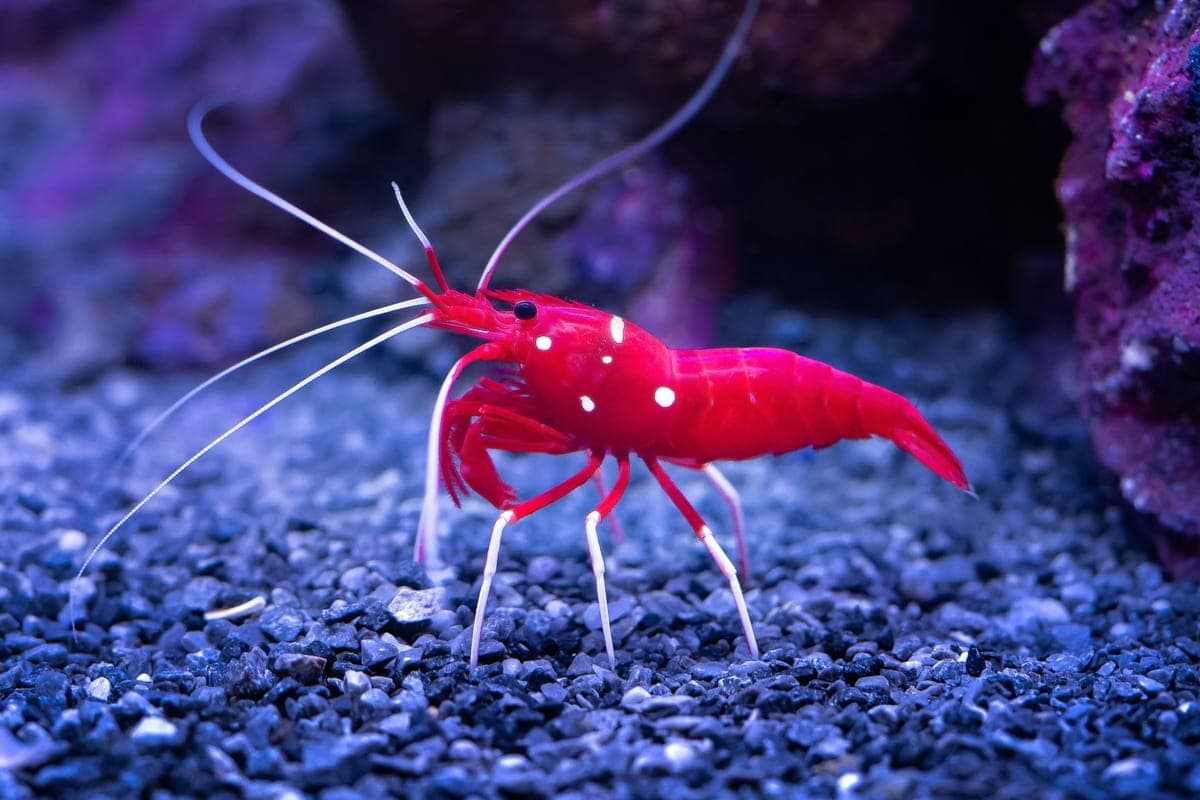
Aqueon publishes that “red cherry, crystal and bee shrimp are better suited to aquariums of 10 gallons or less,” while larger species - ghost, Amano, bamboo - want 10 to 55 gallons. That is an unusual sentence in this hobby: a manufacturer care sheet saying the smaller tank is the correct one.
It is also why this page exists on a nano site. Every other stocking page here starts by telling you the tank is too small. This is the one where a rated 5-gallon holding 4.3 gallons of water is a genuinely good home rather than a floor you are scraping.
| Rated volume | Actual water | What it suits |
|---|---|---|
| 3 US gal | 2.6 gal | A small dwarf shrimp colony, and nothing else |
| 5 US gal | 4.3 gal | A comfortable cherry shrimp colony that will breed |
| 10 US gal | 8.5 gal | The upper end Aqueon names for dwarf shrimp, and room for a few tiny fish |
Why small works here and nowhere else
Bioload. A colony of dwarf shrimp produces a fraction of the waste one betta does, so the ammonia arithmetic that makes a 3-gallon marginal for a fish is comfortable for shrimp. What a small tank still cannot do is buffer a mistake - the water parameters swing faster in less water, and shrimp are considerably less tolerant of a swing than a betta is.
The rule that comes out of that: a nano shrimp tank is easy to run and unforgiving to change. Small, frequent water changes with temperature-matched water, and no sudden anything.
The copper problem
Aqueon states it plainly: “avoid products containing copper, as it is toxic to freshwater shrimp.” This is the single most common way a healthy shrimp colony dies overnight, and the reason is that copper turns up where you are not looking for it.
- Fish medications, particularly anything for external parasites. Read the ingredients rather than the front of the box.
- Some plant fertilizers, which include copper as a micronutrient.
- Snail treatments, which are frequently copper-based and will take the shrimp with the snails.
- Old copper household plumbing, in a house where the water sits in the pipes overnight. Run the tap before you fill.
There is no treating this after the fact. It is a read-the-label discipline, and it is the reason we would not medicate a shrimp tank at all - this site does not cover treatment, and a shrimp tank is the clearest case for why.
Filtration: one answer, and it is not a close call
A sponge filter. Aqueon’s own care sheet says to use sponge pre-filters on intake screens, and in a nano tank the simplest way to satisfy that is to skip the intake entirely and run the sponge as the filter.
The reason is mechanical rather than chemical: baby shrimp are a millimeter or two long and an impeller does not distinguish them from detritus. A sponge filter has no impeller. It also gives the shrimplets a grazing surface, which is a second benefit nobody advertises - biofilm on the sponge is food.
If you already run a hang-on-back, fit a sponge pre-filter over the intake and check it is actually seated. Our sponge versus hang-on-back comparison covers the trade-offs for a fish tank; for shrimp the trade-off mostly disappears.
Plants: moss first, and Aqueon says so too
Aqueon’s care sheet recommends live plants “particularly species such as Java moss.” That is not a stylistic preference. Moss does three jobs at once in a shrimp tank: it hides shrimplets from anything that would eat them, it grows the biofilm the colony grazes on, and it exports nitrate.
Aquarium Co-Op publishes Java moss as low light, 10-20 PAR, no CO2, sold on a mesh grid of 2.75 by 2.75 inches - which is a genuinely useful figure when you are working out how many portions cover the floor of a 5-gallon. Add anubias or crypts around it if you want structure, and see our nano plant picks for what stays in scale in a tank this size.
Cycle it first, and mean it
Shrimp go into an established tank, not a new one. The colony wants stable parameters and a biofilm to graze, and neither exists in week one - a tank that has been running with plants for a month is the minimum we would put shrimp into. The fishless cycle is the same process here, and the extra few weeks of patience afterwards is the difference between a colony that breeds and one that slowly disappears.
Feeding: less than you think
Aqueon publishes that dwarf shrimp are “largely algae eaters” and that you should feed “only what they can consume in 2 to 3 minutes, once or twice a day.” In a planted, established tank a colony finds most of its own food, and the most common error is feeding a shrimp tank like a fish tank.
Uneaten food in a nano tank is ammonia with a delay on it. Feed small, watch them clear it, and skip days without guilt.
Tank mates: mostly, no
Aqueon’s published compatibility list for dwarf shrimp is small fish with small mouths - Boraras rasboras, ember tetras, celestial danios, Endlers, Otocinclus, pygmy corydoras. Even with those, adult shrimp survive and shrimplets get eaten, so a mixed tank is a colony that never grows.
A betta is a special case with its own page: can a betta live with shrimp works through the volume threshold and the individual-temperament problem. The short answer is that it sometimes works, that it depends on the individual fish, and that you need somewhere to move one of them if it does not.
Snails are the exception that genuinely works - same water, same diet, no predation in either direction, and the snail page covers the species worth having.
What we cannot tell you
Whether your water will suit crystal or bee shrimp. Aqueon publishes that those species need soft, low-pH water while ghost and Amano shrimp are not particular, and your tap water is a fact about your municipality that we cannot look up for you. Cherry shrimp are the forgiving starting point for exactly that reason.
We also cannot tell you why a colony sometimes stops breeding in a tank that tests perfectly. That is one of the genuinely open questions in this corner of the hobby, and we would rather say so than invent a cause.
What we would buy for this
Chosen from the same registry as our roundups, on published specifications and the arithmetic they imply - not on testing we have not done.
Nano sponge filter with air pump
The cheapest correct answer for a betta, and the one we would fit if we could only fit one thing. A sponge filter has no impeller, no outflow jet and no way to shred a fin. It is also the only filtration in this list that keeps working when the power comes back on after an outage without needing to re-prime. What it does not have is a manufacturer: these are sold under a dozen interchangeable brands with no published specifications at all, and we are not going to pretend otherwise.
Skip it if: You cannot live with an air pump humming on your desk, or with a black sponge in the corner of the display.
Java Moss
The only plant on this site that solves a problem nothing else does: it gives baby shrimp and fry somewhere to hide, and it does it in a tank with no substrate, no CO2 and a cheap light. Aquarium Co-Op publishes low light at 10-20 PAR, no CO2, easy, and sells it attached to a flexible wire mesh grid measuring 2.75 by 2.75 inches - which is a genuinely useful figure, because it tells you how much tank floor one portion covers.
Skip it if: You want a tidy scape. Moss traps every scrap of uneaten food and detritus that passes it, and getting that out means pulling the moss.
Fluval Spec V Aquarium Kit, 5 US Gal
The one nano kit whose published numbers all point the same way. Nineteen and a half inches of length in a five-gallon footprint is the whole argument: a betta swims horizontally, and this is the only kit at this volume that gives it a long tank instead of a tall one. The rear chamber hides the pump and media, the 821-lumen LED is enough for low-light plants, and the pump's 55-80 GPH is far too much flow for a betta straight out of the box - which is a solvable problem, not a dealbreaker.
Skip it if: You will not baffle the outflow. At 55-80 GPH into 4.25 gallons of water this runs 13-19 turnovers an hour, three times our 4x target, and a long-finned betta will spend its life fighting it.
Seachem Prime
The dechlorinator whose published dosing makes it the obvious nano choice: 5 mL treats 50 US gallons, so a 5-gallon water change needs half a milliliter. A 100 mL bottle is therefore roughly two hundred water changes. It also binds ammonia and nitrite, which is the property that turns a cycling accident into a survivable week.
Skip it if: You need something you can dose by the capful into a nano. At this concentration a capful in a 5-gallon is a ten-times overdose - you are measuring in drops.
Frequently asked
What size tank do cherry shrimp need?
Aqueon publishes that red cherry, crystal and bee shrimp are “better suited to aquariums of 10 gallons or less.” A rated 5-gallon, holding 4.3 gallons of water, is a comfortable colony tank. A 3-gallon works for a small colony and gives you less margin for error.
Do shrimp need a heater?
Usually not in a heated home, which is the opposite of the answer for a betta. Aqueon notes that Sulawesi Caridina want higher temperatures, but common cherry shrimp do well at normal indoor room temperature. If the room drops hard overnight, size a heater the way we size any other - the arithmetic is the same.
What filter is safe for baby shrimp?
A sponge filter, or a sponge pre-filter over an existing intake - which is what Aqueon’s own care sheet recommends. The risk is mechanical: an impeller cannot tell a shrimplet from detritus, and a sponge has no impeller.
Why did all my shrimp die suddenly?
The two causes worth checking first are copper - Aqueon states outright that it is toxic to freshwater shrimp, and it arrives through medications, fertilizers and snail treatments - and a sudden parameter swing from a large water change with unmatched water. We do not diagnose illness and will not guess beyond those two.
Can I keep shrimp with a betta?
Sometimes, and it depends entirely on the individual fish. Our page on that pairing sets out the volume threshold, the cover requirement, and the rule we would not break: do not try it unless you have somewhere to move one of them.