Betta bowls, and what actually happens in one
The labyrinth organ is real and the myth built on it is not. A betta in a bowl does not suffocate - it dies of ammonia and cold, slowly enough that nobody connects the two.
We earn a commission if you buy through the links on this page, at no extra cost to you. It never changes a ranking, and there are products recommended here with no affiliate link behind them at all. Full disclosure.
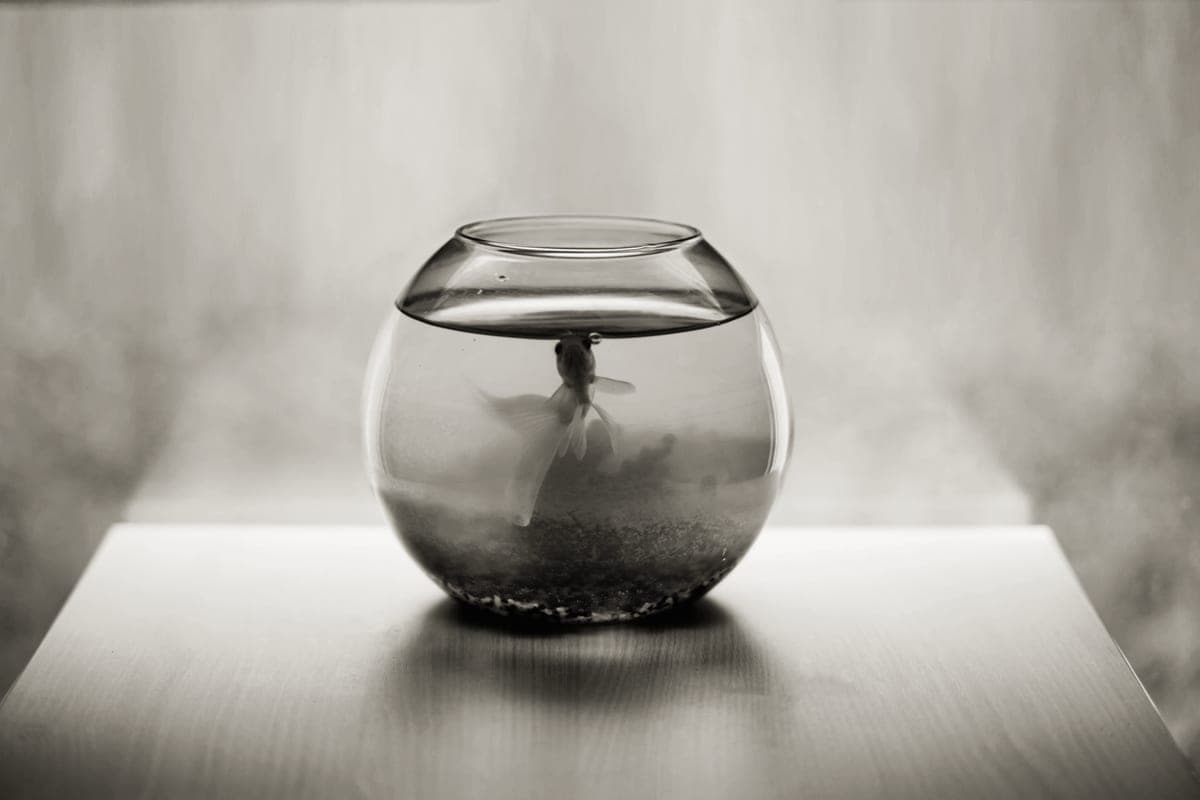
The claim, and the part of it that is true
Bettas have a labyrinth organ. It is a genuine anatomical structure that lets them take oxygen directly from the air at the surface, and it is why they survive in water that would asphyxiate almost any other aquarium fish. In the wild it is what lets them live in shallow, warm, low-oxygen water.
So the bowl argument is not built on a lie. It is built on a true fact that answers a question nobody was asking. Oxygen is not what kills a fish in a bowl.
What kills it instead
Ammonia. A fish excretes ammonia continuously. In a cycled tank, bacteria in the filter convert it within hours. A bowl has no filter, so it has nowhere for those bacteria to live in useful numbers, so ammonia accumulates until the next water change. In 0.9 gallons of water that happens in a day or two. Ammonia burns gills and skin at concentrations well below what it takes to kill outright, so the visible result is a fish that is repeatedly, mysteriously unwell.
Cold. A bowl is too small for any heater sold, and an unheated tank in an American room sits at 67-69°F against a preference of about 80. A permanently cold betta has suppressed immune function, so the ammonia damage above does not heal.
Temperature swing. 0.9 gallons of water tracks the room almost immediately. Every time a door opens or the heating cycles, the fish feels it.
Why the myth survives
Because of the timing. None of the above kills a betta on the day the mistake is made. It kills over three, six, twelve months - and the published lifespan is three to five years from hatching, with shop fish typically six to twelve months old at purchase. So a bowl-kept betta that dies at fourteen months looks, to somebody who does not know the number, like a fish that lived a normal life.
It did not. It lost somewhere between one and three years, and there was no single moment anybody could point at.
If you have a betta in a bowl right now
The cheapest thing that helps most, today, is a 50% water change with temperature-matched dechlorinated water, and then the same again every two or three days. Seachem publishes 5 mL of Prime per 50 US gallons, so a one-gallon change is about 0.1 mL - use a syringe. That is not a fix. It is the holding pattern until you can move the fish into something with a filter and a heater, and it is a great deal better than nothing.
The vase-with-a-plant version
You will see a betta sold in a vase with a peace lily rooted through the top, on the claim that the fish feeds the plant and the plant feeds the fish. The plant does take up some nitrate, and that is where the truth ends. A peace lily is a terrestrial plant whose roots rot when permanently submerged, the arrangement has no filtration and no heater, and it is the same one-to-two gallons of cold unfiltered water as any other bowl with a decoration on top.
What to move to instead
Five gallons rated, minimum, with a heater and a filter. A plain five-gallon glass tank, a sponge filter, an air pump and a 25W heater is the cheapest complete answer there is, and it costs less than most decorative bowls.
If a bowl was a gift, or the fish arrived in one unexpectedly - which is how most people end up here - none of the above is a criticism. It is just what the next step is.
What we cannot tell you
How long any individual fish will last in any particular bowl. Fish vary, rooms vary, and people who keep bettas in bowls with religious daily water changes get better outcomes than people who keep them in unmaintained five-gallons. What we can tell you is what the mechanisms are and which way each one pushes.
What we would buy for this
Chosen from the same registry as our roundups, on published specifications and the arithmetic they imply - not on testing we have not done.
Fluval Spec V Aquarium Kit, 5 US Gal
The one nano kit whose published numbers all point the same way. Nineteen and a half inches of length in a five-gallon footprint is the whole argument: a betta swims horizontally, and this is the only kit at this volume that gives it a long tank instead of a tall one. The rear chamber hides the pump and media, the 821-lumen LED is enough for low-light plants, and the pump's 55-80 GPH is far too much flow for a betta straight out of the box - which is a solvable problem, not a dealbreaker.
Skip it if: You will not baffle the outflow. At 55-80 GPH into 4.25 gallons of water this runs 13-19 turnovers an hour, three times our 4x target, and a long-finned betta will spend its life fighting it.
Seachem Prime
The dechlorinator whose published dosing makes it the obvious nano choice: 5 mL treats 50 US gallons, so a 5-gallon water change needs half a milliliter. A 100 mL bottle is therefore roughly two hundred water changes. It also binds ammonia and nitrite, which is the property that turns a cycling accident into a survivable week.
Skip it if: You need something you can dose by the capful into a nano. At this concentration a capful in a 5-gallon is a ten-times overdose - you are measuring in drops.
Frequently asked
Can a betta live in a bowl?
It can survive in one, which is not the same thing. Bettas breathe air through a labyrinth organ so they do not suffocate, but a bowl has no filtration for ammonia and no room for a heater, and those two together typically cost the fish one to three years of a three-to-five-year lifespan.
How often do you change the water in a betta bowl?
Every two to three days, at 50%, temperature-matched and dechlorinated - and that is a holding pattern rather than a solution. A cycled filtered tank needs one 25-50% change a week because the filter is doing the work in between.
Do bettas get bored in a bowl?
We are not going to guess at what a fish experiences. What is observable is that bettas in larger planted tanks patrol, explore and build bubble nests, and bettas in bare bowls do much less of any of it. Draw from that what you reasonably can.
Is a 2-gallon bowl enough?
Better than one, still below our floor. Five gallons is the minimum, and the reason is buffer against ammonia and temperature rather than swimming space.