Aquarium heater safety, in a tank with no margin
A heater is the only object in a nano tank that can kill everything in it in an afternoon. Here is how it does that, and what actually reduces the odds.
We earn a commission if you buy through the links on this page, at no extra cost to you. It never changes a ranking, and there are products recommended here with no affiliate link behind them at all. Full disclosure.
The failure mode that matters
Aquarium heater thermostats are a bimetallic strip or a relay closing a circuit. When they fail, they overwhelmingly fail closed - stuck on, heating continuously, with nothing left to switch them off. That is the wrong way round for a fish, and it is the reason this page exists.
In a 40-gallon tank a stuck 100W heater is a slow problem: there is enough water to absorb the energy for hours and somebody usually notices. In 4.3 gallons - what a rated 5-gallon actually holds - the same failure moves the temperature fast enough to matter overnight, and overnight is when it will happen.
Nothing on this page is a claim about any particular brand. We have not run these heaters and cannot tell you which sticks most often. What we do instead is describe the physics and the habits, because those are the same whatever is in your tank.
Rule one: buy the wattage the sum asks for, then stop
The instinct when you read the paragraph above is to buy a smaller heater. The instinct after a cold winter is to buy a bigger one. Both are wrong as general rules, and the arithmetic settles it for your specific tank.
5 US gal rated, less 15% for substrate and fill line, is 4.3 gal of water. A 78F target minus a coldest-room 68F is a 10F lift. 4.3 x 0.35 x 10 = 15.1W required. Nothing is sold at 15.1W, so the answer is the 25W.
Round up once - to the next size that is actually sold - and stop there. Every extra watt past that is stored energy sitting behind a component that fails closed. The full derivation and the table covers every common tank size and room temperature.
| Tank (rated) | Water after substrate | Coldest room | Watts required | Heater to buy |
|---|---|---|---|---|
| 5 US gal | 4.3 gal | 74°F | 6W | 10W |
| 5 US gal | 4.3 gal | 72°F | 9W | 10W |
| 5 US gal | 4.3 gal | 70°F | 12W | 25W |
| 5 US gal | 4.3 gal | 68°F | 15.1W | 25W |
| 5 US gal | 4.3 gal | 66°F | 18.1W | 25W |
| 5 US gal | 4.3 gal | 64°F | 21.1W | 25W * |
Rule two: the thermometer is the safety device
A heater’s dial or preset is a claim. A thermometer is a measurement. If they disagree, the thermometer wins, and the gap between them is the only early warning you get that a thermostat is drifting.
Put a glass alcohol thermometer or a cheap digital probe at the opposite end of the tank from the heater - beside it, it reads the heater rather than the tank. Not a stick-on liquid crystal strip: those sit on the outside of the glass and read a blend of water and room. Then look at it whenever you feed. That habit catches a stuck thermostat inside a day, and a day is usually survivable.
Rule three: unplug the heater before a water change
The second-most common way a heater dies is being left running when the water level drops below it. Older glass heaters can crack when the exposed element heats dry and then gets hit with cold water on refill; modern units with a dry-run cutoff are meant to handle it, and EHEIM and Fluval both publish that feature on the models we list - but a published cutoff is a feature, not a guarantee, and it costs you nothing to switch the socket off first.
Make it part of the routine rather than a thing you remember: switch off, change water, wait a few minutes for the glass to equalize, switch on. The waiting matters more than people think in a nano, because a small heater body changes temperature quickly. Our maintenance schedule puts the switch-off at the top of the list for exactly this reason.
Rule four: a drip loop, on every cord
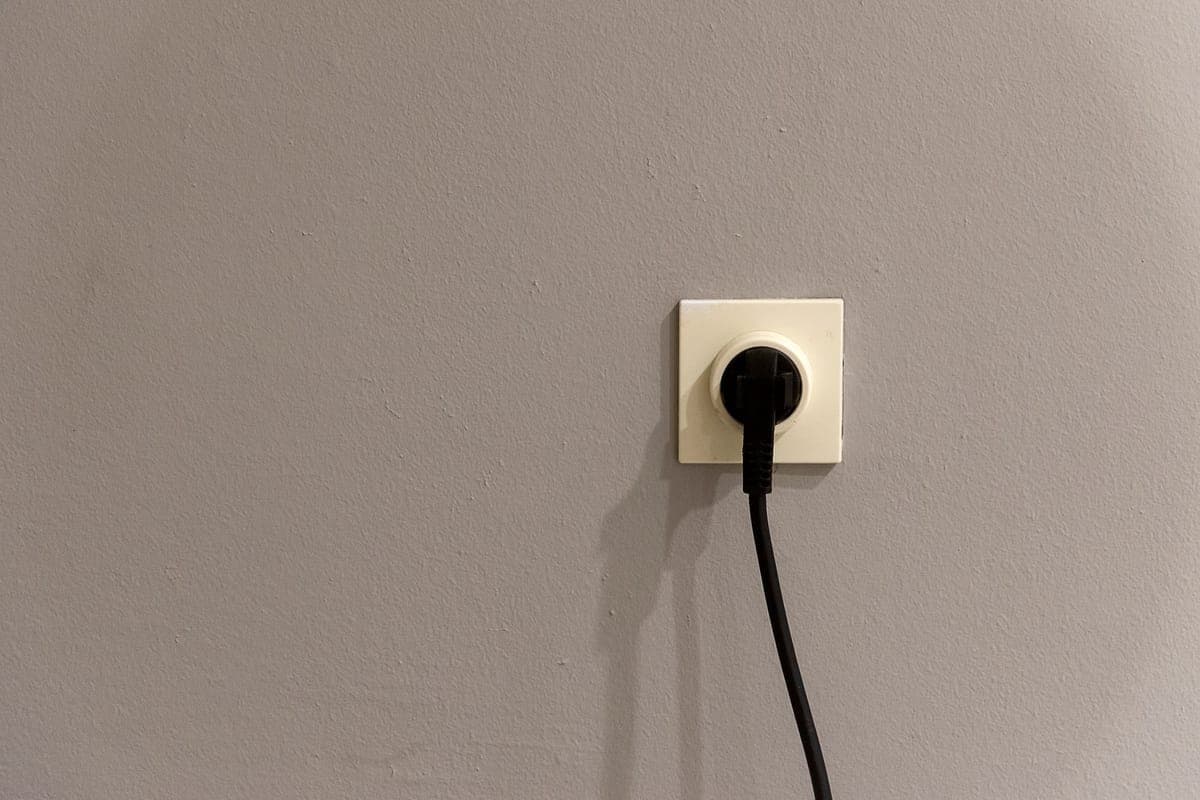
Every cable leaving the tank should hang below the level of the socket before it rises to it. Water runs down a cord and stops at the lowest point; if that point is a loop in the air, it drips on the floor, and if it is the socket, it does not. This is the cheapest safety measure in the hobby and it takes ten seconds.
Beyond that: a power strip mounted on the wall rather than sitting on the floor behind the stand, and a GFCI outlet if the room has one. An aquarium is a bucket of conductive water with four mains appliances in it, and the drip loop is what keeps that sentence uninteresting.
If the tank is already too hot
Unplug the heater first - not last. Then take the lid off, aim a fan across the water surface, and float a sealed bag or bottle of cool water in the tank. Do not pour cold water in: a nano tank has so little thermal mass that you will overshoot in the other direction and swap one problem for another. Aim to come down a couple of degrees an hour rather than all at once, and watch the thermometer, not the clock.
If the tank is running too cold
Cold is the more common complaint and it is usually not the heater’s fault. Work through it in this order.
- Check the thermometer position. A probe sitting in the filter outflow reads warmer than the tank; one buried in substrate reads colder. Mid-water, far end, is the honest spot.
- Check the room at 3am, not at 8pm. Our sizing works off the coldest the room gets, and most people size against the number on the thermostat during the day. If the overnight low is 62°F rather than 68, your heater is not undersized by a little, it is undersized by 9.0 watts.
- Fit a lid. Evaporation is the largest single heat loss in an open-top nano tank, and a lid is a one-time purchase that typically buys back a degree or two permanently.
- Move the tank. Off the exterior wall, away from the window, and not directly under a heating vent either - a vent blowing warm air at the glass makes the temperature swing rather than sit, and swings are what stress fish.
- Then, and only then, look at wattage. If the lift you need is more than the 12°F Fluval publishes as a single-heater ceiling, the answer is a warmer room or two heaters, not one large one.
Two heaters instead of one
From about ten gallons upward, splitting the load is genuinely safer arithmetic. Two heaters at half the wattage mean a stuck thermostat has half the power to work with, and a dead thermostat leaves you with half your heat rather than none. Below ten gallons there is rarely physical room for two, and the wattages involved are small enough that it buys you little.
The other option at that size is an external controller: a probe in the tank and a relay on the socket, with the heater set a couple of degrees above the controller’s target so the controller is the thing doing the switching. It is the only arrangement here that puts a second independent thermostat between your fish and a failure, and it costs about as much as the heater does.
What a heater guard is and is not for
Guards exist mainly for large fish that rest against a heater long enough to burn, and for tanks where a heater can be knocked into the glass. A betta is too small to injure itself on a nano heater. In a 5-gallon a guard costs you display volume you do not have, and it does nothing whatsoever about the failure mode that actually matters, which is electrical rather than mechanical.
What we cannot tell you
Which brand sticks on most often, how long any of these hold calibration, or whether a given unit’s dry-run cutoff works when it is three years old. Those questions need a lot of heaters and a lot of years. We have neither, so this page is about arrangement and habit - the parts you control.
What we would buy for this
Chosen from the same registry as our roundups, on published specifications and the arithmetic they imply - not on testing we have not done.
Fluval P25 Submersible Heater, 25W
The default answer for a 5-gallon betta tank, and the reason the folk rule of thumb happens to land in the right place. Our sum for a 5-gallon in a normal US room - 68F, Aquarium Co-Op's published figure for a typical American house - is 15.1W. Nothing is sold at 15W. The next size up is 25, and that is the P25.
Skip it if: You want to run a degree cooler in summer or warmer for a sick fish. This is preset; buy the adjustable if you want a dial.
EHEIM Jager Aquarium Thermostat Heater, 50W
Sold in the US as the Jager and in EHEIM's own catalog as the thermocontrol 50, and it is the only adjustable heater in this size class we found that publishes a control accuracy. EHEIM states plus or minus 0.5C, a 25 L recommended volume with a 60 L ceiling, a 243 mm body and an automatic dry-run cutoff. That is more of the specification than anyone else in the nano class prints, and it is why this outranks the other adjustables here despite being the longest heater on the page.
Skip it if: The tank is a short 5-gallon. At 243 mm the body is most of the water column, and EHEIM's own recommended volume starts at 25 L.
Frequently asked
Can an aquarium heater catch fire?
The realistic electrical risks in a home aquarium are a failed seal letting water into the element, and water tracking down a cord into a socket. Both are addressed by the same two habits: a drip loop on every cable, and switching off at the wall before your hands go in the tank. Replace any heater whose body is cracked or whose seal looks compromised rather than running it one more month.
How do I know if my heater is stuck on?
The thermometer reads above the set point and keeps climbing, and the heater’s indicator light stays on continuously rather than cycling. That is why the thermometer goes at the far end of the tank and why you look at it daily - the indicator light alone tells you what the heater thinks it is doing, not what the water is doing.
Should I unplug the heater during a water change?
Yes. Switch it off before you start, and leave it a few minutes after refill before switching back on so the body and the new water equalize. Even on heaters that publish a dry-run cutoff, this costs nothing and removes the whole category of problem.
Is a preset heater safer than an adjustable one?
It has one fewer thing to set wrong, which is a real advantage for a betta whose target temperature never changes. It is not safer against the failure that matters - a preset thermostat sticks on exactly like an adjustable one. The trade-offs are in preset versus adjustable.
My betta tank is 72 degrees. Is that dangerous?
It is not an emergency, but it is the bottom of the range and not somewhere to live. Our target is 78°F. What happens at each end of the range sets out the published guidance; the fix here is usually a lid and a correctly sized heater rather than a bigger one.