We earn a commission if you buy through the links on this page, at no extra cost to you. It never changes a ranking, and there are products recommended here with no affiliate link behind them at all. Full disclosure.
The short answer
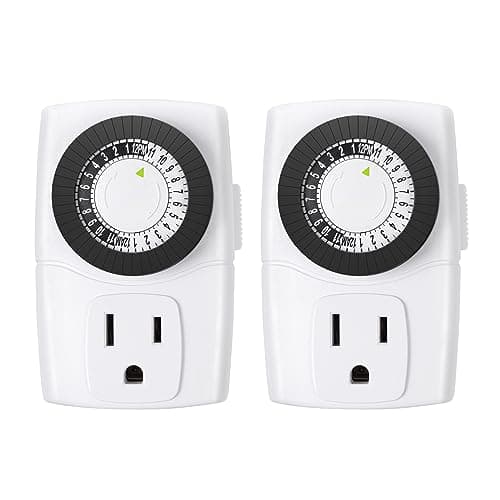
Buy the mechanical dial. A 24-hour outlet timer with pins on a ring costs a fraction of any light fixture, has no firmware and no account, and BN-LINK publishes both its full electrical rating and its 30-minute resolution - finer than a photoperiod needs. For most nano tanks this is the end of the decision.
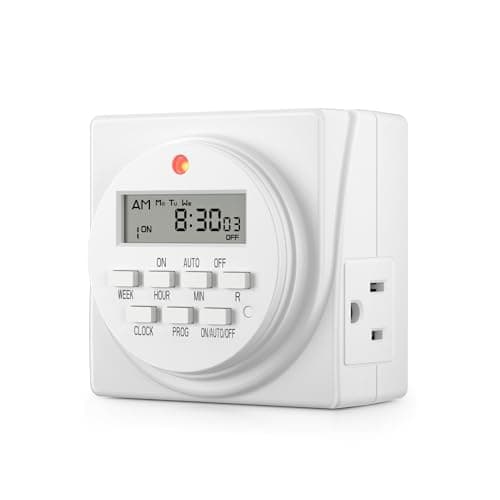
Buy the digital one instead if your power goes out. That is the single real difference between the two: BN-LINK publishes a backup battery on the digital unit that holds the schedule through an outage, and publishes no battery at all on the mechanical one. A mechanical dial stops turning while the power is off and then runs exactly that far behind for good, silently, until you happen to look at it.
Buy nothing if your light already schedules itself. Check this first, because a large share of the people searching for this already own the answer.
Check what you own before you buy anything
Programmable scheduling is now standard on mid-range aquarium LEDs, and it is strictly better than an outlet timer because it can ramp rather than just switch. Fluval publishes that the Plant 3.0 Nano is operated exclusively through its app with a programmable 24-hour cycle covering sunrise, midday, sunset and night. If you own that fixture, or any light with a built-in schedule, an outlet timer adds nothing except a second thing that can be wrong.
Two cases where you do need one anyway: a light with a physical switch and no program at all, which is most kit lights and most budget clip-on fixtures; and a tank where you want the light and something else - a second fixture, a small circulation pump - switching together on one schedule.
One thing never goes on a timer
Never put the heater on it. A heater switched off for hours every night means a tank that swings through the exact temperature range we spend a whole page warning about. A heater already has a thermostat; what it sometimes needs is a second, independent one, which is a controller and not a timer. The distinction is not pedantic - a timer interrupts power on a clock, a controller interrupts it on a temperature.
What the photoperiod actually buys you
The reason this cheap accessory outranks a better light: in a tank this size the length of the lit period controls algae more reliably than the intensity does. Algae and plants both want light, but plants win on consistency and algae wins on excess. A fixed period, the same every day, is the one variable you can set once and stop thinking about.
We run six to eight hours a day, and we label that as our judgment rather than a published figure. We went looking for a photoperiod published by a major betta or nano care publisher and did not find one, which is recorded on the lighting page as an absence rather than papered over. Eight hours is where we start a planted tank; six is where we go when algae appears before we touch anything else.
The fish, incidentally, does not care much. A betta has no published light requirement and does not need a fixture to be healthy. The light is for the plants and for you being able to see the tank - the plants are what the schedule is for.
How we judged these
- 01
What happens in a power cut
The differentiator, and the one most buyers never think about. A schedule that silently shifts by three hours after an outage is worse than no schedule, because you will not notice until the algae does.
- 02
Resolution, against what a photoperiod needs
You are setting one on and one off, at the same clock times, forever. Thirty-minute steps are already finer than that requires. Anything selling you one-minute precision is selling you a feature this job does not have.
- 03
What the maker publishes
Volts, amps, watts, the number of programs and the switching resolution. A timer is an electrical device carrying a load in a room with water in it; a maker that will not print its rating is not a maker we rank.
- 04
How little it asks of you
Every account, app, firmware update and network dependency is a way for the light to be on at three in the morning. Simplicity is a specification here, not an aesthetic.
Mechanical against digital, on published figures
| BN-LINK mechanical | BN-LINK digital | Kasa EP10 |
|---|
| Published rating | 125 V, 15 A / 1875 W | 115 V, 15 A / 1725 W | 15 A / 1800 W |
| Resolution | 30 minutes | 1 minute | App schedule |
| Programs | Up to 24 on/off daily | Up to 8 on/off | Not published as a count |
| Power-cut behavior | Not published; dial stops | Backup battery keeps settings | Not published |
| Outlets | 1 each, 2 in the pack | 2, switched together | 1 each, 2 in the pack |
| Needs a network | No | No | Yes - 2.4 GHz Wi-Fi |
| Certification published | Not stated on the product page | UL listed | Not stated in the specs we read |
Read that table as one argument: the mechanical timer wins on simplicity and on headline rating, the digital one wins on the only failure mode that actually happens, and the smart plug wins on nothing that is specific to an aquarium.
The drift problem, spelled out
A mechanical outlet timer is a small synchronous motor turning a dial. The motor runs on mains power, so when the power stops the dial stops with it. When the power comes back the motor starts again from wherever the dial happened to be - which is now behind real time by the length of the outage, and stays behind permanently.
A two-hour outage moves your eight-hour photoperiod two hours later, every day, until you notice. A handful of those across a year and the tank is being lit in the evening on a schedule you set for the morning. This is mechanism rather than a published specification, and we are labeling it as such - but it follows directly from how the device works, and BN-LINK publishes no backup battery for this model to prevent it.
The digital unit is the fix, and it is the only reason to prefer it. Everything else it offers - seven-day scheduling, a random vacation mode, Daylight Savings - is aimed at lamps in an empty house. An aquarium wants the identical schedule every single day of the year, including the ones you are away for.
The smart plug, and the specification nobody publishes
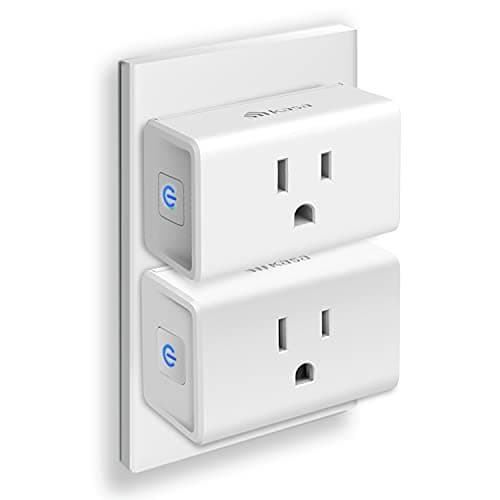
The Kasa EP10 is a good product being asked to do a job beneath it. TP-Link publishes 15 A and 1800 W, an operating range of 0 to 40 degC, 2.4 GHz Wi-Fi with no hub required, and scheduling in the app. All of that is fine.
What TP-Link does not publish, anywhere we could find, is what a saved schedule does when the Wi-Fi or the internet connection goes away. For a plug whose entire purpose is switching at a fixed time, that is the specification we most wanted and the one we could not get. We are not going to assert that it keeps running, and we are not going to assert that it does not. We are recording that it is not published, which is the same thing we do when a filter maker will not print a flow rate.
So: if Kasa is already in your house and the app is already on your phone, adding the tank light is free and the convenience is real. If this would be your first smart plug, you are adding an account, an app and a network to a job a dial does for less.
Inline controllers, and why one probably will not fit
There is a fourth category the search results will push at you: aquarium-specific inline controllers that sit between an LED light and its power supply, dimming it and ramping it through a simulated sunrise. NICREW makes the common ones. They are genuinely nicer than switching a light hard on and off, because a fish and a tank of plants get a gradual transition rather than a lighting change like a camera flash.
The catch is fitment, and it is absolute. These controllers connect on the light’s low-voltage barrel plug, so they work only with a fixture wired that way and within the controller’s voltage and current limits. A mains-powered fixture, a light with an integrated driver, or a barrel plug of the wrong diameter will not work at all. We are not listing one as a pick because we could not extract a readable published specification sheet for the current model from NICREW - only the marketing copy - and we do not recommend products we cannot describe from published figures. If you want to go this route, check your light’s connector and voltage against the maker’s own documentation before ordering anything.
Setting it, once
- 01
Pick the hours you are actually home
Nothing about a plant cares whether the eight hours run morning or evening. You do. Set the period so it overlaps the time you look at the tank, and the light stops being a chore you resent.
- 02
Start at eight hours, not more
Eight is a full period for the low-light plants a nano tank should be running. Longer does not grow them faster past a point; it grows algae.
- 03
Cut to six before changing anything else
When algae appears, shorten the photoperiod and feed less first. Both are free, both act on the actual cause, and both are reversible.
- 04
Write the schedule somewhere
On the timer, on the lid, in your phone. It is the one setting you will never remember and the one you need to compare against when the tank changes.
One more thing worth doing at the same time: get the tank out of direct sun. A timer controls the fixture and has no authority whatsoever over a window, and a tank sitting in afternoon sunlight is running a photoperiod you did not set - which is a recurring cause of green water and cloudiness.