We earn a commission if you buy through the links on this page, at no extra cost to you. It never changes a ranking, and there are products recommended here with no affiliate link behind them at all. Full disclosure.
The answer first
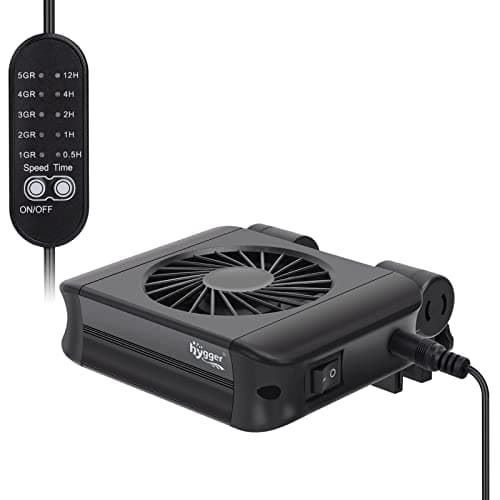
Buy a clip-on fan. On a tank under about twenty gallons an evaporative fan is the correct answer and a chiller is not, and it costs roughly a tenth as much. The hygger single-head fan is 2.2 watts, has five speeds and a real timer, and clips to glass up to 11 mm thick. It is the first thing to try and it resolves almost every case of a nano tank running a few degrees warm in summer.
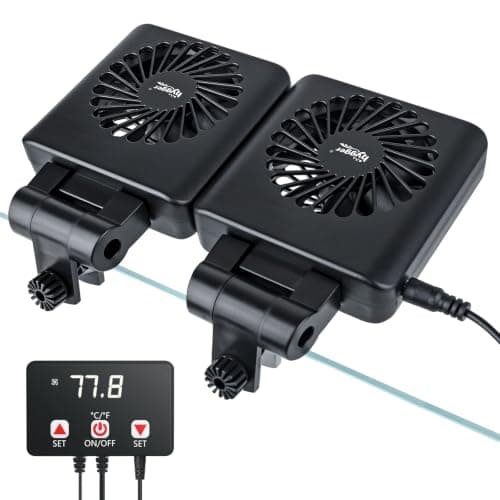
Pay for the temperature-controlled version if the fan has to run while nobody is home. A manual fan keeps cooling after the room has cooled, and on 4.3 gallons of water with no thermal mass that turns a heat problem into a swing problem - which is worse for the fish than being a degree warm. hygger rates that model from 10 gallons up.
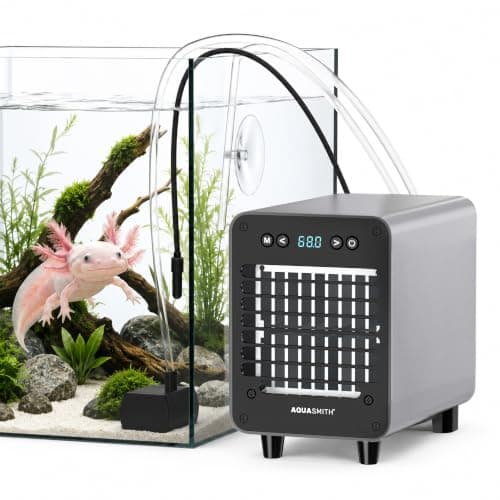
A chiller is right in one narrow case: a tank that still will not come down with the top open and a fan running. That is usually a humid room, where evaporation has nowhere to go. A thermoelectric chiller removes heat instead of relying on evaporation, works under a closed lid, and costs more than most complete setups recommended on this site.
If the tank is dangerously hot right now
This page is about the purchase. The emergency protocol - unplug the heater first, lift the lid, aim a fan across the surface, float a sealed bottle of cool water, and come down a couple of degrees an hour rather than all at once - is on the heater safety page, and it needs no equipment you do not already own.
How we judged these
- 01
Does the maker publish how many degrees it drops?
This is the specification you are buying and essentially nobody publishes it. hygger's manual explains the mechanism and stops short of a figure; the listings in this class claim 3-7F, and that claim is not traceable to any manufacturer spec sheet. We mark the absence rather than repeating the number.
- 02
Does it stop on its own?
On a nano tank this matters more than raw cooling power. Overshoot is a real risk when the water volume is small and the fan is still running at 3am, so a thermostat is worth more here than another speed setting.
- 03
Is it rated for a volume, in gallons?
A published tank range is the only way to tell whether a model suits a 5-gallon or a 25. hygger publishes ranges on the controlled models; the chiller publishes none at all, which is remarkable on a product at that price.
- 04
What does it cost against the tank it cools?
Not a specification, and the most decisive criterion on the page. A cooling device that costs several times the aquarium is a bad purchase even when it works perfectly, and that is why the chiller is ranked third rather than first.
- 05
What does it do to the rest of the setup?
Evaporative cooling needs an open surface and drops the water line. That interacts with the lid, the heater and the top-up routine, and nobody selling a fan mentions it. The section below does.
The mechanism, and the trade-off nobody mentions
An aquarium fan does not blow cold air at the water. It accelerates evaporation from the surface, and evaporation carries heat away - the same reason a wet towel feels cold. Three consequences follow, and all three are things a buyer should know before the fan arrives.
- It needs an open or vented top. A sealed glass lid is exactly what evaporative cooling cannot work through. This site recommends fitting a lid for the opposite reason - it is the cheapest degree of heat you will ever buy in winter - so the honest position is that a lid is a seasonal decision rather than a permanent one. Lid on in winter, lid off or propped in summer.
- The water line drops, and faster than you expect. On 4.3 gallons, visible evaporation within two days is normal with a fan running. Top up with dechlorinated water, not with what comes out of the tap, and top up before the heater is anywhere near the surface.
- Evaporation concentrates whatever is dissolved. Water leaves; minerals, nitrate and any salt you have added do not. That is a slow effect rather than an emergency, and it is the reason a fan running all summer wants the normal water-change schedule kept rather than relaxed.
It also means a fan does almost nothing in a humid room. Evaporation needs somewhere for the moisture to go, and in a bathroom in August there is nowhere. That, not raw power, is the real case for a chiller.
The figure nobody publishes
We went looking for a published temperature drop and there is not one. hygger publishes voltage, wattage, five speed levels, timer steps of 0.5, 1, 2, 4 and 12 hours, 180 degrees of airflow adjustment and an 11 mm clip rating - a reasonably complete sheet by the standards of this category - and no degrees. No CFM or m/s airflow figure either, at any speed.
Retail listings in this class do print a figure: three to seven degrees Fahrenheit. We cannot trace it to a manufacturer specification, it is the same range on products from four different brands, and the physics says the real answer depends on humidity, air movement in the room and surface area - none of which the seller knows. So we record it as a listing claim and not as a specification, the same way we treat a nano filter that will not publish a flow rate.
The practical substitute for a published figure is a thermometer that publishes one. An inexpensive digital thermometer stating +/- 0.5F tells you what your fan actually achieves in your room within a day, which is better information than any manufacturer could give you anyway.
Fan against chiller, as published
| Clip-on fan | Thermoelectric chiller |
|---|
| How it cools | Evaporation from the surface | Active heat removal |
| Works under a closed lid | No | Yes |
| Works in a humid room | Poorly | Yes |
| Published degrees of cooling | Not published | Not published |
| Published tank-volume rating | On the controlled models (10-25 gal) | None published |
| Power draw | 2.2 W | Not published; far higher |
| Also needs | Nothing | A circulation pump, tubing, bench space |
| Effect on water level | Drops it - top up every few days | None |
| Cost against a 5-gallon setup | A fraction of it | Several times it |
Read the fourth row carefully: neither category publishes what it actually achieves. The difference is that the fan costs seventeen dollars, so buying it on an unpublished claim is a cheap experiment, and the chiller costs a hundred and seventy, so buying it on one is not.
Before you buy anything, four free degrees
Most nano overheating is the room, the light or the lid rather than the weather, and three of those are free to change.
- 01
Move the tank out of the sun
A nano tank in a window picks up heat through the glass all afternoon and gives it back all evening. This is the single largest free change available, and it also reduces algae.
- 02
Lift the lid, or prop it
The same lid that buys a degree or two in winter traps it in summer. Propping it open an inch restores evaporative cooling without giving a jumping fish an exit the size of the tank.
- 03
Raise the light off the glass, or shorten the photoperiod
A fixture sitting directly on a closed lid conducts heat straight into the water. Standing it on the rim rather than the glass, or running it in the cooler part of the day, is free. The light-timer page covers scheduling it.
- 04
Check whether the heater is cycling when it should not be
A thermostat that has stuck on is an overheating cause rather than a victim of one, and it is the first thing to rule out before buying a cooling device. The heater safety page covers how that fails.
If all four are already done and the tank still sits above the range on the temperature page, buy the fan. If the fan is running at full speed with the top open and the tank still will not come down, that is the chiller case, and it is the only one.
What we cannot tell you
How many degrees any of this will drop your tank. Nobody publishes it, the answer genuinely depends on the humidity and air movement in your room, and a figure invented here would be no better than the one on the listing. Buy the cheap thing, measure it with a thermometer that publishes its tolerance, and you will have a number for your room - which is the only room that matters.
We also cannot tell you what volume the chiller is rated for, because AQUASMITH does not publish one. On a device whose entire purpose is to hold a set point against a thermal load, the absence of a rated volume is the specification gap that matters most, and it is a large part of why it is ranked third.