We earn a commission if you buy through the links on this page, at no extra cost to you. It never changes a ranking, and there are products recommended here with no affiliate link behind them at all. Full disclosure.
The short answer
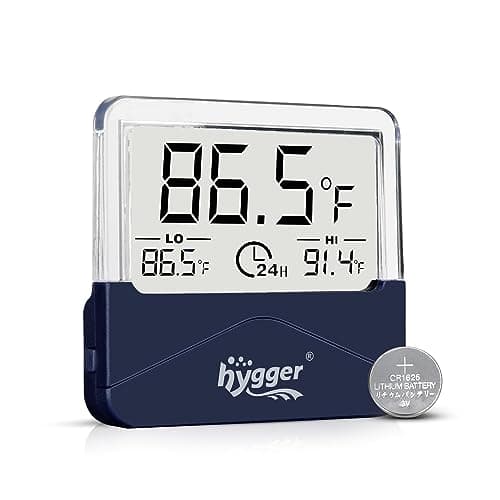
Buy the hygger digital thermometer. It is the only one in this category we could find that publishes a measurement deviation - plus or minus 0.5 degF - and it records the high and low over the previous 24 hours. Those two properties are the entire reason to own a thermometer separate from the heater.
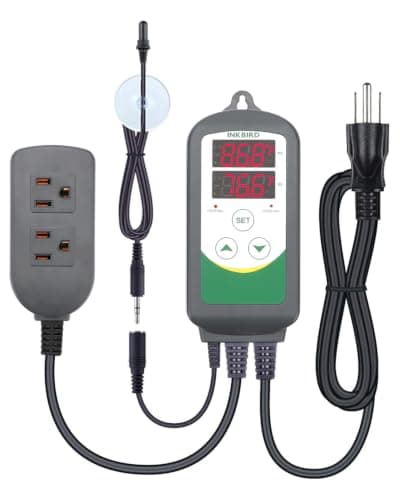
Buy the Inkbird controller instead if you want the reading to do something. A thermometer tells you the heater failed. A controller cuts the power when it does. They are different purchases and we have a whole page on which one you actually need.
Do not rely on the heater’s own dial. This is the part most people get wrong, and it is worth a section of its own.
A dial is a setting. A thermometer is a measurement.
Set an adjustable heater to 78 degF and you have told it what to aim for. You have not learned what the water is. The gap between those two things is the heater’s control accuracy, and here is what the makers in our registry actually publish:
| Device | Published accuracy | What it is |
|---|
| hygger digital thermometer | Plus or minus 0.5 degF | A measurement |
| EHEIM Jager / thermocontrol | Plus or minus 0.5 degC (about 0.9 degF) | A control accuracy |
| Inkbird ITC-308S controller | Plus or minus 1 degC (about 1.8 degF) | A control accuracy |
| Fluval P Series preset heaters | Not published | A factory setting |
| Aqueon preset heaters in LED kits | Not published | A factory setting |
Read the top two rows together, because they are the argument. A twelve-dollar-ish stick-on thermometer publishes a tighter figure than the best heater in this registry publishes for its own thermostat. That is not a criticism of EHEIM - controlling a temperature is a harder problem than reading one - but it does mean the dial cannot be your source of truth.
The preset heater case is worse
Fluval and Aqueon both sell preset heaters with no user-adjustable setting and no published control accuracy at all. If you own one, a thermometer is not an accessory - it is the only way you will ever know what the factory setting is doing in your room. We recorded that absence when we wrote the preset versus adjustable comparison and it is the single strongest reason on this page to own one of these.
Why the 24-hour record is the feature that matters
A thermometer you glance at in the evening tells you the temperature in the evening. The failures worth catching do not happen then.
The temperature in a room falls overnight - that is when the heating goes off, when the window is coldest and when a small volume of water loses heat fastest. Our wattage arithmetic is built on exactly that: 5 US gal rated, less 15% for substrate and fill line, is 4.3 gal of water. A 78F target minus a coldest-room 68F is a 10F lift. 4.3 x 0.35 x 10 = 15.1W required. Nothing is sold at 15.1W, so the answer is the 25W. If the room actually drops further than you assumed, the heater runs longer than you planned, and the first sign is an overnight low you were asleep for.
A 24-hour high and low record turns that into something you can read with your coffee. Two numbers, every morning, for the cost of nothing extra. It is also how you catch the opposite failure - a stuck-on heater that is climbing - well before it becomes the emergency the safety page describes.
How we judged these
| Criterion | Why it is on the list |
|---|
| A published accuracy figure | The whole point of the device. A thermometer that will not state its deviation is asking to be trusted on faith, and most of this category does exactly that |
| Records a high and a low | The failure you need to see happens while you are asleep. A live reading alone cannot show it to you |
| Nothing extra in the water | An external sensor means one less object, one less cable and one less thing to knock over in a tank measured in inches |
| Readable in Fahrenheit | Every figure on this site is Fahrenheit because the audience is American. A unit switch is not a luxury, it is the difference between using the thing and translating it |
The two formats we did not pick, and why
Liquid crystal strips. The adhesive strip on the outside of the glass costs almost nothing and reads in coarse bands. No maker we found publishes an accuracy figure for one, and a band-based readout cannot show you a two-degree overnight drift even in principle. It is better than nothing and it is not a measurement.
Glass alcohol thermometers. Genuinely accurate, genuinely readable, and a glass tube on a suction cup inside a tank measured in inches. It takes up swimming room, the suction cup fails eventually, and when a glass thermometer breaks it breaks in the tank. We would not put one in a nano.
Neither is a disaster. Both lose to a stick-on digital unit that publishes its deviation and remembers the overnight low.
Using it properly
- 01
Mount it away from the heater
Opposite end of the tank from the heating element, and not directly in the filter outflow. You want the temperature of the tank, not of the water leaving the heater.
- 02
Give an external sensor time to settle
A stick-on unit reads through the glass. Fit it, leave it an hour, then trust it. A reading taken thirty seconds after mounting is reading the room.
- 03
Read the high and low, not just the live number
The live number tells you the tank is fine now. The pair of recorded numbers tells you whether it was fine all night, which is the question.
- 04
Check it against the heater dial once, then stop trusting the dial
Set the heater, wait a day, compare. Whatever the offset turns out to be, from then on the thermometer is the number and the dial is the input.
How these picks were chosen
Everyone in this category says they tested twenty tanks. We have not tested any, and we say so. What we did instead: read the manuals, compile the published specifications, compute the wattage and the turnover against the tank’s real water volume rather than its shelf label, and show the arithmetic so you can check it.
The full method, including what we refuse to claim.