We earn a commission if you buy through the links on this page, at no extra cost to you. It never changes a ranking, and there are products recommended here with no affiliate link behind them at all. Full disclosure.
The answer first
If your tank is a kit - a Fluval Spec, a Flex, a Marineland Portrait - you already have a lid and you need nothing from this page. Every nano kit this site recommends ships with a fitted top, usually carrying the light. Buying a flat glass canopy for one of them is a return, because they are not rectangular at the rim.
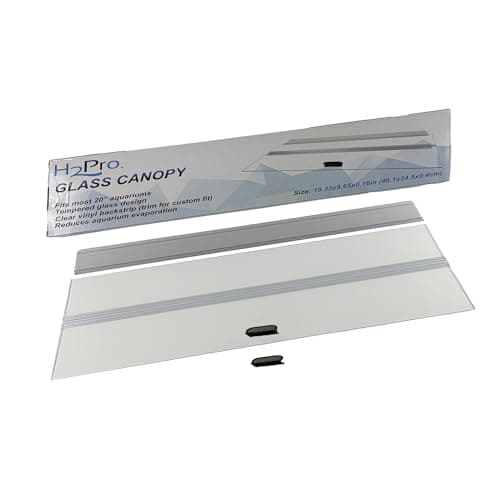
If your tank is a standard rimmed aquarium that came bare, buy a hinged glass top in the length that matches your tank, not the gallonage. A 5.5-gallon takes a 16 inch. A standard 10-gallon takes a 20 inch - and the H2Pro 20GT is worth the extra few dollars purely because its listing names the 10 gallon Aqueon and Marineland tanks outright instead of making you convert. A 20-gallon high takes a 24 inch.
It is worth it for three reasons at once, and one of them is the fish. Bettas jump. Evaporation is the largest single heat loss in an open-top nano tank. And a dropping water line on 4.3 gallons is a maintenance job every few days. One piece of glass addresses all three.
The sizing trap, stated plainly
Lids are sold in inches. Tanks are sold in gallons. A 20-gallon long and a 20-gallon high hold the same water and need different lids - 30 inches and 24 inches respectively - because one is spread out and the other is stacked up. Measure the inside of your tank’s rim, front to back and left to right, and buy to that. Retailers publish a caution that these tops may not fit tanks from other manufacturers, and it is a real caution: an eighth of an inch narrow inside the rim means the glass sits on top of the frame instead of in it.
How we judged these
- 01
Is the fit published, and in what unit?
This is the whole purchase. Aqueon publishes a size-to-tank chart, though you will find it at retailers rather than on a reachable Aqueon page. The H2Pro listing goes further and names the tank models it fits. Everything else in this category is a length and a hope.
- 02
Does it hinge?
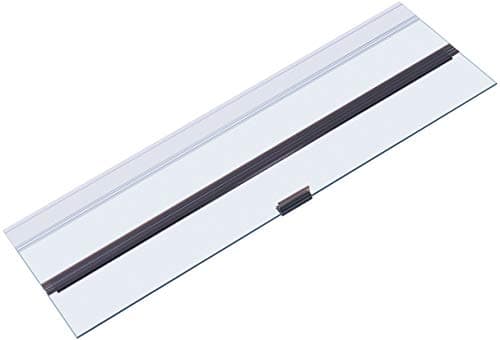
A one-piece top has to come off the tank to feed, which means it goes somewhere - and that somewhere is a dry surface, wet. A hinged front half lifts and stays attached. On a tank you open daily this is the difference between a lid you use and a lid in a cupboard.
- 03
Can the back strip be cut?
A heater cable, a filter intake and an airline all have to pass the rim. A lid whose back strip is designed to be trimmed sits flat; one that is not gets propped open by its own cables, which defeats the point. The vinyl strip on the Aqueon tops is meant to be cut with scissors.
- 04
Glass or acrylic?
Glass, in this one application. Thin acrylic above a light fixture yellows and bows over a couple of years, and a bowed lid does not seal. Our glass-versus-acrylic page argues the opposite way about tanks themselves, for different reasons.
- 05
Is the benefit quantified?
Never, by anybody. Every lid on the market claims reduced evaporation and jump prevention, and not one publishes a percentage or a degree. We mark that against all three picks equally.
Reason one: bettas jump
This is not a rare event and it is not a sign of a sick fish. A betta is a fish from shallow, seasonal water that moves between pools, and surface-oriented fish with that history jump. It happens most often when something startles the fish, when the water line is low enough that the gap to the rim is small, and when the tank is new.
Which makes a lid the only item on this site that prevents a specific, sudden, total loss. A heater failure gives you hours. An ammonia spike gives you days. A fish on the floor gives you minutes, and usually at night.
The practical note: it is the gaps that matter, not the glass. A lid with a two-inch cutout for a filter is a lid with a two-inch exit, and the usual fix is a piece of the trimmed vinyl strip or a square of plastic mesh over the gap. The corner notches that come cut for airline are small enough not to matter.
Reason two: the cheapest degree of heat you will ever buy
Evaporation is the largest single heat loss from an open-top nano tank - it costs energy to turn water into vapour, and that energy comes out of the water left behind. A lid cuts it, which is why our heater pages put “fit a lid” above “buy a bigger heater” in the order of fixes for a tank running cold.
Worth being precise about the size of the claim, though. No lid manufacturer publishes how many degrees it saves, or what percentage of evaporation it stops. Aqueon publishes that its tops reduce evaporation and keep fish from jumping out, and stops there. So does H2Pro. We have looked, on three product ranges, and there is no number on any of them. What is defensible: the mechanism is real, the fix is one-time, it costs between ten and forty dollars, and it is the right thing to try before a larger heater on a tank whose room genuinely sits cold.
Our sizing arithmetic is built on a published Fluval ceiling of 12F of lift for a single heater, and the honest consequence is that a lid is not a substitute for a correctly sized heater. It is the step that stops you oversizing one.
Reason three: the water line, and what topping up does
A rated 5-gallon holds about 4.3 gallons of actual water. Open-topped in a dry heated room, the line drops visibly within a week, and two things follow that are easy to miss.
- Evaporation concentrates. Water leaves; nitrate, minerals and any salt you have dosed stay. Topping up is not a water change and does not reduce anything.
- A falling line exposes equipment. A heater running with its element above the water line is the failure mode the safety page is most concerned with, and a hang-on-back whose intake breaks the surface starts making the noise the filter noise page opens with.
A lid does not remove the need to top up. It turns it from a twice-weekly job into a fortnightly one.
The one argument against a lid, and it is a real one
A lid blocks evaporative cooling, and evaporative cooling is how a nano tank survives a hot week. The cooling page works through this properly; the short version is that a clip-on fan cools by accelerating evaporation from the surface, and a sealed glass top is precisely what it cannot work through.
So the honest position is that a lid is a seasonal decision rather than a permanent one. On in winter, propped open an inch in summer - which keeps most of the jump protection while restoring the airflow. That is also the reason a hinged lid is worth more than a one-piece: propping a hinged top is a thirty-second adjustment, and propping a loose sheet of glass is an accident waiting for somebody to lean on it.
The second argument against is light. A glass top between the fixture and the water loses some output and collects a mineral film that loses more, so a planted tank running at the lower end of what plants need may notice. The fix is wiping the underside of the glass when you clean, not going lidless.
Which lid for which tank
| Tank | Lid length | Notes |
|---|
| Any nano kit (Fluval Spec / Flex, Marineland Portrait) | None - it has one | Curved or rimless edges; a flat canopy will not seat |
| 5.5 US gal standard | 16 inch | The smallest size this site recommends for a betta |
| 10 US gal standard (20" x 10") | 20 inch | The H2Pro 20GT states the Aqueon and Marineland fit outright |
| 15 or 20 US gal high | 24 inch | Published actual size 23.25" x 11.125" |
| 20 US gal long | 30 inch | Same gallons as the 20 high, six inches more lid |
| Rimless or curved-front tank of any size | Cut to order, or mesh | No stock canopy fits; a glazier will cut polished glass to a template |
What we cannot tell you
How much a lid saves. Not in degrees, not in percent of evaporation, not in watts of heater you can go down by. Nobody publishes any of it, on any product in the category, and inventing a figure would make this page worse rather than more useful. What the makers do publish is the claim and the fit; what we can add is the arithmetic of the volume and the order to do things in.
We also cannot tell you that a given lid fits your tank. The chart is published by tank size in the abstract, retailers publish an explicit caution about other manufacturers, and the only reliable measurement is the one you take inside your own rim before ordering.