Betta tank setup, in the order that works
The fish is the last thing you buy, three to six weeks after the tank. Everything else here follows from that one decision.
We earn a commission if you buy through the links on this page, at no extra cost to you. It never changes a ranking, and there are products recommended here with no affiliate link behind them at all. Full disclosure.
The one rule
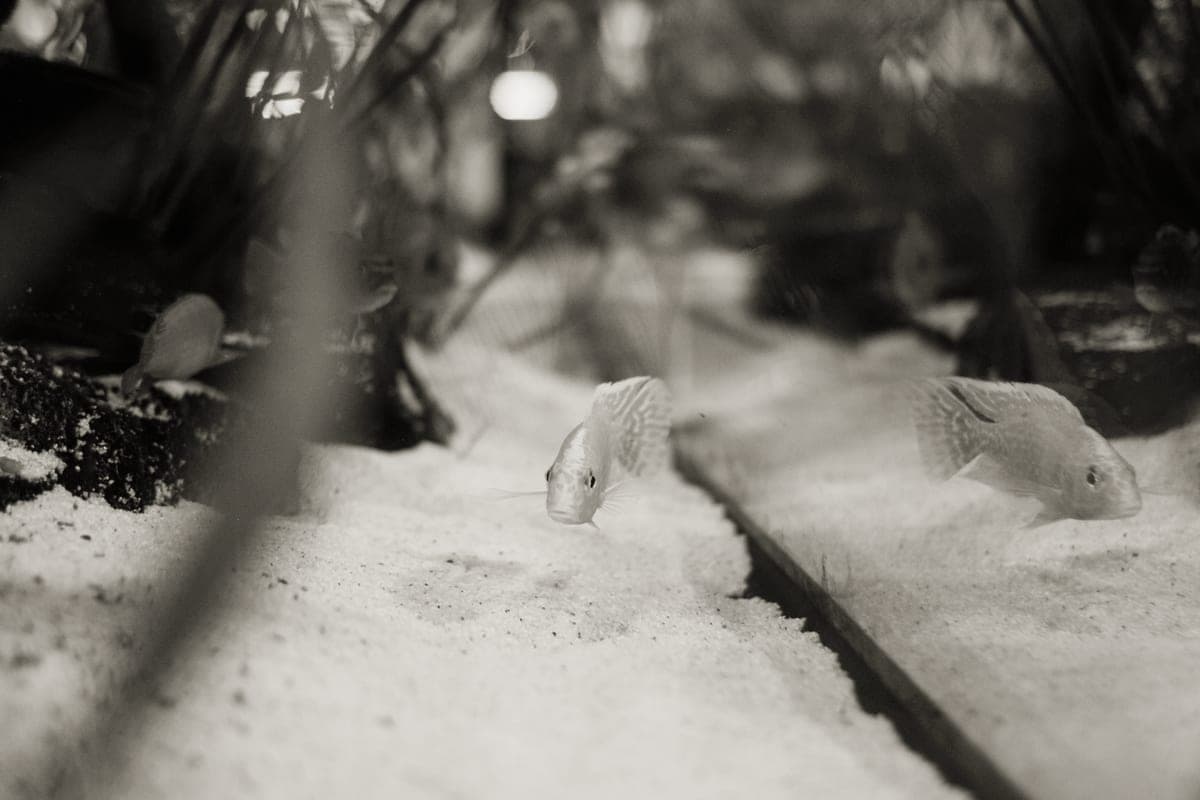
The fish arrives last. Three to six weeks after the tank, after the filter has grown a bacterial colony that can process ammonia. Every other decision on this page is downstream of accepting that wait.
If you have already bought the fish - which happens, and is not a moral failing - skip to the cycling page and read the section on cycling with a fish already in the tank. It is harder and it involves daily testing, but it is survivable.
The shopping list, with the numbers already worked out
Assuming a rated 5-gallon, which holds 4.3 gallons:
| Item | What size, and why |
|---|---|
| Tank | 5 US gal minimum, and prefer length - why |
| Heater | 25W at a 68°F room. 5 US gal rated, less 15% for substrate and fill line, is 4.3 gal of water. A 78F target minus a coldest-room 68F is a 10F lift. 4.3 x 0.35 x 10 = 15.1W required. Nothing is sold at 15.1W, so the answer is the 25W. |
| Thermometer | Glass, in the water, at the far end from the heater |
| Filter | Target about 17.2 GPH, ceiling 25.8 - the picks |
| Substrate | About 2.1 kg for a 19.5 x 6.5 inch footprint at one inch, using Fluval’s published formula |
| Dechlorinator | Seachem publishes 5 mL per 50 US gal, so a 5-gallon fill is about 0.5 mL. Buy a 1 mL syringe |
| Liquid test kit | Ammonia, nitrite, nitrate. Not strips |
| Plants and hardscape | Anubias or java fern tied to wood. Cover is functional, not decorative |
The order
- 01
Site the tank before you fill it
A filled 5-gallon weighs about 50 lb; a 10-gallon about 100. Put it somewhere level, out of direct sunlight (which grows algae faster than any light you own), off an exterior wall if your room gets cold, and near an outlet. Once filled it does not move.
- 02
Rinse the substrate, then add it
Rinse in a colander until the water runs mostly clear - Seachem says Flourite needs this despite being pre-washed, and Fluval says to rinse Stratum gently without agitating it. About an inch deep, sloping slightly up toward the back if you want depth. Do not rinse soil substrates aggressively; they break down.
- 03
Hardscape next, plants after
Wood and rock go in before water, because you will move them several times. Tie anubias and java fern to the wood with cotton thread or superglue gel - never bury the rhizome, which is the most common way to kill both.
- 04
Fill slowly, onto a plate
Put a saucer or a plastic bag on the substrate and pour onto that. Filling straight onto substrate excavates it and clouds the tank for days. Fill to about an inch below the rim - a betta jumps, and that gap is the margin.
- 05
Dechlorinate
Seachem publishes 5 mL of Prime per 200 L / 50 US gallons, so a 5-gallon fill needs about 0.5 mL. Use a 1 mL syringe. A capful in a nano tank is a ten-times overdose - not dangerous, Seachem states overdosing is safe, but wasteful and loosely measured.
- 06
Install heater and filter, then leave it running
Heater in the rear chamber if the tank has one, otherwise horizontal along the back glass just above the substrate. Filter in, flow turned down. Turn both on and check the thermometer the next morning - this is when you find out whether your heater is sized right, and the answer costs nothing while the tank is empty of fish.
- 07
Cycle the tank. This is the part you cannot skip
Three to six weeks of dosing ammonia and testing. The full procedure, with Seachem’s published Stability schedule. You are finished when the tank processes an ammonia dose to zero ammonia and zero nitrite within 24 hours.
- 08
Then, and only then, buy the fish
Buy from a shop where you can look at the fish first. Float the bag to match temperature, then drip acclimate or add small amounts of tank water over half an hour. Do not tip the shop water into your tank. Lights off for the first evening.
Use the waiting time
The cycling weeks are when you find out what your tank actually does: how far the temperature drops overnight, how fast it evaporates, whether the flow is too strong, whether the light grows algae at eight hours. Every one of those is far easier to fix before there is a fish in the tank depending on the answer.
The four mistakes this order prevents
- Fish first. The tank cycles around the animal instead of before it, and the animal absorbs the cost.
- Filling before hardscaping. You will rearrange it. Do that dry.
- Discovering the heater is undersized in January. Test it in week one, empty.
- Rinsing filter media under the tap. Ever. Chlorine kills the colony you spent a month growing. Media rinses in old tank water, in a bucket.
What we would buy for this
Chosen from the same registry as our roundups, on published specifications and the arithmetic they imply - not on testing we have not done.
Fluval Spec V Aquarium Kit, 5 US Gal
The one nano kit whose published numbers all point the same way. Nineteen and a half inches of length in a five-gallon footprint is the whole argument: a betta swims horizontally, and this is the only kit at this volume that gives it a long tank instead of a tall one. The rear chamber hides the pump and media, the 821-lumen LED is enough for low-light plants, and the pump's 55-80 GPH is far too much flow for a betta straight out of the box - which is a solvable problem, not a dealbreaker.
Skip it if: You will not baffle the outflow. At 55-80 GPH into 4.25 gallons of water this runs 13-19 turnovers an hour, three times our 4x target, and a long-finned betta will spend its life fighting it.
Fluval P25 Submersible Heater, 25W
The default answer for a 5-gallon betta tank, and the reason the folk rule of thumb happens to land in the right place. Our sum for a 5-gallon in a normal US room - 68F, Aquarium Co-Op's published figure for a typical American house - is 15.1W. Nothing is sold at 15W. The next size up is 25, and that is the P25.
Skip it if: You want to run a degree cooler in summer or warmer for a sick fish. This is preset; buy the adjustable if you want a dial.
Seachem Prime
The dechlorinator whose published dosing makes it the obvious nano choice: 5 mL treats 50 US gallons, so a 5-gallon water change needs half a milliliter. A 100 mL bottle is therefore roughly two hundred water changes. It also binds ammonia and nitrite, which is the property that turns a cycling accident into a survivable week.
Skip it if: You need something you can dose by the capful into a nano. At this concentration a capful in a 5-gallon is a ten-times overdose - you are measuring in drops.
Fluval Stratum
Volcanic soil from the foothills of Mount Aso, and the substrate we would put in a planted nano. It is a soil, not a gravel: it holds nutrients at the root, it supports a neutral to slightly acidic pH, and Fluval publishes the formula for how much of it you need, which almost nobody else does. It is also soft, light, and it will cloud if you dig in it.
Skip it if: You rearrange your scape often. Stratum breaks down under repeated disturbance and turns into a fine silt that clogs foam.
Frequently asked
How long does it take to set up a betta tank?
An afternoon to build it, and three to six weeks to cycle it before the fish goes in. The physical setup is the fast part; the biology is not negotiable.
Can I speed up the cycle?
Somewhat. Bottled bacteria helps - Seachem publishes a seven-day schedule for Stability - and a handful of squeezed filter media from an established tank helps more. Neither deletes the wait, and anybody selling you a product that claims to is overselling it.
Do I need to wash a new tank before using it?
Rinse it with plain water, and nothing else. Never use soap or detergent on anything that goes in an aquarium - residue is very hard to remove and is lethal in a small volume.
How much substrate for a 5-gallon?
Using Fluval’s published formula on a 19.5 x 6.5 inch footprint at an inch deep: 2.1 kg, about 4.6 lb. One 4.4 lb bag covers it with a little spare.
Should I add plants before or after cycling?
Before. Plants tolerate the ammonia involved in a fishless cycle perfectly well, they start establishing during the wait, and a heavily planted tank often cycles faster because plants consume ammonia directly.
Where the figures on this page came from
- Fluval Spec Aquarium Kit - published specifications
- Fluval Flex Aquarium Kit, 9 US Gal / 34 L - published specifications
- Aquarium Co-Op, Betta Fish Care Guide - published temperature and tank-size guidance
- Seachem Prime - published dosing directions
- Fluval Stratum - published product page and substrate volume formula