Amano versus cherry shrimp
The two dwarf shrimp everyone chooses between, separated by a published tank-size line and one practical difference that changes what you are actually buying.
We earn a commission if you buy through the links on this page, at no extra cost to you. It never changes a ranking, and there are products recommended here with no affiliate link behind them at all. Full disclosure.
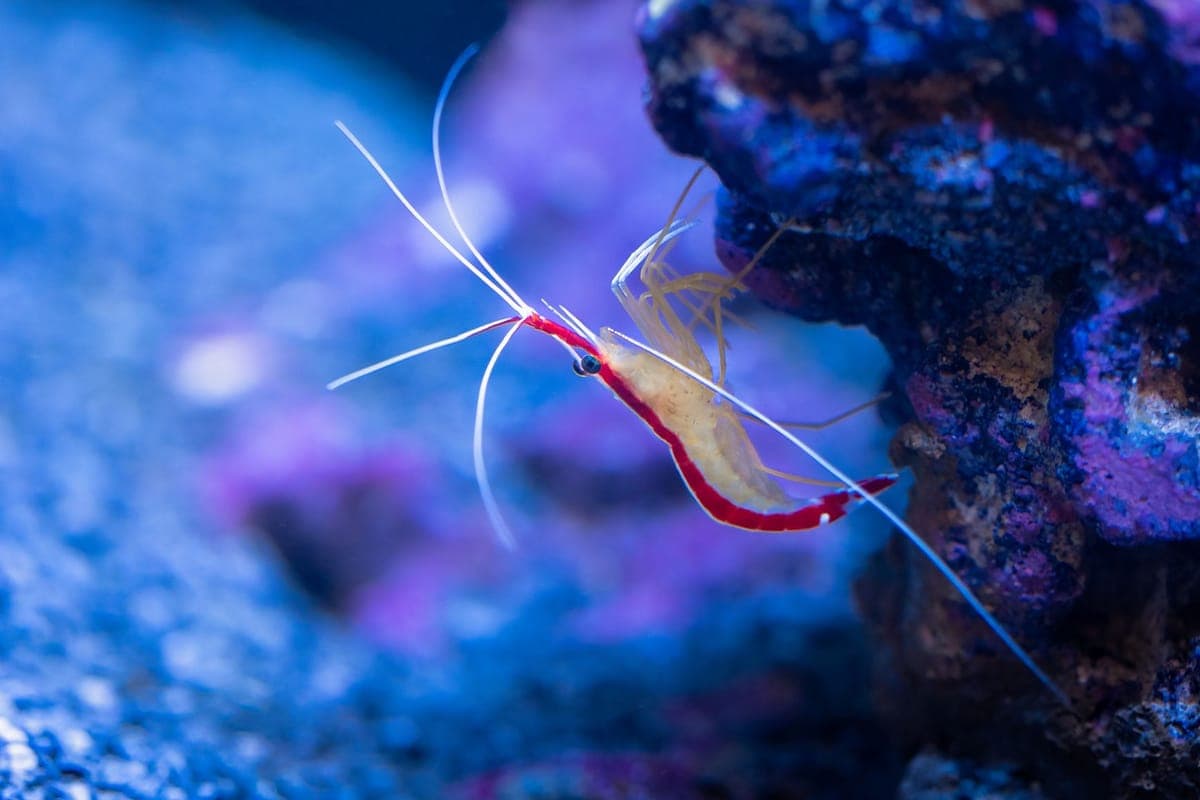
The published line that decides most of it
Aqueon’s freshwater shrimp care sheet splits the category by tank size in a single sentence: “larger species such as ghost, Amano and bamboo shrimp can be kept in aquariums of 10 to 55 gallons, while red cherry, crystal and bee shrimp are better suited to aquariums of 10 gallons or less.”
That is unusual and worth pausing on. It is a manufacturer stating that the smaller animal suits the smaller tank and the larger one wants room - which for a site about desk-scale aquariums settles the default before any other argument.
| Amano shrimp | Cherry shrimp | |
|---|---|---|
| Published tank size | 10 to 55 US gallons | 10 US gallons or less |
| Adult size | Noticeably larger | Small - roughly an inch |
| Color | Translucent, faintly speckled | Solid red, bred for it |
| Breeds in a freshwater tank | No, in practice | Yes, readily |
| Algae grazing | The species people buy specifically for it | Grazes, but less voraciously per animal |
| Visible in a planted tank | Hard to spot | Obvious |
| With a betta | Large enough to be a poor mouthful | Adults usually fine; young get eaten |
The breeding difference, and how confident we are about it
This is the difference that changes what you are buying, and it is the one we can least well source.
Cherry shrimp breed in an ordinary freshwater tank. Buy ten, keep the water stable, and in a few months you have a colony - a self-sustaining population that replaces its own losses. That is why a cherry shrimp tank is a project rather than a purchase.
Amano shrimp effectively do not. Females carry eggs and the larvae require brackish water to develop, so in a freshwater aquarium the population does not replace itself. Whatever you buy is what you will have, minus losses.
How solid is that? It is the most consistently reported difference between the two species and it matches what every shop will tell you. We could not find it stated on a manufacturer care sheet we can cite, so we are flagging it as widely reported rather than published - the same standard we apply to every other figure on this site. Treat it as reliable enough to plan around and not as a number we measured.
What that means for the purchase
Cherry shrimp are a colony. You buy a starter group and the tank fills itself. The running cost is near zero and the surplus is a thing you give away. If your intention is “I want a shrimp tank,” this is the species, and the nano shrimp tank page is the build.
Amano shrimp are livestock you replace. You buy a cleanup crew, it works, and in some years you buy more. If your intention is “I want algae eaten in a planted tank,” this is the species - accepting that it is a recurring purchase rather than an investment.
Both die to the same mistake
Aqueon states it flatly: “avoid products containing copper, as it is toxic to freshwater shrimp.” Copper arrives through fish medications, some plant fertilizers, snail treatments, and old copper household plumbing where the water has sat overnight. Neither species is more tolerant than the other, there is no treatment after the fact, and it is the single most common way a healthy colony disappears overnight. Read ingredient labels, and run the tap before you fill.
Which one suits a betta tank
Neither is a safe bet, and the risk is different for each.
Amano are large enough that an adult is an awkward mouthful for a betta, which makes them the marginally safer choice in a mixed tank. They are also fast and they mostly stay low. The cost is that they are nearly invisible in a planted tank, which is a strange thing to pay for.
Cherry shrimp adults often coexist with a calm betta. Their young do not - a colony in a betta tank is a colony that never grows, because every shrimplet is food. That is not necessarily a reason to avoid it, but you should know you are buying a static population rather than a colony.
Either way the requirements are the same and non-negotiable: dense cover and somewhere to move one of them if the individual betta turns out to be one that will not tolerate anything. That page covers the temperament problem in full, and it applies identically to both species.
What they both need
Sponge filtration. Aqueon’s care sheet specifies sponge pre-filters on intake screens. In a nano the simplest way to satisfy that is to run a sponge filter as the filter - there is no impeller, so nothing can distinguish a shrimplet from detritus and shred it.
Moss. Aqueon names Java moss specifically. It does three jobs at once: shelter for young, a biofilm surface the adults graze, and nitrate export - our nano plant list has the published care data for it.
Stability over perfection. Both species tolerate a wide range of parameters and neither tolerates a swing. Small frequent water changes with temperature-matched water beat large occasional ones.
Very little food. Aqueon publishes that dwarf shrimp are “largely algae eaters” and to feed “only what they can consume in 2 to 3 minutes, once or twice a day.” In a planted established tank they find most of it themselves.
Can you keep both?
Yes - they do not interbreed and they do not compete meaningfully. In a 10-gallon, a cherry colony plus a few Amano is a common and sensible arrangement: the cherries populate the tank and the Amano handle the algae the cherries cannot keep up with.
The caveat is bioload and Aqueon’s published sizes pulling in opposite directions - Amano sit at the bottom of their stated range in a 10-gallon while cherries sit at the top of theirs. That is a tank running both species at the edges of their published envelopes, which is fine in a stable, cycled, lightly-fed tank and unforgiving in a new one.
The honest recommendation
For a dedicated nano shrimp tank: cherry. Published for tanks of 10 gallons or less, self-sustaining, visible, and the reason to have the tank at all.
For algae control in a planted tank you already have: Amano. More effective per animal, large enough to survive a betta, and you are buying a service rather than a population.
For a 5-gallon: cherry, and only cherry. Aqueon’s published range puts Amano at 10 gallons minimum. A rated 5-gallon holds 4.3 gallons of water, which is half that.
What we cannot tell you
How many shrimp your specific tank supports. Bioload guidance for invertebrates is not published in any form we can cite, the figures circulating in the hobby vary by an order of magnitude, and we are not going to add another invented number. Start small, watch nitrate between water changes, and let the tank tell you.
What we would buy for this
Chosen from the same registry as our roundups, on published specifications and the arithmetic they imply - not on testing we have not done.
Nano sponge filter with air pump
The cheapest correct answer for a betta, and the one we would fit if we could only fit one thing. A sponge filter has no impeller, no outflow jet and no way to shred a fin. It is also the only filtration in this list that keeps working when the power comes back on after an outage without needing to re-prime. What it does not have is a manufacturer: these are sold under a dozen interchangeable brands with no published specifications at all, and we are not going to pretend otherwise.
Best for: A betta tank, a shrimp tank, or a quarantine tank on a budget
Skip it if: You cannot live with an air pump humming on your desk, or with a black sponge in the corner of the display.
Java Moss
The only plant on this site that solves a problem nothing else does: it gives baby shrimp and fry somewhere to hide, and it does it in a tank with no substrate, no CO2 and a cheap light. Aquarium Co-Op publishes low light at 10-20 PAR, no CO2, easy, and sells it attached to a flexible wire mesh grid measuring 2.75 by 2.75 inches - which is a genuinely useful figure, because it tells you how much tank floor one portion covers.
Best for: A shrimp tank, a fry tank, or hiding hardscape you dislike
Skip it if: You want a tidy scape. Moss traps every scrap of uneaten food and detritus that passes it, and getting that out means pulling the moss.
Seachem Prime
The dechlorinator whose published dosing makes it the obvious nano choice: 5 mL treats 50 US gallons, so a 5-gallon water change needs half a milliliter. A 100 mL bottle is therefore roughly two hundred water changes. It also binds ammonia and nitrite, which is the property that turns a cycling accident into a survivable week.
Best for: Every water change, and every cycling emergency
Skip it if: You need something you can dose by the capful into a nano. At this concentration a capful in a 5-gallon is a ten-times overdose - you are measuring in drops.
Frequently asked
Are Amano or cherry shrimp better for a small tank?
Cherry. Aqueon publishes red cherry shrimp as “better suited to aquariums of 10 gallons or less” and puts Amano at 10 to 55 gallons. In a rated 5-gallon holding 4.3 gallons, cherry is the only one of the two inside its published range.
Do Amano shrimp breed in freshwater?
Not in practice - the larvae need brackish water to develop, so a freshwater tank population does not replace itself. We flag that as widely reported rather than published, because we could not find it on a manufacturer care sheet we can cite. Cherry shrimp breed readily in ordinary freshwater.
Which eats more algae?
Amano, per animal, and it is the species people buy specifically for algae control. Cherry shrimp graze too but less voraciously - though a breeding colony eventually has far more mouths.
Can I keep shrimp with a betta?
Sometimes, and it depends on the individual fish. Amano are large enough to be an awkward mouthful; adult cherries often coexist but their young get eaten, so the colony stays static. Our page on that pairing covers the cover requirement and the rule about having somewhere to move one of them.
What kills shrimp fastest?
Copper. Aqueon states outright that it is toxic to freshwater shrimp, and it arrives through fish medications, some fertilizers, snail treatments and old copper plumbing. There is no treatment after the fact.
Can I keep Amano and cherry shrimp together?
Yes - they do not interbreed or compete meaningfully, and the combination is common in a 10-gallon. Be aware it runs both species at the edge of their published size ranges, which needs a stable, cycled, lightly fed tank.