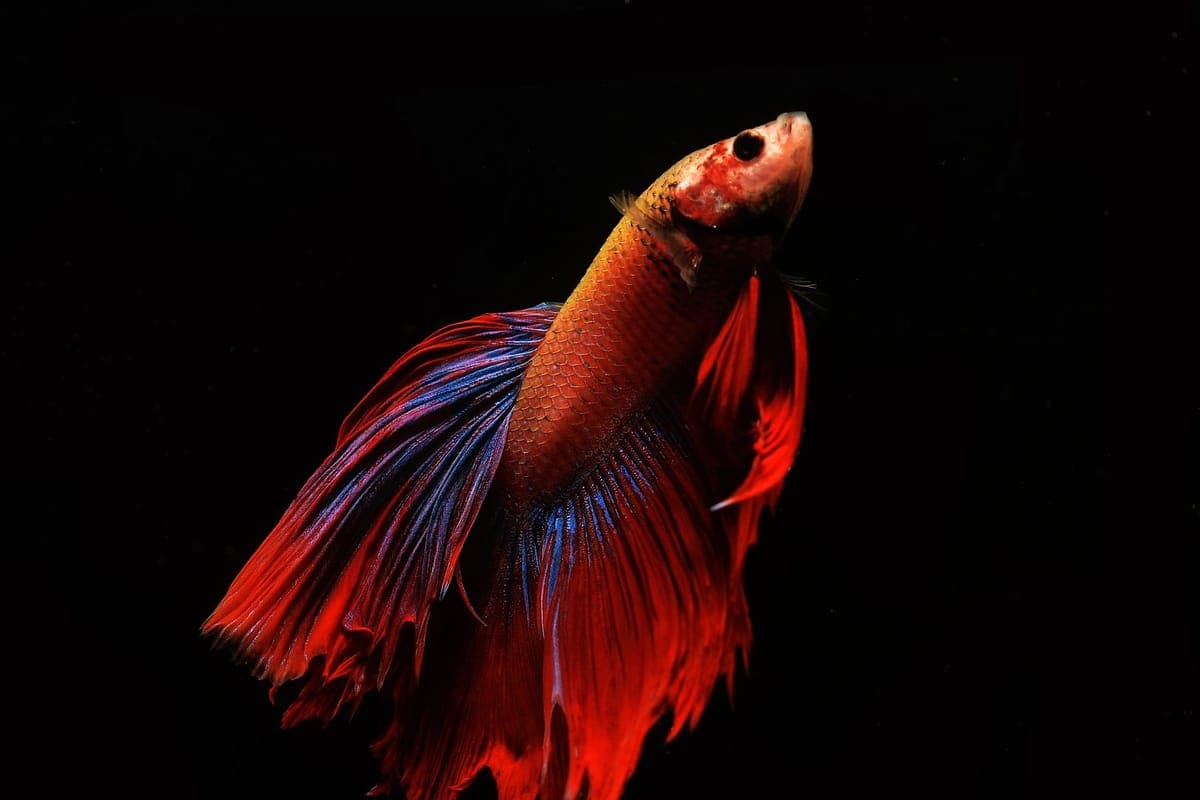
Betta at the top of the tank
Usually this is a fish doing exactly what its anatomy is built for. The useful question is which of four specific things would make it not normal - and every one of them is measurable.
We earn a commission if you buy through the links on this page, at no extra cost to you. It never changes a ranking, and there are products recommended here with no affiliate link behind them at all. Full disclosure.
Start here: it is probably normal
A betta has a labyrinth organ and takes atmospheric air directly from the surface. Going up for a gulp is not a distress signal - it is the fish using the anatomy that defines its family. Every healthy betta does it regularly, all day.
Bettas also simply prefer the upper third of the water column. They are ambush feeders that watch the surface, they rest on broad leaves near the top, and they build bubble nests up there. A betta hanging around the top of the tank is, most of the time, a betta being a betta.
So the useful version of this question is not “why is it at the top?” It is “is it at the top differently than usual?” - gulping rapidly and constantly, resting listlessly at the surface rather than patrolling, or hanging there with clamped fins. Those are worth investigating, and there are four measurable causes.
The four things to check, in this order
Every one of these is something you measure rather than guess at. Work down the list; do not skip to the bottom.
1. Temperature. The most common and the easiest to rule out. A cold betta is lethargic and often sits still near the surface where the water is marginally warmest; a tank that has run hot holds less dissolved oxygen, which increases surface breathing. Aquarium Co-Op publishes that bettas prefer temperatures around 80°F and this site sizes heaters to 78°F. What happens at each end of the range sets out both directions.
What to measure: a thermometer at the opposite end of the tank from the heater, read at the coldest part of the night if you can. Not the heater’s own dial, which is a claim rather than a measurement.
2. Ammonia and nitrite. The reading that matters most. A tank that is not cycled, or has crashed, irritates gills - and a fish with compromised gill function surfaces more. This is the cause that is genuinely urgent, and it is invisible through the glass.
What to measure: ammonia and nitrite with a liquid test kit. Both should read zero in a stocked tank. Anything above zero makes this the whole problem and everything below it irrelevant for now.
3. Flow. A long-finned betta cannot swim against a current, and the surface near the filter outflow is sometimes the only place it can hold station - or, conversely, it retreats to the far surface corner to escape. Our turnover target is 4 tank volumes an hour with a ceiling of 6, and almost every nano filter exceeds that out of the box.
What to measure: watch where the fish chooses to be over a day. Wedged in one corner permanently is the tell. Baffling the outflow takes ten minutes and costs nothing.
4. Surface agitation and gas exchange. A completely still surface exchanges gas poorly. This matters less for a betta than for most fish - it breathes air - but it matters for everything else in the tank, and a tank with no movement at all is usually a tank whose filter has stopped.
What to measure: look at the surface. Is it moving? Is the filter actually running? A hang-on-back that lost its prime after a power cut looks fine and moves nothing.
What this page will not do
Diagnose an illness. This site does not diagnose disease - that is stated in our editorial policy and it holds here. Where a symptom is specific enough to act on, the symptom page covers it. What we can tell you is that the four causes above are measurable, that they account for the large majority of “my betta is at the top” questions, and that they are all worth ruling out before you conclude anything medical. If water and temperature test clean and the behavior persists, that is the point to talk to someone qualified - not to start dosing.
The behaviors that are simply normal
Regular trips to the surface for air. Several times an hour is ordinary for a labyrinth fish.
Resting on a leaf near the top. Bettas sleep and loaf on broad leaves. A leaf placed high is one of the reasons anubias is the plant we recommend most.
Building a bubble nest. A raft of bubbles in a corner is a healthy, unprompted behavior, and the fish will hover under it.
Watching you. Bettas learn where food comes from and will wait at the surface near where you stand. This one is frequently mistaken for distress.
When the answer is the tank, not the fish
Two structural situations produce surface-hanging that no amount of observation fixes, because the tank is the cause.
The tank is too small. In 2.6 gallons or less, temperature and ammonia both move faster than a keeper can react to. Our floor is five rated gallons - the volume argument is about buffer, and a fish in a tank with no buffer spends more of its life in conditions outside its range.
There is no heater. A betta in an unheated American room sits at 67 to 69°F against a published preference around 80. That is a chronically cold fish, and lethargy near the surface is one of the ways it shows - the heater argument in full.
The order to act in
- 01
Read the thermometer
Thirty seconds, free, and it rules out the most common cause. Read the glass thermometer, not the heater dial.
- 02
Test ammonia and nitrite
Five minutes. If either is above zero, stop here - that is the problem, and the fix is water changes plus finishing the cycle rather than anything on this list.
- 03
Watch the fish for a day
Where does it choose to be when nobody is standing at the glass? Wedged in a corner means flow. Moving normally with surface trips means normal.
- 04
Check the filter is actually running
Surface movement, outflow, bubbles. A filter that stopped after a power cut is a common and invisible cause.
- 05
Change one thing, then wait
Baffle the flow, or correct the temperature, and give it several days. Fish behavior does not reset in an hour.
What we cannot tell you
Whether your specific fish is unwell. Behavior is not a diagnosis and we have run no observations of our own. Our method is to give you the measurable causes, the order to check them in, and the honest statement that after those four there is nothing further we are qualified to say.
What we would buy for this
Chosen from the same registry as our roundups, on published specifications and the arithmetic they imply - not on testing we have not done.
API Freshwater Master Test Kit
The liquid test kit the whole hobby ends up owning, and the only product on this site that can actually tell you whether your tank is cycled. It reads pH, high-range pH, ammonia, nitrite and nitrate, and API publishes over 800 tests per kit - which in a nano tank you will be years getting through. The nitrate test is the one people get wrong: bottle two needs banging on a hard surface for a full 30 seconds or it reads low.
Best for: Anyone cycling a tank, which is anyone setting one up
Skip it if: You want a two-second answer. This is five test tubes, a dropper count and a five-minute wait, and strips are the product for that.
Fluval P25 Submersible Heater, 25W
The default answer for a 5-gallon betta tank, and the reason the folk rule of thumb happens to land in the right place. Our sum for a 5-gallon in a normal US room - 68F, Aquarium Co-Op's published figure for a typical American house - is 15.1W. Nothing is sold at 15W. The next size up is 25, and that is the P25.
Best for: A 5-gallon betta tank in a normally heated room
Skip it if: You want to run a degree cooler in summer or warmer for a sick fish. This is preset; buy the adjustable if you want a dial.
Nano sponge filter with air pump
The cheapest correct answer for a betta, and the one we would fit if we could only fit one thing. A sponge filter has no impeller, no outflow jet and no way to shred a fin. It is also the only filtration in this list that keeps working when the power comes back on after an outage without needing to re-prime. What it does not have is a manufacturer: these are sold under a dozen interchangeable brands with no published specifications at all, and we are not going to pretend otherwise.
Best for: A betta tank, a shrimp tank, or a quarantine tank on a budget
Skip it if: You cannot live with an air pump humming on your desk, or with a black sponge in the corner of the display.
Frequently asked
Is it normal for a betta to stay at the top of the tank?
Largely yes. A betta has a labyrinth organ and breathes atmospheric air from the surface, and it naturally occupies the upper third of the tank. What is worth investigating is a change - constant rapid gulping, listlessness, or clamped fins.
Why is my betta gasping at the surface?
Check temperature first, then ammonia and nitrite with a test kit, then flow, then whether the filter is actually running. Those four account for most cases and all are measurable. We do not diagnose illness beyond that.
Does a betta at the top mean low oxygen?
Less often than for other fish, because a betta breathes air directly. Very warm water does hold less dissolved oxygen, so temperature is worth reading - but a still surface is more likely to indicate a stopped filter than an oxygen crisis for this species specifically.
My betta rests on a leaf near the surface. Is that bad?
No, that is characteristic behavior. Bettas loaf and sleep on broad leaves, which is one reason anubias is the plant we recommend most often for them.
Could the filter be causing it?
Yes, in both directions - too much flow pushes a long-finned fish into whatever corner is calmest, and a filter that has stopped leaves the surface still. Watch where the fish settles over a day, and check the outflow is moving.
When should I worry?
When temperature and water tests are clean, the flow is right, the filter is running, and the behavior still looks different from this fish's normal. At that point it is beyond what this site will speculate about - we do not diagnose illness. If the symptom is one of the specific ones on the symptom page, start there.