Black beard algae
Dark, stiff tufts on leaf edges and hardscape. It is the one algae in a nano tank that does not retreat when you turn the light down, which is why it ends up here.
We earn a commission if you buy through the links on this page, at no extra cost to you. It never changes a ranking, and there are products recommended here with no affiliate link behind them at all. Full disclosure.
What it is, and how to know that is what you have
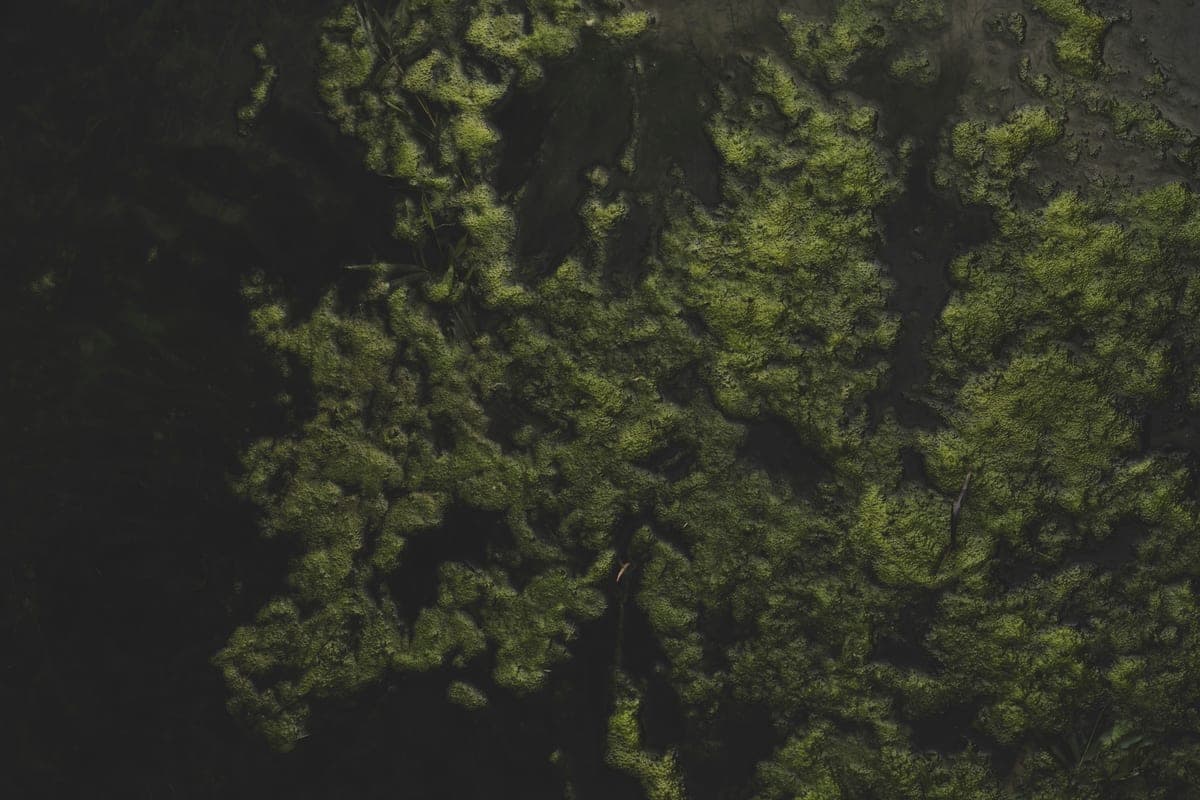
Black beard algae is a red alga that grows in dark gray to near-black tufts, stiff to the touch, anchored hard to leaf margins, hardscape and equipment. It does not wipe off. That last property is the field test: green film algae surrenders to a magnet, and black beard algae does not.
It colonizes edges first - the rim of an anubias leaf, the lip of a filter outflow, the top of a piece of wood. That is a clue about the cause, and we come back to it below.
The short answer
Fix the flow and the carbon, or it comes back. Black beard algae is associated with unstable or insufficient dissolved carbon and with areas of persistent high flow. Everything else is treatment of symptoms.
For what is already there, Seachem Flourish Excel is the one product whose maker publishes an effect. Seachem states that certain algae growth tends to lessen when Excel is dosed and that black beard algae is particularly affected - and, in the same breath, that the product is not marketed as an algicide. We are repeating that caveat because Seachem bothered to print it.
Remove what you can by hand first. Trim the worst leaves off entirely. An affected anubias leaf is not recoverable and the plant grows more.
Why the usual corrections do not work on this one
On this site the standard answer to algae is to shorten the photoperiod and feed less, because for green water, film algae and most nuisance growth that is the actual cause and it costs nothing. We recommend a fixed six-to-eight-hour period on a timer precisely for this reason.
Black beard algae is the exception that makes the rule visible. It is not primarily a light-excess alga. Cutting the photoperiod slows it and does not clear it, which is the single most common frustration reported with it - people do the thing that always works, it does not work, and they conclude the tank is beyond help.
| Correction | Works on green film / green water | Works on black beard algae |
|---|---|---|
| Shorter photoperiod | Yes, reliably | Slows it, rarely clears it |
| Feeding less | Yes | Helps, indirectly |
| Larger water changes | Yes | Helps stability, does not remove it |
| Scraping the glass | Yes | It is not usually on the glass |
| Manual removal and trimming | Unnecessary | Yes - the first thing to do |
| Stabilizing flow and carbon | Marginal | Yes - this is the actual cause |
The cause: flow and unstable carbon
Black beard algae takes hold where dissolved carbon is low or fluctuating and where flow is persistently strong. That combination explains the growth pattern: it appears on edges and on equipment because those are the surfaces water moves past fastest.
In a nano tank there is a specific and common way to arrive here. The stock pump in a kit is usually far too strong for a betta, so the tank runs at high turnover. Meanwhile the tank is low-tech with no CO2, which is what we recommend for a nano, so dissolved carbon is whatever the water and the fish supply. Strong flow across carbon-limited plants is precisely the condition this alga exploits.
Baffling the filter is an algae fix as well as a fish fix
Dropping the outflow from something like thirteen turnovers an hour toward the 4x we target does two useful things at once: it stops the fish fighting the current, and it removes the high-flow edge condition black beard algae prefers. It is free, it is reversible, and it is the first change we would make.
What Seachem publishes about Excel, stated exactly
Flourish Excel is sold as a source of bioavailable organic carbon - photosynthetic intermediates that let plants bypass CO2 uptake. The dosing Seachem publishes is one capful (5 mL) per 40 L / 10 US gallons as an initial dose, then one capful per 200 L / 50 US gallons daily or every other day for maintenance.
On algae, Seachem publishes that certain types of algae growth tend to lessen when Excel is dosed, that black beard algae is particularly affected, and that the product is not marketed as an algicide. Three statements, and the third one is the one the internet drops.
Seachem also publishes cautions that matter more in a small tank than a large one: large doses can cause melting of Vallisneria leaves, and sensitive plants such as Anacharis should be dosed every other day rather than daily.
The figure Seachem does not publish
There is no published invertebrate guidance. Seachem prints plant cautions and says nothing about shrimp or snails, and a nano tank is where shrimp and snails live. We are not going to fill that gap with a number we invented. If your tank has invertebrates in it, dose at the published maintenance rate rather than anything higher, watch them, and treat the absence of guidance as a reason for caution rather than permission.
A method that respects all of the above
- 01
Trim and remove first
Cut off badly affected leaves entirely rather than trying to clean them. Pull affected hardscape out and scrub it in a bucket. You are removing biomass so that everything after this has less work to do. - 02
Fix the flow
Baffle the outflow or redirect it at the glass. If black beard algae is growing on the filter lip, that is the flow telling you where it is strongest. - 03
Stabilize the routine, do not intensify it
A fixed photoperiod on a timer, a consistent water change day, a consistent dosing day. This alga exploits fluctuation; a boring tank is a hostile tank. - 04
Dose at the published maintenance rate
Seachem's maintenance figure is one capful per 50 US gallons, which at nano volumes is a very small quantity - measure it rather than estimating from a cap. Do not scale up because progress is slow. - 05
Give it weeks, and judge by the new growth
The tufts already present darken and die back rather than vanishing. The real signal is whether new leaves come in clean. If they do, you have won, whatever the old leaves look like.
What we will not tell you to do
Spot-dosing a concentrated product directly onto algae with the water level lowered is a widely-repeated technique and it is outside anything Seachem publishes. The maker gives dilution-based directions and explicit overdose cautions; a method that deliberately exceeds them is not one we are going to write instructions for.
Buying an algae-eating animal to fix it is a recommendation you will find everywhere. We do not link livestock and we do not stock a nano tank by adding animals to solve problems. A fish or shrimp bought as a tool is still an animal with a volume requirement that a five-gallon tank probably cannot meet.
Hydrogen peroxide, bleach dips and the rest. Effective on removed hardscape in a bucket, genuinely risky in an occupied tank, and not something we will publish a dose for.
What we would buy for this
Chosen from the same registry as our roundups, on published specifications and the arithmetic they imply - not on testing we have not done.
Seachem Flourish Excel, 100 mL
Sold as a bioavailable carbon source, and bought by most people as the thing that kills black beard algae. Seachem is unusually straight about this: it publishes that certain algae growth tends to lessen when Excel is dosed and that black beard algae is particularly affected, while stating plainly that the product is not marketed as an algicide. Read that as written. It also publishes real cautions - large doses can melt Vallisneria, and sensitive plants should be dosed every other day - which is more warning than most bottles in this aisle carry.
Best for: A planted nano tank with black beard algae and no CO2
Skip it if: Your tank is built around Vallisneria or Anacharis. Seachem publishes melting and sensitivity for exactly those, and there is no version of this that is worth losing the planting over.
API Freshwater Master Test Kit
The liquid test kit the whole hobby ends up owning, and the only product on this site that can actually tell you whether your tank is cycled. It reads pH, high-range pH, ammonia, nitrite and nitrate, and API publishes over 800 tests per kit - which in a nano tank you will be years getting through. The nitrate test is the one people get wrong: bottle two needs banging on a hard surface for a full 30 seconds or it reads low.
Best for: Anyone cycling a tank, which is anyone setting one up
Skip it if: You want a two-second answer. This is five test tubes, a dropper count and a five-minute wait, and strips are the product for that.
Aqueon Algae Cleaning Magnet, Small
A two-part magnet that keeps your hand out of the tank, rated by Aqueon for glass or acrylic up to 20 gallons or quarter-inch glass. The figure worth knowing is the one most buyers miss: the scrubber is weighted, so if it separates from the outer magnet it falls straight down rather than floating up into your scape. In a nano that is the difference between retrieving it with two fingers and dismantling the hardscape.
Best for: Cleaning the front glass of a nano without wetting your sleeve
Skip it if: Your tank is acrylic and you intend to use the glass pad on it. Aqueon supplies both pads for a reason and the wrong one scratches.
Frequently asked
Does Flourish Excel kill black beard algae?
Seachem publishes that certain algae growth tends to lessen when Excel is dosed and that black beard algae is particularly affected - while also stating that the product is not marketed as an algicide. Treat it as something that shifts the balance against the alga, not as a treatment that removes it.
Is Flourish Excel safe for shrimp and snails?
Seachem does not publish invertebrate guidance, so we cannot tell you that it is, and we are not going to invent a figure. Our position: if the tank has invertebrates, stay at the published maintenance dose, measure rather than estimate, and watch them closely.
Why did shortening my light period not work?
Because black beard algae is not primarily driven by excess light. It is associated with low or fluctuating dissolved carbon and with persistent high flow. The photoperiod fix works on most other algae, which is exactly why this one is so frustrating.
Can I just cut off the affected leaves?
Yes, and you should - it is the first step. An affected anubias or java fern leaf will not recover its appearance, and the plant grows replacements from the rhizome. Removing biomass makes everything that follows more effective.
Will it come back?
If the flow and the carbon stability are unchanged, yes. That is why this page puts the cause above the product. The test is whether new growth comes in clean over several weeks.
Where the figures on this page came from
- Aquarium Co-Op, Anubias Nana Petite - published light and CO2 requirements
- Aquarium Co-Op, Java Fern - published care requirements
- Fluval Stratum - published product page and substrate volume formula
- Seachem Flourite Black Sand - published mineral analysis
- Seachem Flourish Excel - published description, dosing directions, algae note and cautions
- API Freshwater Master Test Kit - published product listing