Skip to content
Glass & Gravel
Roundup

The best heater for a 20-gallon tank

The first tank size on this site where a manufacturer's own recommended volume and our arithmetic land on the same number.

By Scooter M., Enthusiast. Published September 13, 2026.

We earn a commission if you buy through the links on this page, at no extra cost to you. It never changes a ranking, and there are products recommended here with no affiliate link behind them at all. Full disclosure.

A glass aquarium set into a blue cabinet against a white wall
Quick picks

The shortlist, ranked

Ranked on published manufacturer specifications and, where the figures exist, on the arithmetic they imply for a tank this size. Tap any row for the full write-up, including who should skip it.

#ProductBest forScorePrice
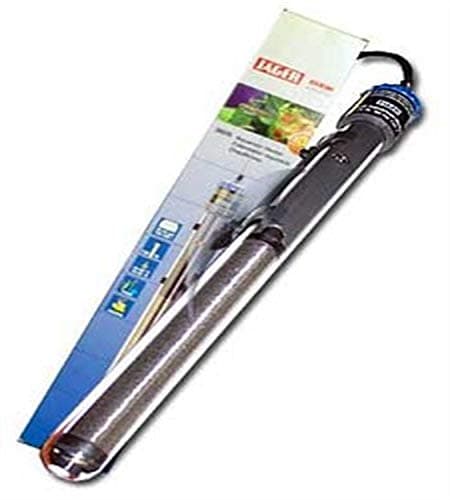
01EHEIM Jager Aquarium Thermostat Heater, 75WEHEIM Jager Aquarium Thermostat Heater, 75WA 20-gallon in a normally heated room, where you want a dialThe right answer8.6$31.99 - View on Amazon
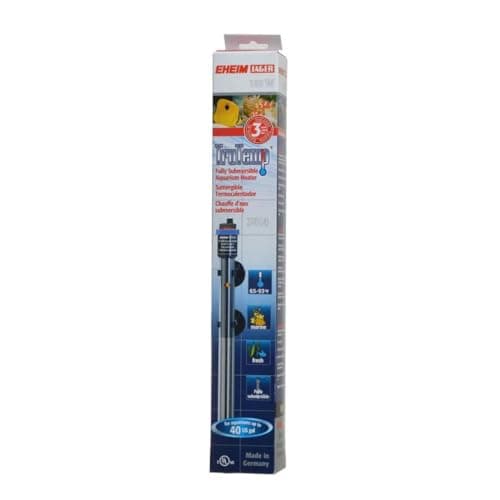
02EHEIM Jager Aquarium Thermostat Heater, 100WEHEIM Jager Aquarium Thermostat Heater, 100WA 20-gallon in a room that genuinely runs cold all winterFor a cold room8.0$33.99 - View on Amazon
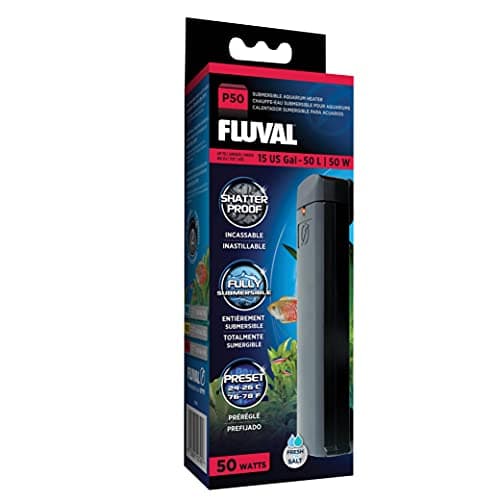
03Fluval P50 Submersible Heater, 50WFluval P50 Submersible Heater, 50WA 10-gallon, or a 5-gallon in a genuinely cold roomTwo of these, split8.5$29.02 - View on Amazon

Scores are ours and editorial. They are never published as review or rating markup, because we have not tested these products.

The sum, for this exact tank

20 US gal rated, less 15% for substrate and fill line, is 17 gal of water. A 78F target minus a coldest-room 68F is a 10F lift. 17 x 0.35 x 10 = 59.5W required. Nothing is sold at 59.5W, so the answer is the 75W.

A rated 20-gallon holds about 17 gallons of water once there is substrate in it and you have stopped filling below the rim. Against a typical American room - Aquarium Co-Op publishes 67 to 69°F as common - and a 78°F target, that is a 10-degree lift and 59.5 watts of heat.

Seventy-five watts is the next size sold. It is also, unusually, inside the manufacturer’s own recommendation rather than at the edge of it: EHEIM publishes its 75W as suiting aquariums of about 60 L with a 100 L ceiling, and a US 20-gallon is 75.7 L. That is the only product on this site where the maker’s recommended volume and our independent sum agree on the same tank.

How it changes with your room

Tank (rated)Water after substrateColdest roomWatts requiredHeater to buy
20 US gal17 gal74°F23.8W25W
20 US gal17 gal72°F35.7W50W
20 US gal17 gal70°F47.6W50W
20 US gal17 gal68°F59.5W75W
20 US gal17 gal66°F71.4W75W
20 US gal17 gal64°F83.3W100W *

Read down the last column. At 70°F and above the sum is satisfied by a 50W; from 68 down to 66 it wants 75; at 64 it crosses into 100. The 68°F row is the one most American homes live on, which is why 75 watts is the headline answer.

At the 64°F row you are asking for a 14-degree lift, past the 12°F Fluval publishes as the ceiling for a single heater. The arithmetic still resolves - 83.3W required against 100 available - but at that point we would rather you warmed the room, fitted a lid, or split the load than put 100 watts behind one thermostat.

What we ranked these on

We have not run these heaters. No test bench, no drawer of samples, so every criterion below can be checked from a published document rather than taken on trust.

Published spec depth. Wattage is on every box. Rated or recommended volume is on most. The third figure - a maximum lift over ambient, or a stated control accuracy - is what tells you whether the heater works in your room, and almost nobody publishes it.

Sizing honesty. Whether a buyer can compute their own answer from what the maker publishes, or is asked to trust a volume range with no conditions attached.

Cold-room headroom. Behavior at a 64°F room rather than a comfortable one. At twenty gallons this is the criterion that separates the 75 from the 100.

Concealability. A 20-gallon is roughly 24 inches long and 12 to 16 tall. That is more back glass to hide something along than a nano gives you - but the EHEIM 75 is 270 mm and the 100 is 319 mm, and those are real objects in a display.

Control. Preset versus a dial. At twenty gallons you are more likely to be running a community than a single betta, and a community is the case where being able to move the set point actually matters.

Why the EHEIM and not the Fluval P range

Because the P range stops. Fluval publishes the P50 at 50W rated to 15 gallons, and a 20-gallon is past that. The honest options at this size are a larger adjustable heater or two P50s, and the first is simpler.

EHEIM is also the only manufacturer in this class that publishes a control accuracy - plus or minus half a degree Celsius - rather than only a volume range. That is a different and more useful disclosure than Fluval’s maximum-lift note, and at a tank size where you may be holding a specific temperature for a specific species it is the figure worth having.

What EHEIM does not publish is a maximum lift, so its volume range cannot be read as a cold-room guarantee. Our sum is what fills that gap, which is exactly why we publish it.

One 75W, or two 50s?

Twenty gallons is where splitting the load stops being a thought experiment. Two 50W heaters at opposite ends of the tank give you 100 watts of capacity with two independent thermostats, and that changes both failure modes for the better:

  • A thermostat that sticks on has half the power to work with, and 17 gallons of water to dump it into. That is a survivable overnight rather than a fatal one.
  • A thermostat that dies leaves you at half heat rather than no heat, which in a January bedroom is the difference between a cool tank and a cold one.
  • Heat distributes better across 24 inches from two points than from one.

What it costs is two cords, two heater bodies in the display, and roughly double the money. We would take the single 75 in a normally heated house and split in a room that genuinely runs cold - the same conclusion the safety page reaches from the failure-mode side.

The cheapest degree you will ever buy

Before upgrading wattage, fit a lid and move the tank off an exterior wall, away from a window and out of the path of a heating vent. That combination typically lifts the stable water temperature by a couple of degrees for nothing, which is the same lift a wattage step would buy - and unlike a bigger heater it adds no failure mode. A vent blowing warm air at the glass is as bad as a draft, because it makes the temperature swing rather than sit.

Placement in a 24-inch tank

Horizontally, low, along the back glass, with the filter return moving water past it. Heat rises, so a heater lying near the substrate puts its output into the coldest water and lets the flow distribute it; one standing vertically in a corner warms the top third and leaves a cold layer where the fish sleeps.

Then put the thermometer at the opposite end of the tank. Not beside the heater, where it reads the heater rather than the tank. In a 24-inch tank that distance is long enough that the two readings genuinely differ, which is itself useful information about whether your flow is distributing heat.

What twenty gallons changes about the whole tank

Thermal mass is the quiet advantage nobody puts on a box. 17 gallons of water takes hours to move a degree when the power fails, where a nano moves in minutes. It is the same reason the filter decision changes at this size - more volume means turnover stops being the binding constraint - and it is the strongest argument for a bigger tank being easier, not harder, than a small one.

What we cannot tell you

Which of these holds its calibration after a year, which brand sticks on most often, or whether EHEIM’s published half-degree accuracy survives two winters in a real room. Those are the questions that decide whether a heater is any good, they need a lot of heaters and a lot of time, and we would rather say so than dress a specification sheet up as a test report.

The write-ups

Every pick, in full

01 / The right answerEHEIM Jager Aquarium Thermostat Heater, 75W

EHEIM

8.6 / 10

EHEIM Jager Aquarium Thermostat Heater, 75W

The 75W step in the same range as the 50, and the size our arithmetic actually asks for in a 20-gallon. EHEIM publishes a recommended volume of 60 L with a 100 L ceiling, which brackets a US 20-gallon (75.7 L) almost exactly - the only heater on this site where the maker's own recommended figure and our sum land on the same tank. It is 270 mm long, which is the price you pay.

$31.99 - View on Amazon

#ad Price as of September 18, 2026, from Amazon. Prices change. How this site is funded.

Published specifications for the EHEIM Jager Aquarium Thermostat Heater, 75W, with the page each figure was read from
SpecificationValueSource
Wattage75W at 50 HzEHEIM thermocontrol 75 published technical data
Recommended aquarium volumefor aquariums of about 60 L / 15.9 US Gal, up to approx. 100 L / 26.4 US GalEHEIM thermocontrol 75 published technical data
Dimensions270 mm height, 36 mm diameter (10.6" x 1.4")EHEIM thermocontrol 75 published technical data
Temperature settingAdjustable, 18 to 34C / 64 to 93FEHEIM thermocontrol 75 published technical data
Control accuracy+/- 0.5C, published by the manufacturerEHEIM thermocontrol 75 published technical data
SafetyAutomatic dry-run shut-off (Thermo Safety Control); completely submersible; 3 year guaranteeEHEIM thermocontrol 75 published technical data
Maximum lift over room temperatureNot published on the product page - EHEIM publishes a control accuracy instead, so size this against our sum rather than its volume rangeAbsence recorded by Glass & Gravel

The sum for this one

Covers a 20-gallon at a 68F room on our sum.

20 US gal rated, less 15% for substrate and fill line, is 17 gal of water. A 78F target minus a coldest-room 68F is a 10F lift. 17 x 0.35 x 10 = 59.5W required. Nothing is sold at 59.5W, so the answer is the 75W.

What it does well

  • Published recommended volume brackets a US 20-gallon almost exactly
  • Published +/- 0.5C control accuracy, which almost nothing in this class states
  • Adjustable across 64-93F and covered by a 3 year guarantee
  • Published dry-run shut-off

What it does not

  • 270 mm is a long piece of glass to hide, even in a 24-inch tank
  • Glass body - the one heater here you can actually break
  • No maximum-lift figure, so a cold room needs our arithmetic
  • Overkill below about 15 gallons

Skip this one if

The tank is 10 gallons or less. EHEIM's recommended volume starts at 60 L and 270 mm of glass is absurd in a 12-inch-tall tank.

How it scores, by criterion

Published spec depth8.5
Sizing honesty8.0
Cold-room headroom8.5
Concealability3.5
Control9.5
02 / For a cold roomEHEIM Jager Aquarium Thermostat Heater, 100W

EHEIM

8.0 / 10

EHEIM Jager Aquarium Thermostat Heater, 100W

One size up, for the 20-gallon that lives in a cold room. EHEIM publishes 100 L recommended and a 150 L ceiling, so a US 20-gallon sits below its recommended volume - you are buying headroom deliberately, not capacity you need. At 319 mm it is the longest heater on this site, and in a tank this size that is the trade we would only make below about a 64F room.

$33.99 - View on Amazon

#ad Price as of September 18, 2026, from Amazon. Prices change. How this site is funded.

Published specifications for the EHEIM Jager Aquarium Thermostat Heater, 100W, with the page each figure was read from
SpecificationValueSource
Wattage100W at 50 HzEHEIM thermocontrol 100 published technical data
Recommended aquarium volumefor aquariums of about 100 L / 26.4 US Gal, up to approx. 150 L / 39.6 US GalEHEIM thermocontrol 100 published technical data
Dimensions319 mm height, 36 mm diameter (12.6" x 1.4")EHEIM thermocontrol 100 published technical data
Temperature settingAdjustable, 18 to 34C / 64 to 93FEHEIM thermocontrol 100 published technical data
Control accuracy+/- 0.5C, published by the manufacturerEHEIM thermocontrol 100 published technical data
SafetyAutomatic dry-run shut-off (Thermo Safety Control); completely submersible; 3 year guaranteeEHEIM thermocontrol 100 published technical data

The sum for this one

Headroom for a 20-gallon below a 64F room.

20 US gal rated, less 15% for substrate and fill line, is 17 gal of water. A 78F target minus a coldest-room 62F is a 16F lift. 17 x 0.35 x 16 = 95.2W required. Nothing is sold at 95.2W, so the answer is the 100W.

What it does well

  • Real winter headroom in a 20-gallon without splitting across two heaters
  • Same published accuracy figure as the rest of the range
  • Adjustable, so you can hold a lower set point in summer

What it does not

  • 319 mm is the longest heater on this site and it shows in the display
  • Above EHEIM's own recommended volume for a US 20-gallon - deliberate oversizing
  • 100 watts behind one thermostat is the failure mode we warn about everywhere else

Skip this one if

Your room sits at 68F or above. At that point the 75W clears the sum and 100 watts is stored energy behind one thermostat you do not need.

How it scores, by criterion

Published spec depth8.5
Sizing honesty7.5
Cold-room headroom9.5
Concealability2.5
Control9.5
03 / Two of these, splitFluval P50 Submersible Heater, 50W

Fluval

8.5 / 10

Fluval P50 Submersible Heater, 50W

Fifty watts rated to 15 gallons, which is the correct answer for a 10-gallon and the correct answer for a cold-room 5-gallon. It is 6.1 inches long, so it is not subtle in a small tank, but it is the first size in this range with genuine winter headroom.

$29.02 - View on Amazon

#ad Price as of September 18, 2026, from Amazon. Prices change. How this site is funded.

Published specifications for the Fluval P50 Submersible Heater, 50W, with the page each figure was read from
SpecificationValueSource
Wattage (120 V / 60 Hz)50WFluval P Series published specifications
Rated aquarium capacityup to 15 US Gal / 50 LFluval P Series published specifications
Dimensions6.1" L x 1.57" W x 0.78" H (15.5 x 4 x 2 cm)Fluval P Series published specifications
Maximum lift over room temperature12F / 8C, per Fluval's published guidanceFluval P Series published guidance

The sum for this one

Covers a 10-gallon at a 68F room, with margin to 64F.

10 US gal rated, less 15% for substrate and fill line, is 8.5 gal of water. A 78F target minus a coldest-room 68F is a 10F lift. 8.5 x 0.35 x 10 = 29.7W required. Nothing is sold at 29.7W, so the answer is the 50W.

What it does well

  • Real headroom: covers a 10-gallon down to a 64F room on our sum
  • Same published rating discipline as the rest of the P range
  • One heater instead of two in a cold 10-gallon

What it does not

  • Visually bulky in anything under 10 gallons
  • Preset, like the rest of the range
  • Overkill, and mildly risky, in a 3-gallon

Skip this one if

The tank is 3 gallons. Fifty watts into 2.5 gallons of water is a lot of stored heat behind one thermostat, and thermostats are what fail.

How it scores, by criterion

Published spec depth9.5
Sizing honesty9.5
Cold-room headroom9.0
Concealability6.0
Control4.0

How these picks were chosen

Everyone in this category says they tested twenty tanks. We have not tested any, and we say so. What we did instead: read the manuals, compile the published specifications, compute the wattage and the turnover against the tank’s real water volume rather than its shelf label, and show the arithmetic so you can check it.

The full method, including what we refuse to claim.

Questions

Frequently asked

What size heater do I need for a 20 gallon tank?

75 watts in a normally heated room. Our sum for a rated 20-gallon - 17 gallons of actual water, a 78°F target and a 68°F room - is 59.5W, and 75W is the nearest size sold. EHEIM also publishes its 75W as suiting up to 100 L, which covers a 20-gallon.

Is a 100W heater too much for a 20 gallon?

In a normal room, yes - our sum asks for 59.5W at 68°F and 100 watts is stored energy behind one thermostat you do not need. In a room that genuinely sits at 64°F or below the sum rises to 83.3W and the 100 becomes the right call.

Can I use two 50W heaters instead of one 75W?

Yes, and at this size it is genuinely safer: half the power behind each thermostat, half your heat still working if one dies, and better distribution across 24 inches. The costs are two cords, two visible heaters and about double the money.

Does a 20-gallon betta tank need a different heater than a community tank?

No - wattage is decided by water volume and room temperature, not by what swims in it. What changes with a community is that you are more likely to want an adjustable heater, because different species have different targets, where a betta is happy at one fixed number.

Where should the heater go in a 20-gallon?

Horizontally along the back glass, low, with the filter return passing over it, and the thermometer at the far end. If you run two heaters, put them at opposite ends rather than side by side.

Sources

Where the figures on this page came from

  1. Fluval P Series Submersible Heaters - published ratings and heating-capacity note
  2. Aquarium Co-Op, Betta Fish Care Guide - published temperature and tank-size guidance
  3. EHEIM thermocontrol 75 - published technical data (sold in the US as the Jager 75W)
  4. EHEIM thermocontrol 100 - published technical data (sold in the US as the Jager 100W)
Read next