We earn a commission if you buy through the links on this page, at no extra cost to you. It never changes a ranking, and there are products recommended here with no affiliate link behind them at all. Full disclosure.
The short answer
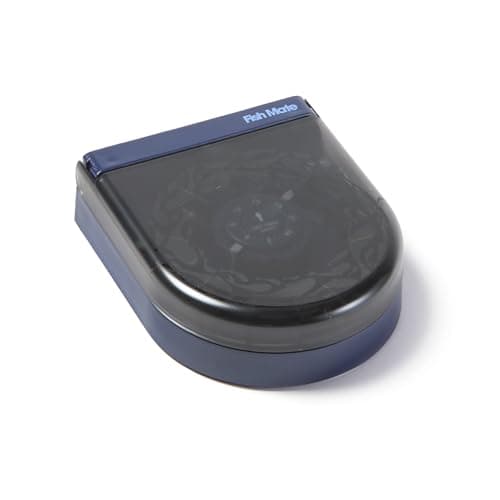
For a betta or a nano tank, buy the Fish Mate F14. It is a drum with fourteen compartments and a timer. You decide what goes in each compartment when you load it, which means the machine physically cannot over-deliver - and over-delivery is the entire failure mode of automatic feeders on small tanks.
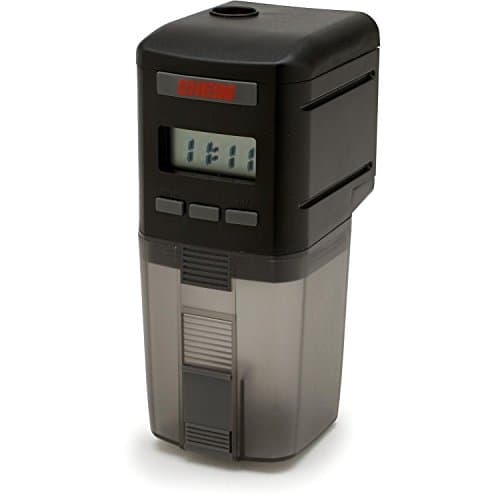
For anything longer than two weeks, buy the EHEIM Everyday. EHEIM aerates the feeding chamber and publishes that this delivers dry food down to the last flake. That is the answer to caking, which is what actually kills a feeder on week three of a holiday.
For a long weekend, buy nothing. A healthy adult betta misses two or three days without harm, and an unfed tank is in far less danger than an overfed one. This is the recommendation that costs us a commission and it is still the right one.
How we judged these
- 01
Can it deliver a nano portion?
A betta eats a few pellets. A feeder calibrated for a community tank delivers a scoop. The question is not how precise the mechanism is - it is whether the smallest thing the device can do is still too much.
- 02
What happens when the food gets damp?
Warm water under a hood produces humid air, and humid air turns pellets into a plug. Every long-absence feeder failure we have read about is this failure. A published moisture measure is worth more than an extra program slot.
- 03
What does the maker publish?
Capacity, feedings per day, battery type and life, dimensions. A feeder is a machine you are trusting with an animal while you are not there; a maker that will not print its numbers is not one we rank.
- 04
What does it do when the battery dies?
The honest answer for every feeder here is: it stops. What separates them is whether the maker gives you a battery life figure or a warning light, so the stop is something you prevented rather than discovered.
Side by side, published figures only
| Fish Mate F14 | EHEIM Everyday |
|---|
| Mechanism | 14-compartment rotating drum | Hopper with an adjustable portion slider |
| Meals available | 14, hard limit | Limited by the 100 mL hopper |
| Feedings per day | Up to 4 | Up to 8 |
| Portion decided by | You, when loading | A slider setting |
| Moisture control | Not published | Actively aerated chamber |
| Battery | 1 AA, stated 12 months | 2 AA, no runtime published |
| Low battery warning | Battery indicator | Low-battery warning |
| Delivery | Gradual, over roughly 2 hours | Released on the program |
Why the drum wins on a small tank
A slider-and-hopper feeder decides the portion mechanically, every time, from a setting you make once. On a community tank that is fine. On 4.3 gallons of water with one fish in it, the smallest repeatable portion a slider can throw is often still several times what the animal will eat, and the uneaten remainder is the classic cause of a tank going cloudy while you are away to see it.
A compartment drum moves the decision to loading time, where you have a pellet count and unlimited patience. Two pellets in the slot means two pellets get delivered. The mechanism has no opinion. For a fish with a stomach roughly the size of its eye, that is the difference between a feeder and a hazard.
Load it, then watch it run for two days
Set the feeder up while you are still home and let it complete at least two cycles with you watching. You are checking two things: that the portion that actually lands is the portion you intended, and that the fish finds it. A feeder discovered to be wrong on day one of a trip is a feeder you can do nothing about.
The caking problem, which is the real one
Every feeder here sits above warm water, usually under or beside a hood. The air it breathes is humid. Dry pellets absorb that moisture, swell slightly, and bind - and the drum or slider that worked perfectly for nine days delivers nothing on day ten.
EHEIM’s answer is the one published measure against this on either product: an actively aerated feeding chamber, which EHEIM states gives dry food down to the last flake. Fish Mate publishes no aeration or moisture claim at all, which is why we hold it to two weeks and hand longer trips to the EHEIM.
There is a cheap partial fix for either: use pellets rather than flakes. Pellets have less surface area per unit of food, absorb moisture more slowly, and do not mat. We already prefer pellets for a betta for unrelated reasons, and this is a third one.
When a feeder is the wrong purchase
A weekend. Two or three days is not a fast for an adult betta, it is a Tuesday. Feed normally before you go, do not top the tank up with extra food on the way out the door, and come back.
A tank that is not cycled. A feeder delivering into an uncycled tank is delivering ammonia on a timer. Cycle the tank first; the feeder is an accessory to a stable system, not a substitute for one.
A tank with a sick or newly-bought fish. You want eyes on a new betta daily for the first fortnight. If you cannot be there, a neighbor with a labeled pill organizer of pre-counted pellets beats any machine, because the neighbor can also notice that something is wrong.
A tank where nobody has checked the heater. Food is not the thing most likely to go wrong while you are away. A stuck heater is, and no feeder helps with that.
Setting one up for a betta
- 01
Count the pellets, do not guess
Whatever you normally feed - and on this site that is a small, countable number - is what goes in each compartment. Write the number on the lid so the next person can reproduce it.
- 02
Feed once a day, not four times
The capability to feed four or eight times a day exists for fry and for community tanks. A betta on a once-daily schedule while you are away is a betta in a stable tank.
- 03
Skip a day deliberately
Leaving one compartment empty mid-trip is not neglect; a fasting day is something we would do anyway. It also halves the consequence if a portion turns out to be generous.
- 04
Fit a fresh battery before you leave
Fish Mate publishes twelve months on an AA and both units have a low-battery indicator, which is useless from an airport. A new cell costs less than the trip.